

A shared cost is an expense that serves several clients at once and that no supplier invoice assigns to just one of them: your design software, your project management tool, cloud storage, a contractor on a monthly fee who works across three accounts. To see each client's real margin, you split that expense using a stated basis: hours, revenue or fixed shares. The total never changes. What changes is how much each client carries, and sometimes your view of which clients are worth keeping.
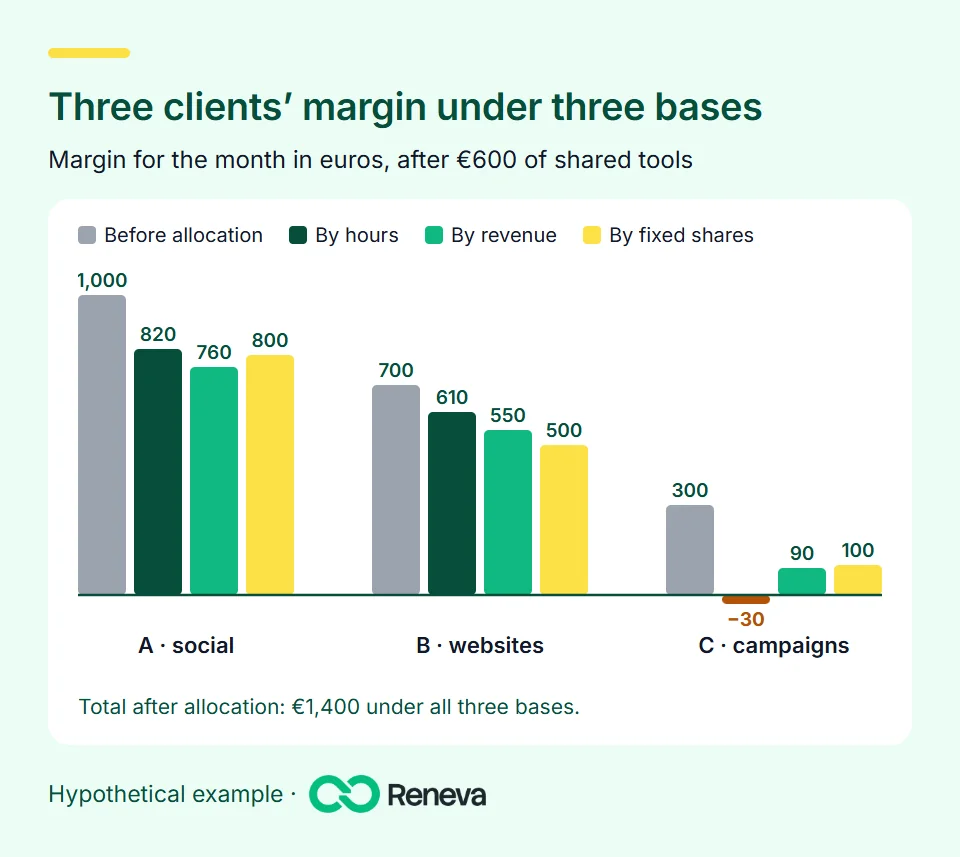
In this article's made-up example, an agency has three clients and €600 a month in shared tools. Allocated by hours, client C ends the month €30 in the red. Allocated by revenue, it keeps €90. With identical starting figures, the basis alone makes the difference.
This guide, also as a PDF
Subscribe to the newsletter: once you confirm from the link in the email, the PDF guide opens.
This site is protected by reCAPTCHA and the Google Privacy Policy and Google Terms apply.

Separate direct costs from shared ones
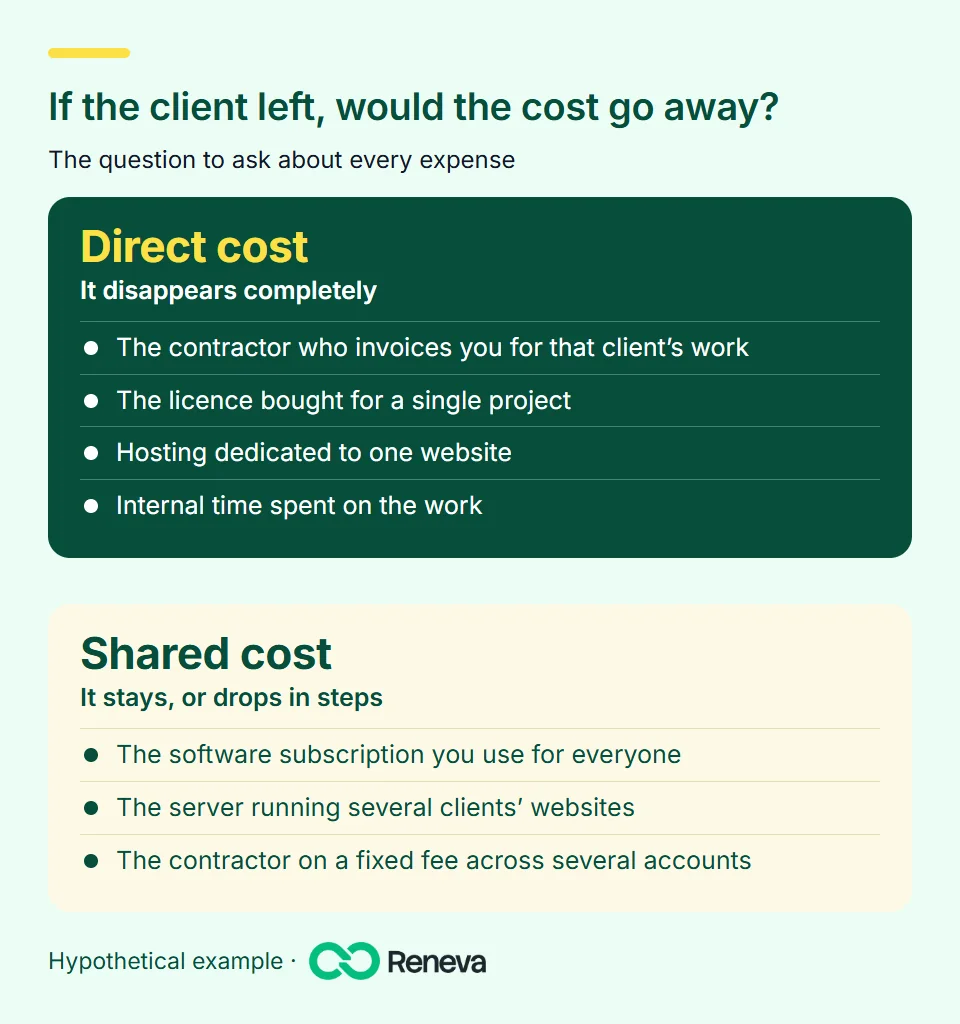
For each expense, ask one question: if this client left tomorrow, would the cost go away? If it would disappear completely, it is a direct cost of that client. If it would stay, or only drop in steps (one seat fewer, a smaller plan), treat it as shared.
Direct costs are usually a contractor who invoices you for work on that client, a licence bought for a single project, hosting space dedicated to one website, and the internal time spent on the work, valued as explained in the article on project margin. Shared costs include software subscriptions you use for everyone, a server running several clients' websites, and a contractor on a fixed monthly fee who works on several accounts.
Contractors are the easiest case to get wrong. If one invoices you per project, the cost is direct and already sits in that project. If you pay a fixed amount each month regardless of the work, it is a shared cost: split it among the clients they worked for, usually by their hours.
Two checks before you start:
- Use the same period for everything. If you are working monthly, a €1,200 annual licence counts as €100 a month.
- Don't count anything twice. If the value you put on an internal hour already includes a share of software, those tools should not be allocated again.
Rent, accountant's fees, insurance and other business overheads are left out here. You can allocate them the same way, but their link to individual clients is weaker: it is better handled as a separate step once your working tools are sorted. This is an internal management calculation. It does not change your invoices or how your accountant records the expense.
An example: three clients and €600 of tools
The figures are made up and exclude taxes. Revenue is the month's fee for work done, not the money received: the two can differ, as the article on invoiced sales and money received explains. Direct costs include each client's external expenses and internal time, valued at a hypothetical €30 an hour.
| Client | Revenue for the month | Hours | Direct costs | Margin before allocation |
|---|---|---|---|---|
| A, social media management | €2,400 | 30 | €1,400 | €1,000 |
| B, website maintenance | €1,500 | 15 | €800 | €700 |
| C, ad campaigns | €2,100 | 55 | €1,800 | €300 |
| Total | €6,000 | 100 | €4,000 | €2,000 |
All three clients rely on the same tools: design software, project management, cloud storage and a reporting tool. Together they cost €600 a month. Once they are paid, the agency keeps €2,000 − €600 = €1,400. That figure does not depend on the basis, which only decides how to divide the €600.
Three ways to allocate shared costs
By hours
Divide the cost by the hours worked for clients: €600 ÷ 100 = €6 an hour. A is allocated 30 × €6 = €180, B €90 and C €330.
This makes sense when the tools are used up by working: more hours on a client means more time spent in that software. The catch is that you need hours that were actually recorded, client by client. If the hours are guesses, the allocation inherits the error.
By revenue
Divide in proportion to revenue: €600 out of €6,000 in revenue is 10%. A is allocated €240, B €150 and C €210.
This is the simplest basis, because you already know the revenue. It works when the cost grows with the size of the client, for example a tool that costs more as you manage more profiles or campaigns. The drawback is that higher-paying clients absorb part of the costs of clients who pay little but need a lot of work. The client who is expensive in time stays hidden.
By fixed shares
Give each client the same share, or one share for each seat it takes up: with three clients, €200 each. The same logic applies to a server hosting ten websites or a licence you pay per workspace: each site or workspace is one seat.
This makes sense when each client takes up a slot in that cost, however much you work for them. The drawback is that it ignores how intensively each client uses the tools. And if a client leaves, everyone else's share goes up, as it does with the other bases, but here the jump is plain to see: from €200 to €300, even though nothing has changed for them.
How each client's margin changes
| Client | Before allocation | By hours | By revenue | By fixed shares |
|---|---|---|---|---|
| A, social media management | €1,000 | €820 | €760 | €800 |
| B, website maintenance | €700 | €610 | €550 | €500 |
| C, ad campaigns | €300 | −€30 | €90 | €100 |
| Total | €2,000 | €1,400 | €1,400 | €1,400 |
Under all three bases, A remains the most worthwhile client and C the least; what moves is how weak C looks. By hours, C takes 55% of the work and therefore 55% of the tools, and ends €30 in the red. By revenue, it accounts for 35% and stays above zero. The €120 a month between the two is the share of tools that the revenue basis shifts from C onto A and B.
Which one should you use? The one that follows the reason the cost exists. Software you use while you work points to hours. A price that grows with the client's volume points to revenue. A per-seat price points to fixed shares. You can use different bases for different costs, as long as you write down which one you use and keep it the same from month to month. Otherwise a margin that moves may reflect a reworked calculation rather than the work itself.
The limit that applies to every basis: the client who leaves
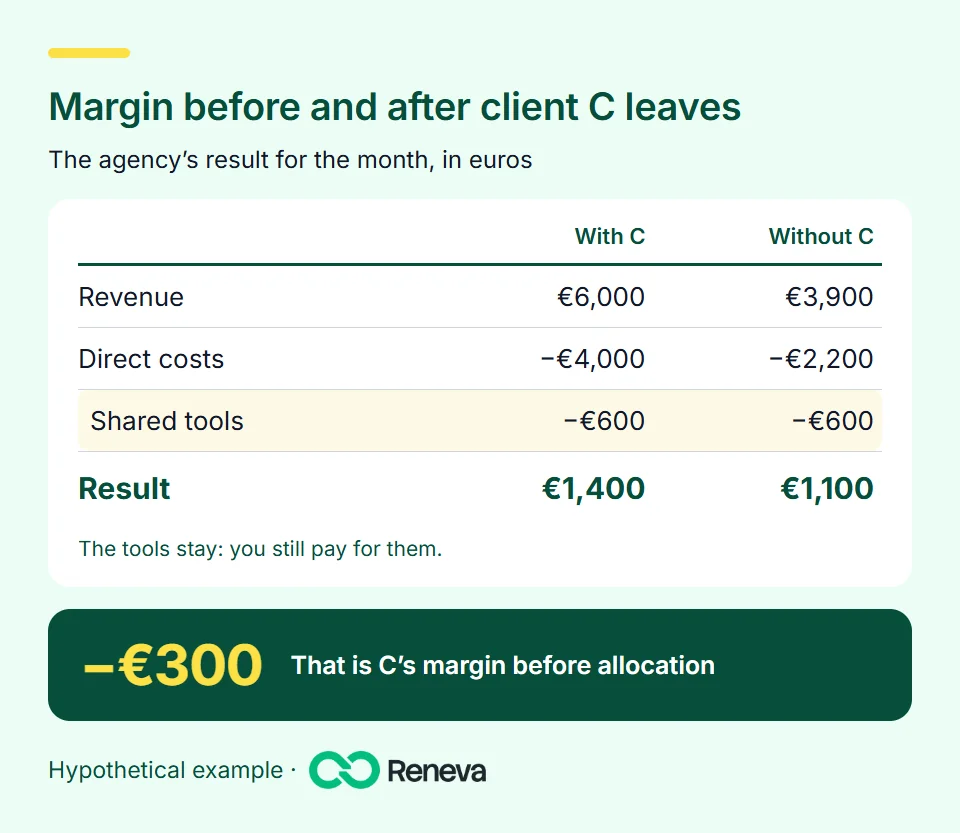
C's −€30 does not mean C is costing you money. If C leaves, you lose its €2,100 of revenue and its €1,800 of direct costs, but the €600 of tools stays. The month's result falls from €1,400 to €1,100: €300 less, which is C's margin before allocation.
So when deciding whether to keep a client, look at that margin first, then ask which shared costs would really go away with them: one seat fewer on a licence, a smaller hosting plan. The margin after allocation answers a different question: whether the price also covers the share of tools that client uses. That is what you need for the next renewal or the next quote.
For C, the useful question is about price and hours. Fifty-five hours for €2,100 is a lot. Before changing the fee, find out where those hours go and whether the agreed work has grown while the price stayed put.
If you use Reneva for subscriptions
In Reneva's Price list, you choose how to calculate the cost of each item. With Direct cost, you enter in My cost what it costs you to provide that item. With Shared cost, you enter an internal annual cost that serves several subscriptions, such as a hosting plan or a licence.
For a shared cost with limited seats, you enter the Shared annual cost and the Seats covered: in the saved item, Capacity shows the share per seat, the seats used by linked rows in active subscriptions and those still free. This is the fixed-shares basis. Without seats, the Expected annual margin compares the annual cost with the annual revenue of the linked rows in active subscriptions. It is an overall forecast, not the margin of a single subscription or a measure of what you have been paid.
The share per seat stays as information in the Price list and does not enter the subscription's margin by itself. To count it, enter it in the My cost of the subscription row. The Guide page Managing price list items has the details. For plans and what they include, see the Pricing page.


