

To estimate the cost of an external professional supplying a service, start with their fee, check what it includes and add agreed extras and the internal time needed to coordinate the work. Then prepare a separate view of the amounts you will pay and their dates.
The project budget and money going out answer different questions. Your coordination time uses resources even if it creates no bank transfer. VAT can be part of the supplier payment without being a cost in the budget when the conditions for deducting it are met.
This guide, also as a PDF
Subscribe to the newsletter: once you confirm from the link in the email, the PDF guide opens.
This site is protected by reCAPTCHA and the Google Privacy Policy and Google Terms apply.

Be clear about the arrangement you are considering
Here we follow a job entrusted to an independent professional or supplier, with an agreed service and fee. This is an Italian service-supply example, not a calculation of employee payroll costs or the cost of an Italian coordinated and continuous collaboration arrangement. Those relationships need their own information and cost items.
The label “contractor” or a VAT number alone does not establish the nature of the relationship. A useful budget starts with the actual service and applicable terms, rather than choosing a working arrangement by adding a standard percentage to a fee.
Check what the supplier's quote already includes
Before adding anything, check deliverables, revisions, materials and deadlines. Clarify travel, licences and other specific expenses: are they included in the fee, quoted separately or paid by you?
If the fee includes the supplier's work, their hours are not another cost to add. You can use them to assess the effort or compare offers, but do not add them again to the same fee. A quote and invoice for the same service are also stages of one purchase. When the invoice arrives, compare it with the estimate instead of counting it as a second cost.
Define who approves the work and which requests need a new agreement. An extra agreed before the work is done is easier to include in the budget and payment schedule.
Add internal coordination once
Estimate the time you need to prepare instructions, answer questions, check the delivery and collect the included revisions. Value it using an internal cost or an assumed value for your time, making the method explicit.
This value is different from the rate you sell to your client. If the same task is already included in another cost allocated to the project, do not add it again.
The result helps you understand the resources the job needs, including your own time. It does not automatically create an invoice or a payment to yourself.
A job with a €1,460 internal budget
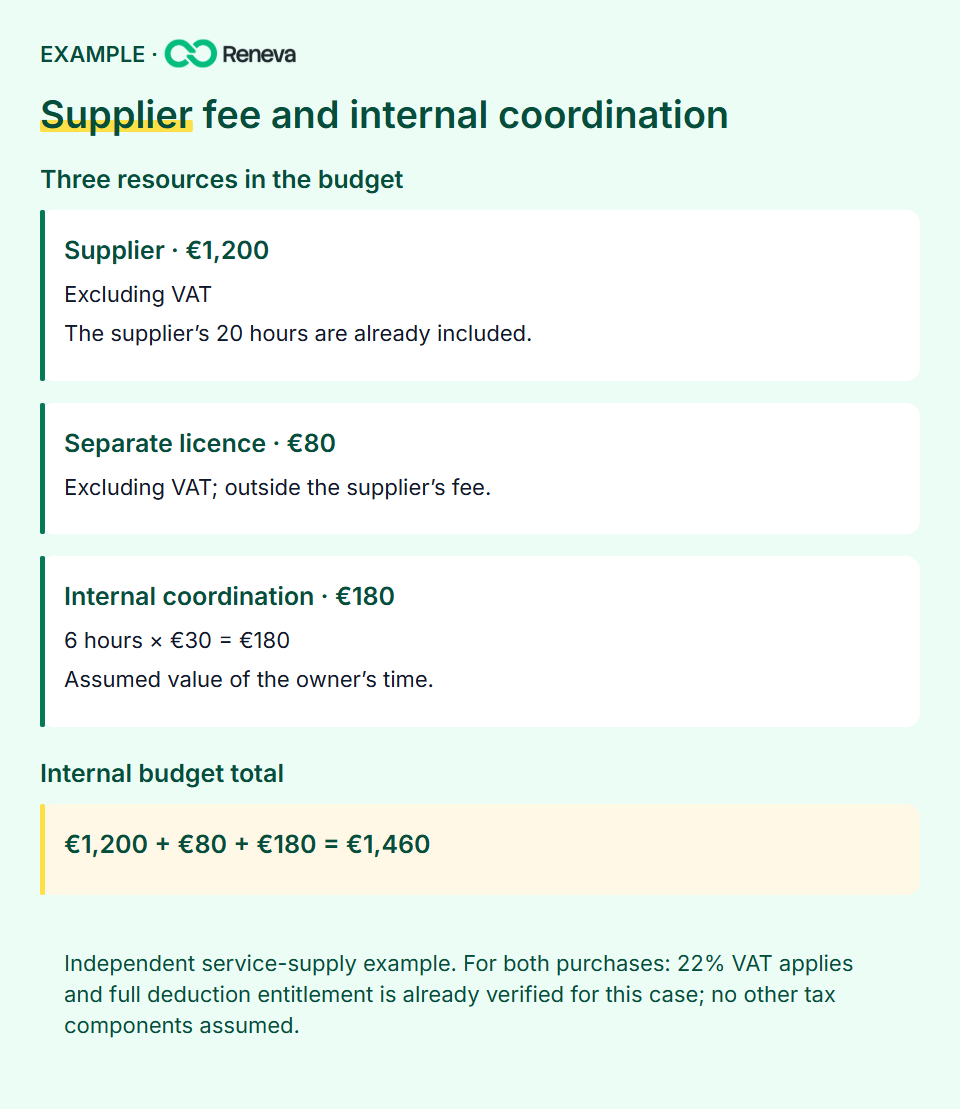
Consider an invented example, for a job completed in November 2026. The supplier charges €1,200 excluding VAT. A specific licence, not included in that fee, costs a further €80 excluding VAT.
For both purchases, assume 22% VAT applies and the right to deduct it in full has already been verified for this case, with no withholding tax, social-security surcharges, pension-fund charges or stamp duty. This is an assumption for the example; check the treatment of your own purchases in your circumstances. The Italian VAT deduction rules have conditions and limits. We are not determining your entitlement or when to exercise it here.
The owner expects six hours of coordination and uses an assumed internal value of €30 an hour. For the items considered, the budget is:
| Item for the job | Basis of the calculation | Internal budget |
|---|---|---|
| Supplier's service | Fee excluding VAT, including the supplier's work | €1,200 |
| Specific licence | Separate purchase, excluding VAT | €80 |
| Internal coordination | 6 hours × €30 | €180 |
| Total | €1,200 + €80 + €180 | €1,460 |
If the supplier estimates twenty hours for the delivery, those twenty hours are already included in the €1,200. The internal work added in the table is coordination by the owner.
This is an internal view of the job before income taxes. It is not profit, revenue or a calculation of tax-deductible costs.
How much money goes out in November and December?
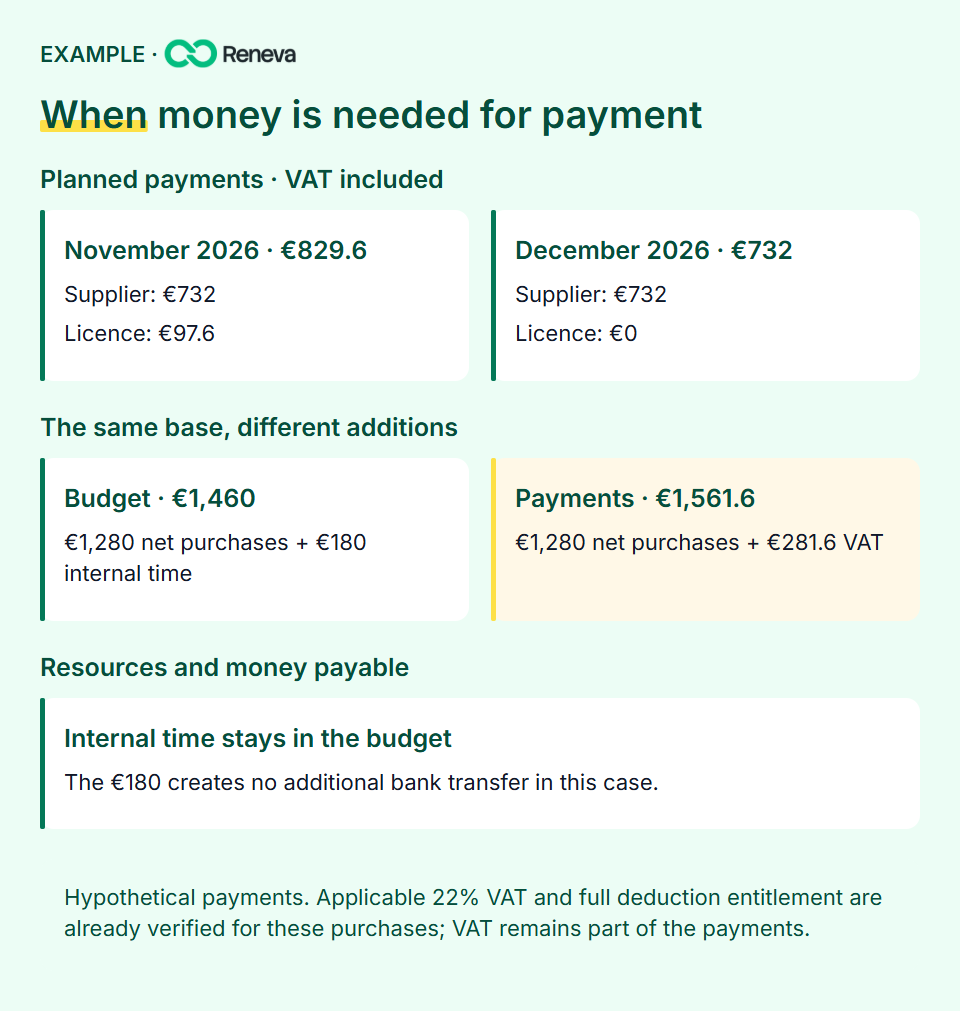
Now look at payments for the same case. The supplier's invoice is €1,200 + €264 VAT = €1,464. Half is due in November and half in December: €732 each. The licence is paid in November at €80 + €17.60 VAT = €97.60.
| Planned payment in the example | November 2026 | December 2026 | Total including VAT |
|---|---|---|---|
| Supplier | €732 | €732 | €1,464 |
| Licence | €97.60 | €0 | €97.60 |
| Bank outflows | €829.60 | €732 | €1,561.60 |
The €180 of internal time creates no additional bank transfer in this example. Bank outflows do include €281.60 of VAT on the two purchases, assumed fully deductible.
The difference between the tables comes from their bases: the budget is €1,280 of purchases excluding VAT plus €180 of internal time; payments are €1,280 plus €281.60 VAT. The deduction assumption does not remove VAT from the supplier payment. If VAT on your purchases is not fully deductible, revisit the budget using the actual treatment.
When extra work is agreed, update only what changes
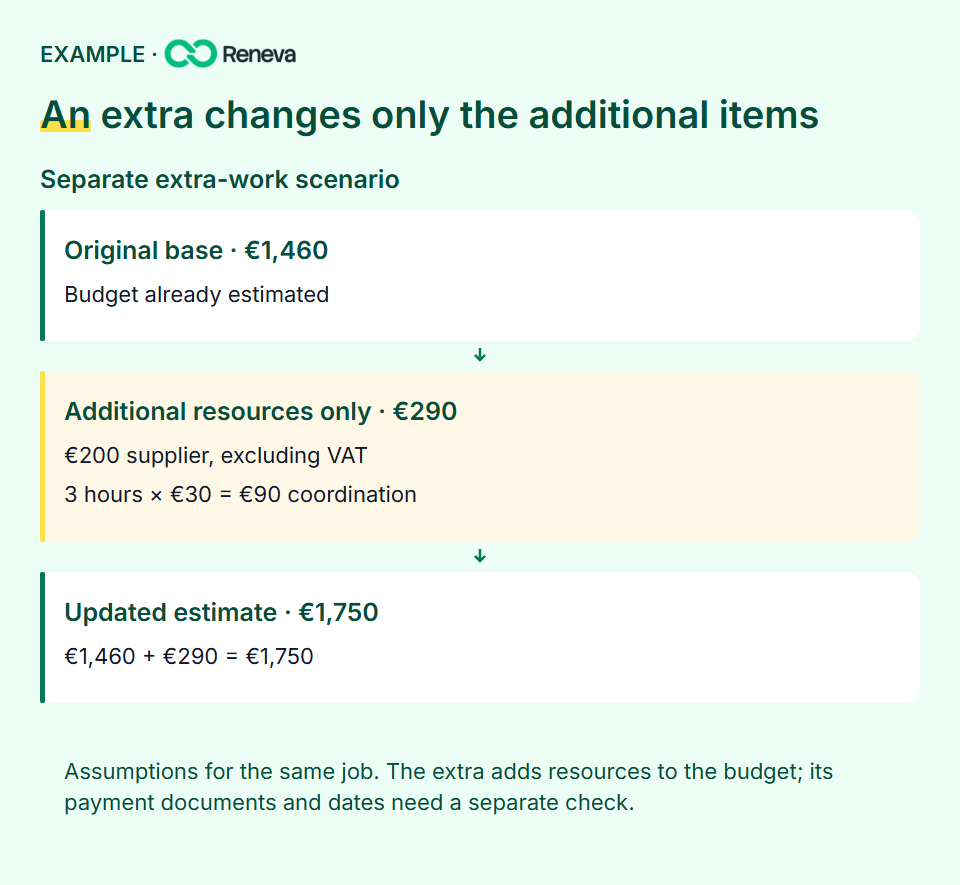
In a separate scenario, suppose you agree a supplier extra of €200 excluding VAT, requiring another three hours of internal coordination. At the assumed €30 hourly value, the additional time is worth €90.
The budget increase is €200 + €90 = €290, so the updated estimate is €1,460 + €290 = €1,750. Do not add the original estimate a second time. Then check the extra's documents and payment dates to update expected outflows too.
During the job, compare actual coordination time with the original six hours. If it takes longer, look for the cause: incomplete instructions, changed requests or underestimated checks. Use that information for the next estimate and future agreements.
Keep the document, payment and time distinct
To track the job, keep the supplier's quote, approved extras, received documents and payments made. Alongside them, record the internal time included in the budget. You need to compare those three types of information without turning them into duplicate costs.
If you use Reneva, you can record a supplier expense and its payment as separate events. The guide to recording an expense explains the steps. Time logged with the Timer can help you review your coordination estimate. Keep the method for valuing that time explicit in the budget, separate from simply counting hours.
Before assigning the next job, check both questions: which resources does it use, and when will you need the money to pay for it?


