

A project's margin is the difference between its fee and the costs you attribute to the work. Start with the agreed price, subtract the project's expenses and put a value on your hours too. Then state which costs you counted: without that detail, the same number can tell different stories.
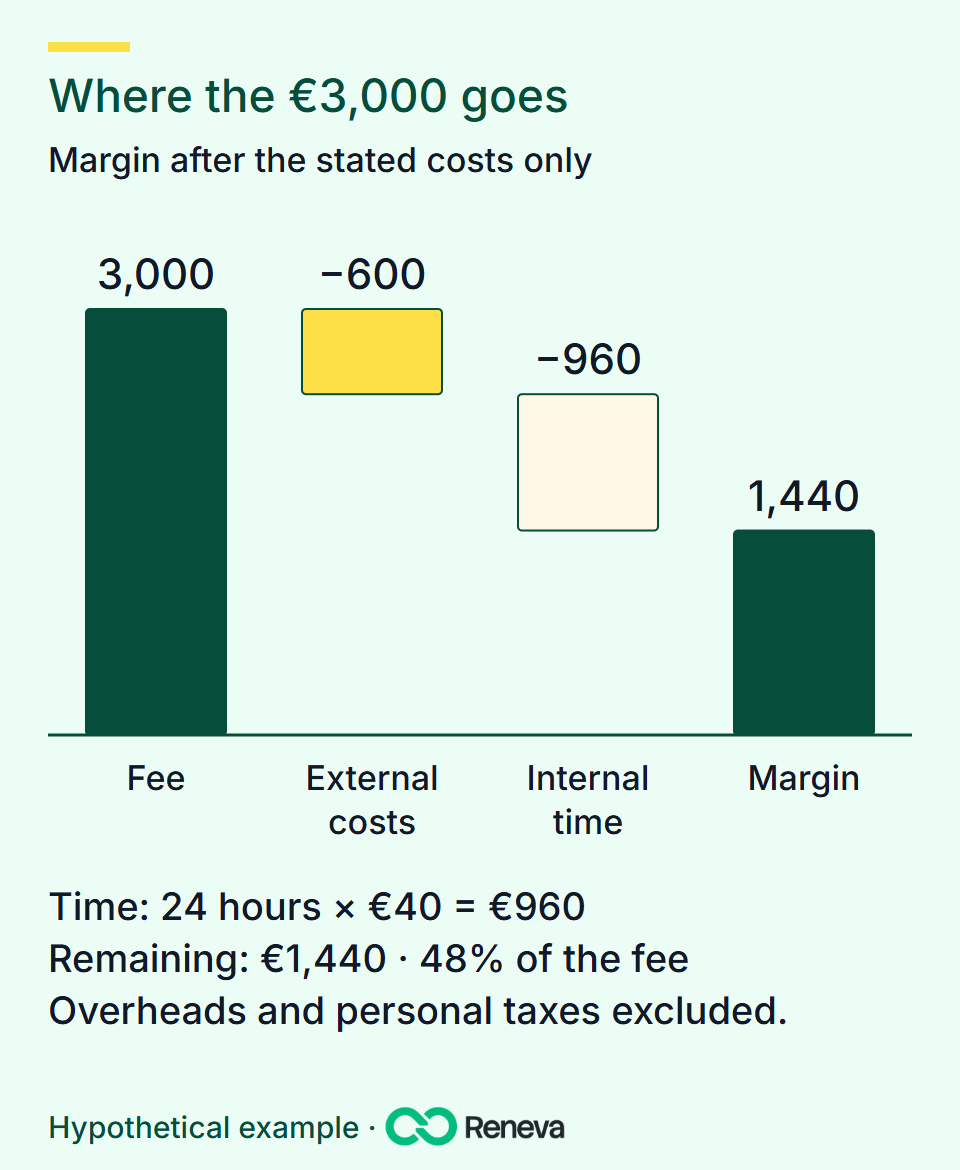
A hypothetical example: for a €3,000 job, you expect €600 in external costs and 24 internal hours, valued at €40 each. The costs included come to €1,560; the expected margin is €1,440, or 48% of the fee. If the job takes 34 hours, the margin falls to €1,040. The price charged to the client has stayed the same; the work needed to deliver has increased.
This guide, also as a PDF
Subscribe to the newsletter: once you confirm from the link in the email, the PDF guide opens.
This site is protected by reCAPTCHA and the Google Privacy Policy and Google Terms apply.

Decide which costs belong to the job
A project here is an identifiable assignment: building a small website, writing a set of texts or carrying out a consultancy project. To understand what it leaves, bring together the fee, hours and expenses for that assignment.
Start with three groups:
- Your time and that of anyone else working internally on the project, including meetings, preparation and revisions.
- External contractors involved in the job.
- Purchases and other expenses attributable to the project, such as a licence bought specifically for it.
Count each cost once. If a contractor's invoice already covers their time, do not add their hours again as internal time.
Our example counts only internal time and external costs for the job. Amounts are before tax; business overheads and personal taxes are excluded. The result shows what remains after these costs, rather than your earnings after everything.
Put a value on your hours, even when you work alone
Your time belongs in the calculation even when nobody sends you an invoice for it. Otherwise, two jobs with the same price and expenses would look equally worthwhile even if one took twice as long.
For this example, €40 is a hypothetical internal cost per hour. It is a calculation assumption, not a recommended rate or a price to charge the client. In your own calculation, use a method suited to your business and keep it consistent when comparing similar jobs.
The expected cost of time is:
24 hours × €40 = €960
In Reneva, a Client project holds the line items for what you sell, with quantities and prices. With the time-tracking module active, you can also link tasks and hours: keeping them with the assignment helps you reconstruct how much work it took. Start with the Guide's section on hours on the client project. For the calculation below, value time using your internal costing method, separately from the selling price of your hours.
Calculate the margin in euros and as a percentage
The formula in euros is:
Margin = fee − project costs included in the calculation
Using our hypothetical job:
| Expected item | Amount |
|---|---|
| Agreed fee | €3,000 |
| External costs | €600 |
| Internal time: 24 hours × €40 | €960 |
| Total costs included | €1,560 |
| Expected margin after these costs | €1,440 |
To express the margin as a percentage of the fee, divide by the fee and multiply by 100:
€1,440 ÷ €3,000 × 100 = 48%
For each €100 of the fee, €48 remains after the costs we included. Read that 48% alongside its scope: adding excluded costs would reduce the difference. If the fee is zero, this percentage cannot be calculated; you can still show the result in euros.
The margin formula based on contract value uses this denominator: value minus costs, divided by value. Here, we apply it to one assignment's positive fee and the stated costs.
Why markup gives a different percentage
Markup compares the same difference with cost rather than the fee:
€1,440 ÷ €1,560 × 100 = 92.31% markup
The expected margin is 48% of the €3,000 fee; the markup is 92.31% of the €1,560 cost. They are two ways of reading the same amounts. When comparing quotes or price lists, check which percentage you are using.
Compare estimated hours with actual hours
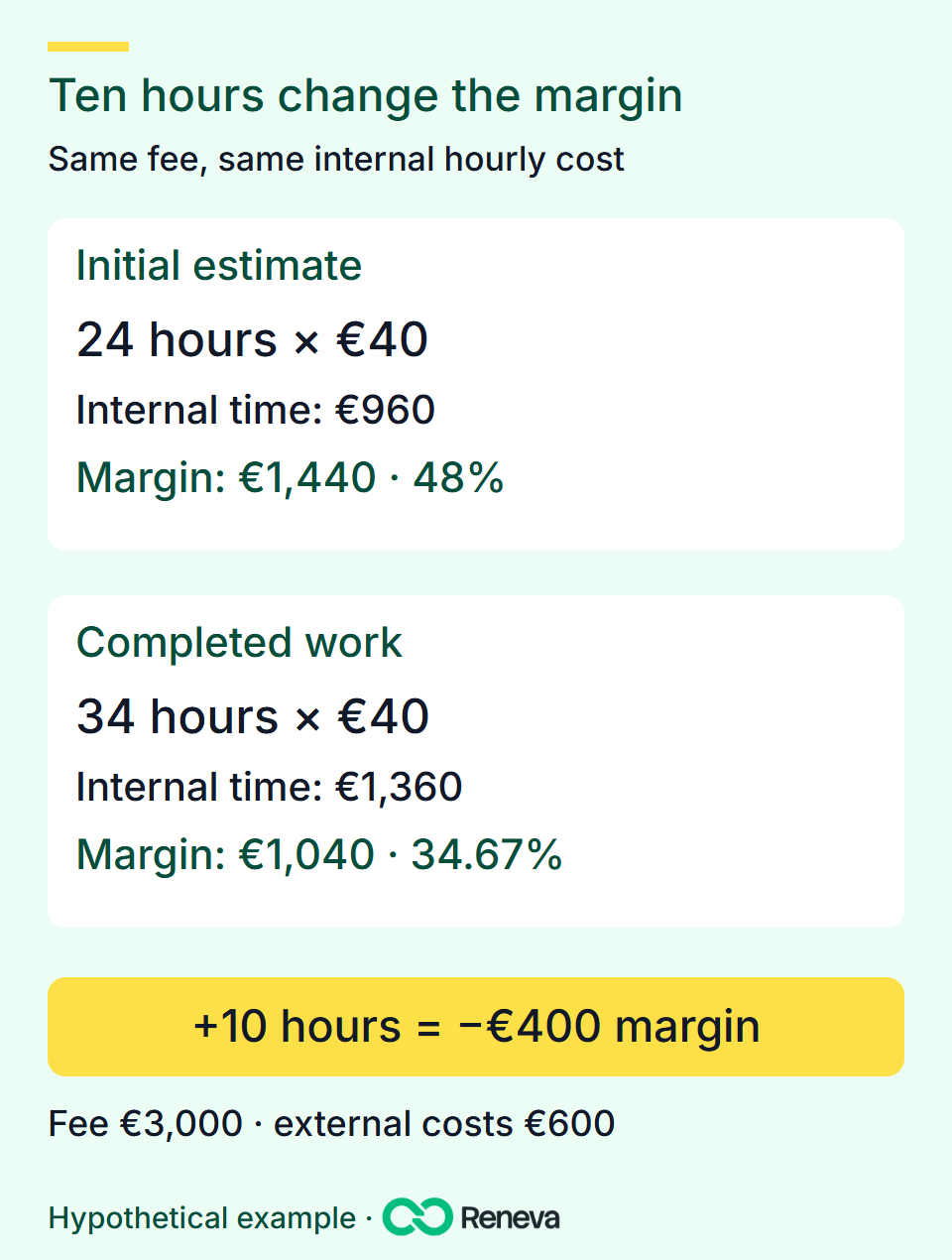
The job is finished and the actual time is 34 hours. In this example, the fee stays at €3,000, external costs stay at €600 and we keep the same internal costing assumption of €40 per hour.
| Item | Initial estimate | Completed job |
|---|---|---|
| Internal hours | 24 | 34 |
| Value of internal time | €960 | €1,360 |
| External costs | €600 | €600 |
| Total costs included | €1,560 | €1,960 |
| Margin after these costs | €1,440 | €1,040 |
| Margin as a percentage of the fee | 48% | 34.67% |
The ten extra hours add €400 in internal cost. That is exactly what the expected margin has lost: €1,440 − €400 = €1,040.
If the project is still open, add an estimate of the time needed to finish to the time already spent. Comparing the price with costs incurred so far would make the margin look available when it still has to cover the remaining work. Comparing the initial estimate, actual costs and forecast remaining costs helps you identify that difference while the project is underway.
Keep margin separate from money in the bank
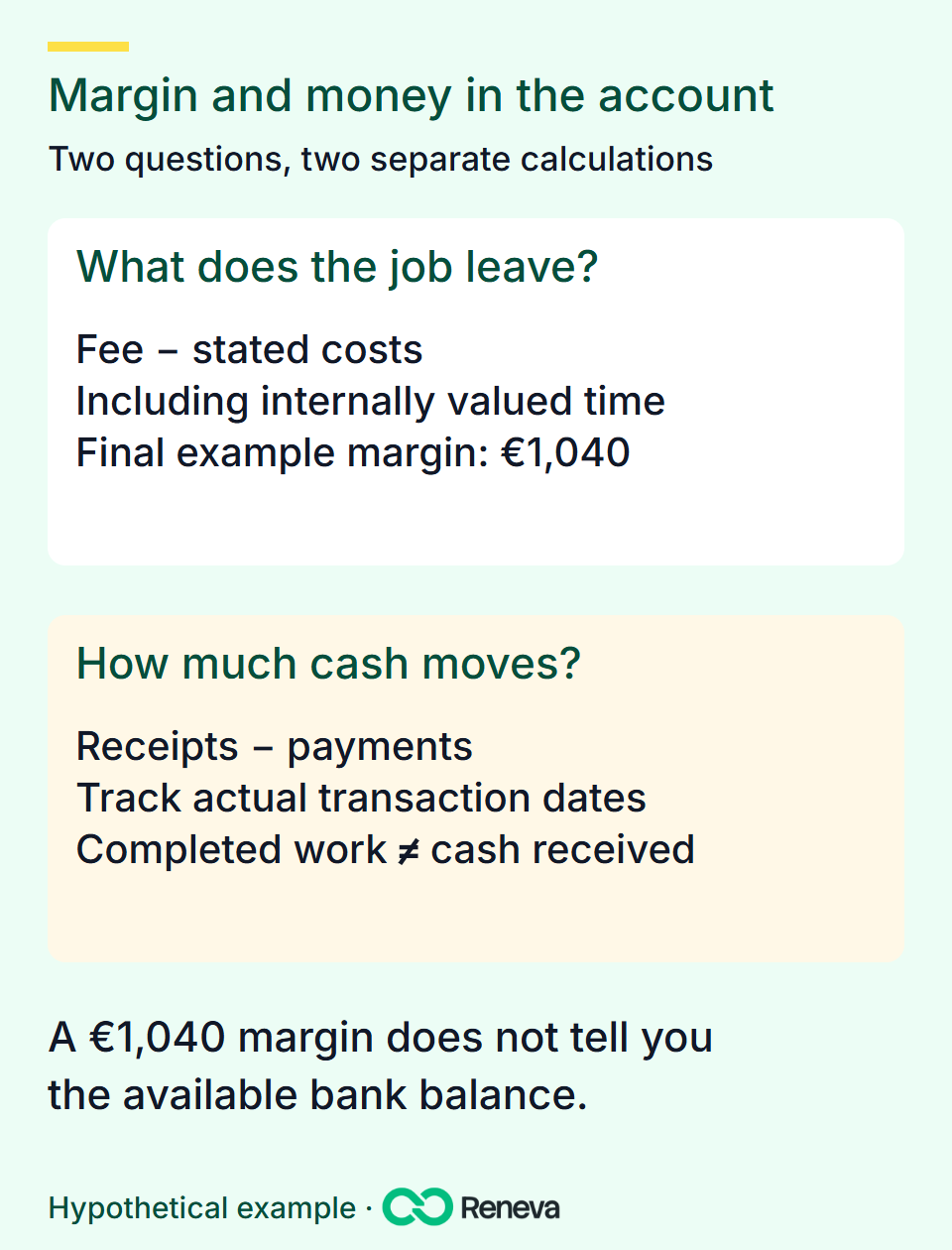
The €3,000 is the agreed fee. The amount invoiced concerns the documents you have issued; money collected is what you have actually received. Their amounts and dates can differ: a completed job may still be waiting to be invoiced or paid.
The example's final margin of €1,040 therefore does not show an available bank balance. The value assigned to your time is part of the project's cost calculation; receipts and payments follow actual money movements. Business overheads and personal taxes, excluded from our calculation, still need to be considered when working out the business's net result.
Use the difference when preparing your next quote
Before changing the price, find out where the ten extra hours went. An estimate that was too low calls for a more realistic time allowance. An expanded deliverable calls for clearer boundaries and terms for additional work. A repeatedly reworked step may suggest changing how you collect materials or approvals.
There is no right percentage for every job: your judgement also depends on the costs left out and what the fee needs to support. For the next similar assignment, start from the 34 hours actually spent, check what will be different and recalculate the result before confirming the price and deliverable.


