

Invoiced sales are the sales you have billed during a period, using the basis chosen for the comparison. Money received is what has actually arrived. An invoice issued today may be paid later; a payment received today may settle last month's invoice.
To understand the difference, look at two dates: when you issued the invoice and when you received the money. Then check whether you are comparing amounts excluding VAT or cash amounts that include it.
This guide, also as a PDF
Subscribe to the newsletter: once you confirm from the link in the email, the PDF guide opens.
This site is protected by reCAPTCHA and the Google Privacy Policy and Google Terms apply.

Two questions, two dates
If you ask “How much did I invoice in January?”, select invoices issued in January. If you ask “How much did clients pay me in January?”, select payments actually received that month, including those for older documents.
In this article, our day-to-day measure of invoiced sales is the sum of the taxable amounts on invoices issued during the period, with no credit notes in the example. We also show VAT and document totals so every figure has a clear basis. This is the stated method for our example, not a universal definition of turnover for Italian VAT purposes.
The invoice date helps you track documents; the payment date tells you when the money arrived. Neither date, by itself, tells you how much profit you made or how much you can spend.
Three invoices, including a payment from December
Take an agency set up as an Italian Srl and a hypothetical case of domestic services to which 22% VAT applies. There are no withholding taxes, pension-fund charges, stamp duty, credit notes or commissions in this example. The rate and components do not apply to every business.
At the end of January, the position is:
| Invoice | Issue date | Taxable amount | VAT | Document total | Payment received |
|---|---|---|---|---|---|
| A | 10 January | €2,000 | €440 | €2,440 | Paid in full on 20 January: €2,440 |
| B | 25 January | €1,000 | €220 | €1,220 | Not received by 31 January |
| C | 15 December of the previous year | €1,500 | €330 | €1,830 | Paid in full on 15 January: €1,830 |
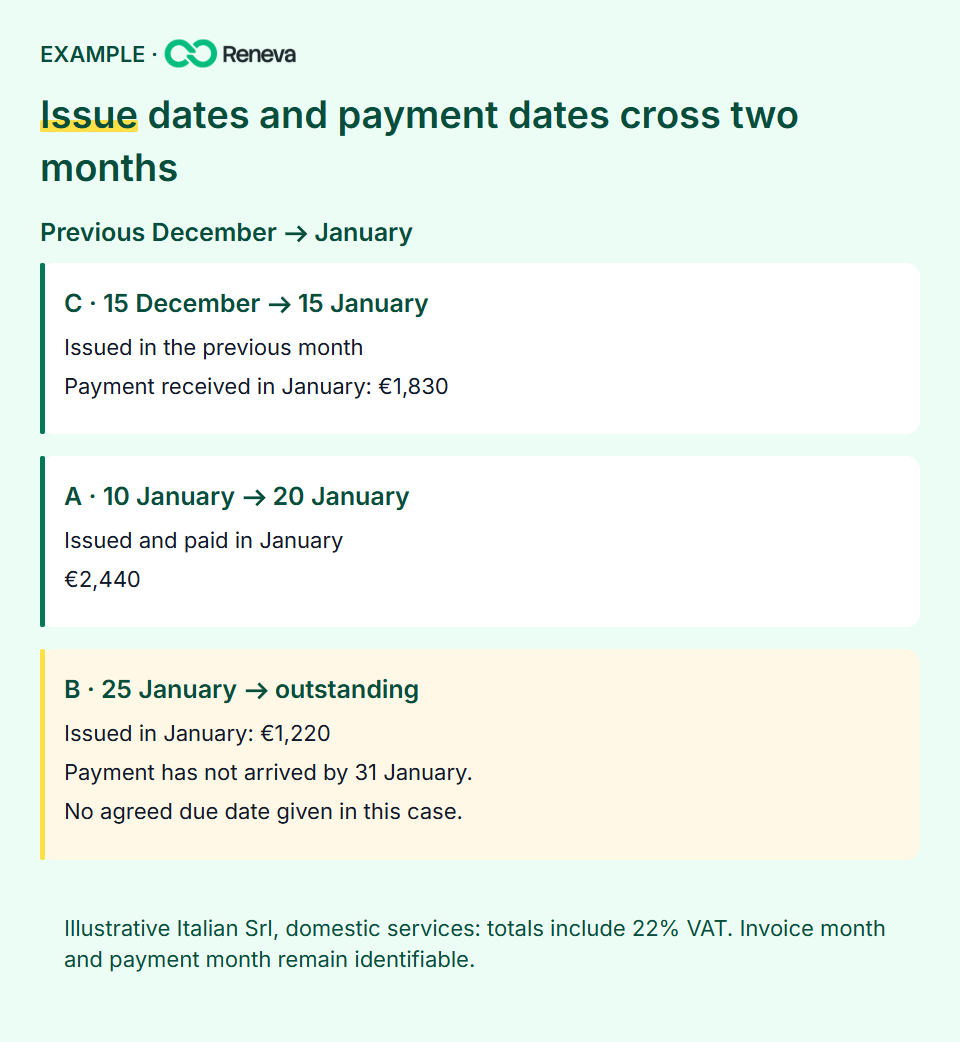
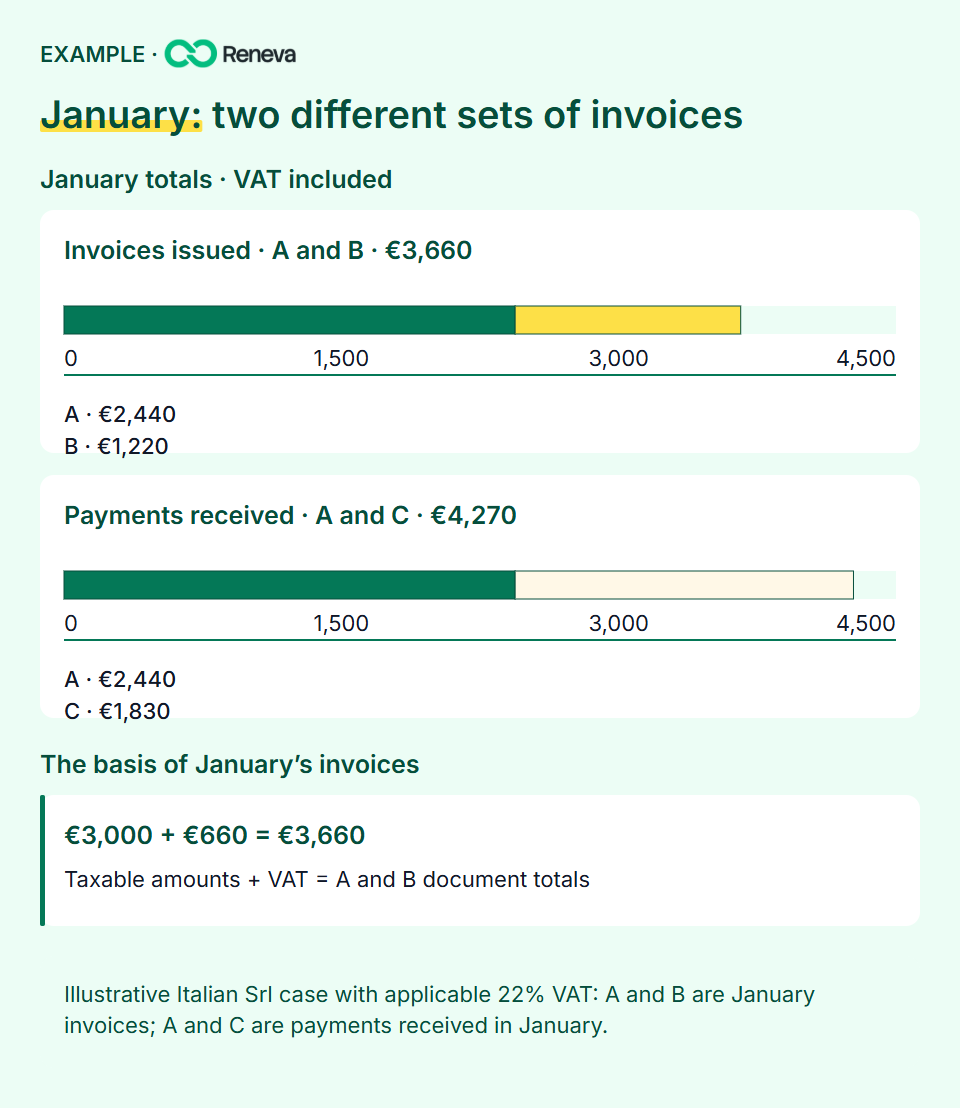
The invoices issued in January are A and B. Their taxable amounts total €3,000, VAT is €660 and the two documents total €3,660.
The payments received in January relate to A and C: €2,440 plus €1,830 gives €4,270 received, including VAT. Invoice C was issued in December, but its payment arrived in January.
Money received can therefore exceed the total of invoices issued in the month. To see that effect without mixing the bases, compare the €3,660 January document total, including VAT, with the €4,270 received in January. The figures relate to different sets of invoices.
Follow each document to find what is still unpaid
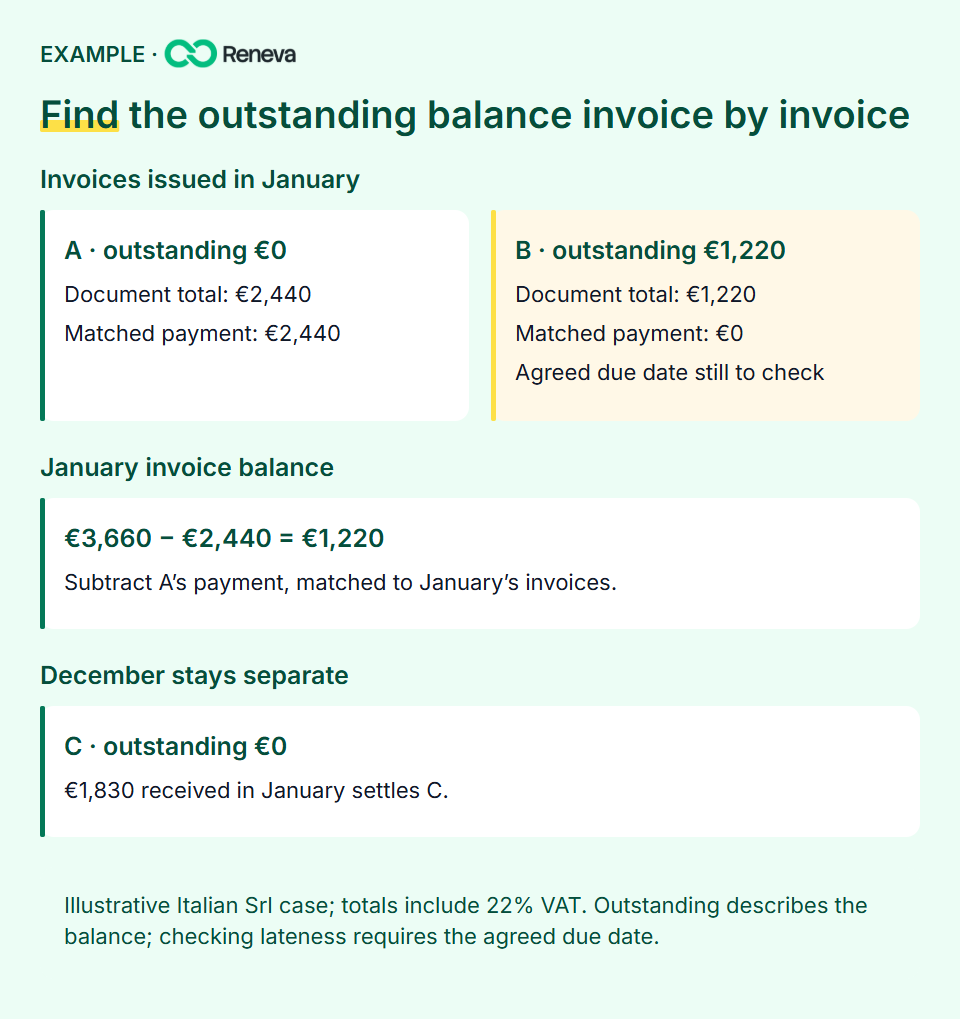
To find the outstanding balance on January's invoices, return to A and B. A is settled; B is still awaiting €1,220. The remaining balance on invoices issued in January is therefore €1,220, including VAT.
You can also check it against their total: €3,660 − €2,440 = €1,220, subtracting only the payment for those invoices. The payment for C settles the December document instead.
Subtracting all €4,270 received in January from the €3,660 January document total would not tell you what remains unpaid. It would include a payment for an invoice outside that total. To find all outstanding receivables, you would also need to check any other older invoices, which are outside this example.
Outstanding and overdue do not mean the same thing. We know B was unpaid on 31 January, but no payment deadline has been given. We cannot conclude that the client is late. Check the agreed due date alongside the remaining balance, as you would in a payment schedule.
Are taxes based on invoices or money received?
The answer depends on the entity and the applicable Italian tax regime. The Italian Chamber of Deputies' summary of business taxation distinguishes types of taxpayer and regimes with different ways of determining income. Choosing one of the totals in our table is not enough to establish the amount on which tax is calculated.
Revenue recognised in financial statements has its own rules too. It does not always follow the invoice date or payment date alone. OIC 34 on revenue sets out those rules for companies within its scope; it does not determine every freelancer's taxable income.
Ask your accountant which basis and period you need for your situation. The example's €3,000 in invoiced sales and €4,270 received are not a calculation of income or tax.
Use the distinction to track payments
To reconstruct the month, first choose the period and the basis of the amounts. Gather the invoices issued, then match actual payments to their documents. Check outstanding balances and due dates, keeping payments for older months recognisable.
If you use Reneva, the Payments section on a document shows the amount received and the remaining balance. Record the money against the relevant due date when it arrives. The document shows as paid once all its due dates have been collected. The partial payments and remaining balance guide explains the steps.
To understand how available money changes, you also need outflows and other inflows: that is the task of cash flow. The distinction between invoiced sales and money received answers three more specific questions: which invoices you issued, which were paid and which amounts you are still waiting for.


