

The fattura differita, or deferred invoice, is a single invoice that groups the services supplied to the same client in the same month, issued by the 15th of the following month. For services you need records that show who, what and when, such as a contract, an engagement letter or proof of a payment, and on the Italian e-invoice the document type code is TD24. Before using it, you should know when a service counts as "supplied" for Italian VAT. Usually it is the day you get paid.
This guide, also as a PDF
Subscribe to the newsletter: once you confirm from the link in the email, the PDF guide opens.
This site is protected by reCAPTCHA and the Google Privacy Policy and Google Terms apply.

Immediate or deferred: the calendar changes
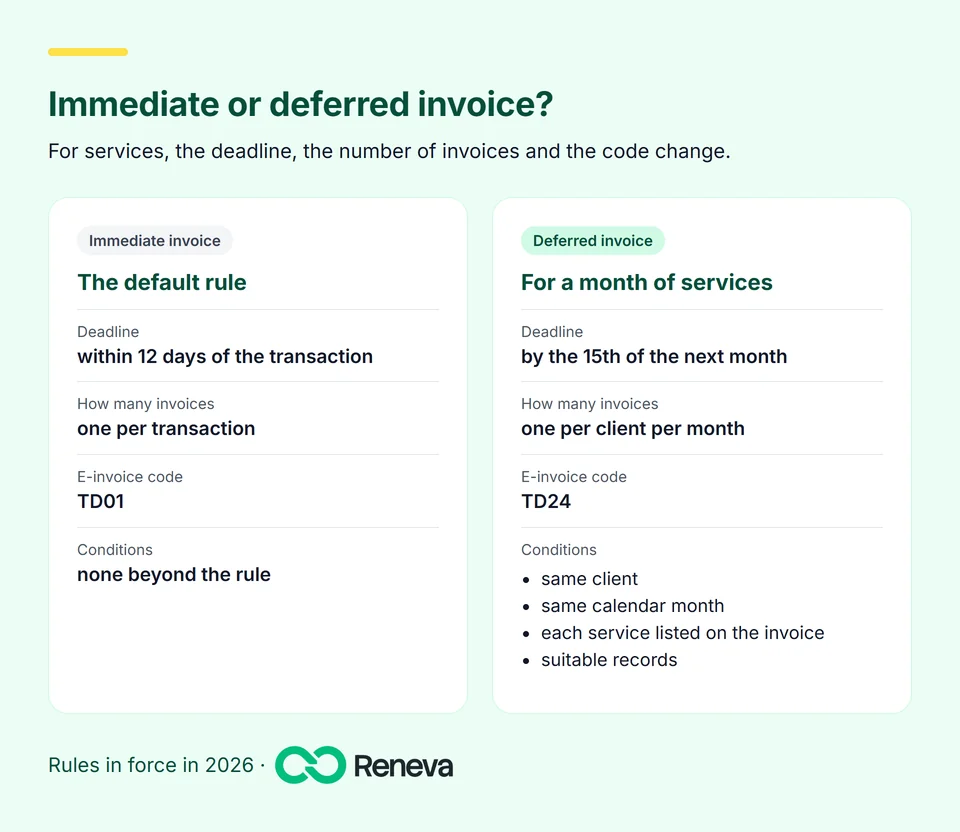
Article 21(4) of DPR 633/1972, the Italian VAT law, sets the basic rule: the invoice is issued within twelve days of the transaction. That is the immediate invoice (fattura immediata). Letter a) of the same paragraph makes an exception for services "identifiable through suitable documentation" supplied to the same customer in the same calendar month: for these you may issue one invoice, listing each transaction in detail, by the 15th of the following month.
So there are four conditions: same client, same month, records showing each service, and every service listed on the invoice. For goods the same exception relies on the transport document (DDT), which is a different story: this article covers services only.
When a service counts as supplied
This is the part that changes the maths. Article 6(3) of DPR 633/1972 says services are deemed supplied when the fee is paid. Not when you deliver the work: when you get paid. Article 6(4) adds that if you issue the invoice before payment, the transaction is deemed to take place on the invoice date, for the amount invoiced.
The Italian Revenue Agency (Agenzia delle Entrate) draws the consequence in ruling no. 389 of 2019: a deferred invoice for services covers the services on which VAT has already become chargeable, which in general means those already paid.
If you sell consulting, development hours or maintenance to Italian clients, that leaves two situations. In the first the client pays after receiving your invoice: until you are paid or invoice, nothing has happened for VAT purposes, and neither the 12-day nor the 15th-of-the-month deadline is running. At month end you issue an ordinary invoice, code TD01, listing the hours or tasks, and the date you put on it is the date of the transaction. From that date you have 12 days to send it to the SdI, and the VAT goes into that month's settlement.
In the other, the client pays during the month: after each session, with an advance, through a payment link. Each payment is a supplied transaction with its own 12-day deadline. This is where the deferred invoice earns its keep, because instead of one invoice per payment you issue a single one by the 15th of the next month. If the payment is an advance before the work, the article on deposit and balance invoices explains how to split it.
Records for services
The law asks for "suitable documentation" without saying which. The Agency's circular 18/E of 2014 clarifies it: there are no specific documentary requirements, and the commercial records you normally produce and keep are enough, as long as they show with certainty the service performed, the date it was supplied and the parties. Its examples are proof of payment, the contract, a work delivery note, the engagement letter and a professional report.
The list is introduced as examples, so it is open. A statement with dates and tasks that the client confirms by email carries the same three elements; the article on the client hours statement shows how to prepare one. The circular also allows a deferred invoice when there is only one service for that client in the month.
Which date goes on the e-invoice
On an Italian e-invoice the "Data" field is not the sending date: the Exchange System (Sistema di Interscambio, SdI), the Agency's channel every e-invoice goes through, already certifies that. Circular 14/E of 2019 says the field holds the transaction date and that, for a deferred invoice, a single date may be shown: the date of the last transaction. Ruling 389 adds that this is an option, not an obligation: the date must still fall in the month in which one of the services was supplied or paid, and the last day of the month is also fine.
The document type code is TD24. The Agency's guide to completing e-invoices, version 1.10 of April 2025, describes it as the deferred invoice under Article 21(4), third sentence, letter a), asks for it to be sent to the SdI by the 15th of the following month and recommends the date of the last transaction. Everything else is filled in as for a TD01 invoice. If the SdI is new to you, start with the article on e-invoicing for freelancers.
A worked example
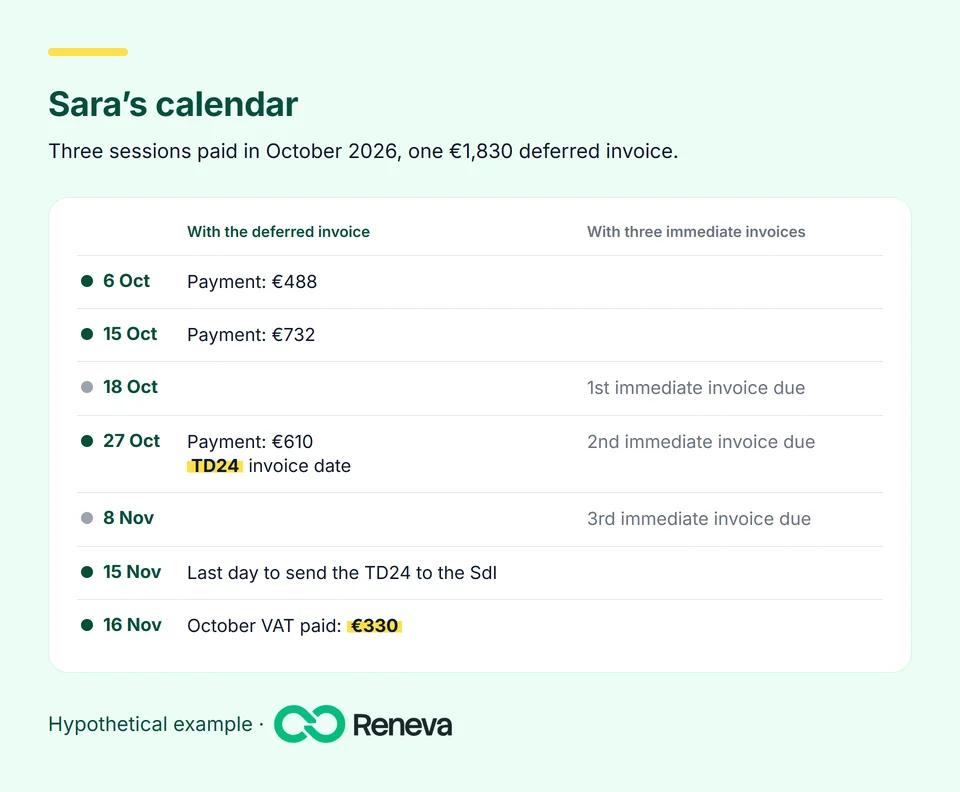
The example is invented. Sara is a marketing consultant under the ordinary VAT regime and settles VAT monthly. A client buys three sessions from her in October 2026 and pays each one by bank transfer on the same day, after receiving an email summary of what they did.
| Session | Supplied and paid on | Taxable amount | VAT 22% | Paid |
|---|---|---|---|---|
| Campaign analysis | 6 October 2026 | €400.00 | €88.00 | €488.00 |
| Content plan | 15 October 2026 | €600.00 | €132.00 | €732.00 |
| Results review | 27 October 2026 | €500.00 | €110.00 | €610.00 |
| Deferred invoice | €1,500.00 | €330.00 | €1,830.00 |
Sara issues one invoice with three lines, code TD24, dated 27 October 2026, and sends it to the SdI by 15 November 2026. The email summaries and the transfers are her records. Without the deferred invoice she would have needed three invoices, by 18 October, 27 October and 8 November.
Had the same client paid 30 days after the invoice, things would look different. On 31 October Sara would have issued a TD01 invoice listing the three sessions and sent it to the SdI by 12 November. The transaction would have been deemed to take place on 31 October, and the VAT would still have gone into the October settlement.
When VAT is paid
The VAT on a deferred invoice belongs to the month of the transactions, not the month you send the invoice. Article 23 of DPR 633/1972 requires issued invoices to be recorded by the 15th of the following month, with reference to the month in which the transactions took place. Article 1 of DPR 100/1998 sets the monthly settlement: by the 16th of each month you work out the VAT chargeable in the previous month.
For Sara, the €330 goes into the October settlement and is paid by 16 November 2026, the day after the invoice deadline. If you settle VAT quarterly the calendar is different, and your Italian accountant (commercialista) will know which one applies to you.
Under the flat-rate regime
Under the regime forfettario, the Italian flat-rate regime for sole traders, you charge no VAT. Article 1(58) of Law 190/2014 says you do not charge it to clients and paragraph 59 exempts you from paying it. Paragraph 59 does keep the obligation to certify your fees, which means issuing the invoice, and the invoice keeps its timing. If you group the services paid in a month into one invoice, the same 15th deadline and the same TD24 code apply. The payment rule is identical too: the service is supplied when you are paid. The regime's limits are in the article on flat-rate regime thresholds.
Common mistakes
The first is putting two months on one invoice. The law refers to services supplied in the same calendar month, so October payments and November payments go on two deferred invoices, one by 15 November and one by 15 December.
Next comes the deferred invoice sent on the 16th or later. That is an invoice issued after the deadline, and it is worth talking to your accountant straight away to put it right.
Another slip is a single line saying "October consulting". The law requires the transactions in detail: one line per session, task or block of hours, with its date.
The last one concerns advances. An advance received before the work is already a supplied transaction: it needs its own invoice, and the deferred invoice covers only what remains.
If you invoice monthly with Reneva
In Reneva you record hours with the Timer, picking a project and a task, and mark the time to be charged as Billable. The Hours tab in Analysis adds up time by period, project and person, so at month end you have the detail to put on the invoice or to send the client as a statement. You create the document from a subscription or client project card, with that card's line items and amounts already filled in. For monthly subscriptions, see the article on recurring invoices. Plans and terms are on the Pricing page.
From 2027
The text of Articles 6, 21 and 23 of DPR 633/1972 currently on Normattiva is in force until 31 December 2026. From 2027 the Italian VAT rules move into the consolidated VAT act (Testo unico IVA, Legislative Decree 10/2026), and the article numbers to cite change. This article follows the texts in force in 2026.


