

A credit note (nota di credito) reduces an invoice already issued, in whole or in part, VAT included. In 2026 you can issue one in three situations: an event cancels or reduces the transaction, you and the client later agree on a lower amount (within one year of the transaction), or the client does not pay and the debt ends up in insolvency proceedings or in an enforcement action that recovered nothing. The final deadline is the least clear point: we cover it below, with the reference practice and the change of August 2026.
In Italian e-invoicing, a credit note is document type TD04.
This guide, also as a PDF
Subscribe to the newsletter: once you confirm from the link in the email, the PDF guide opens.
This site is protected by reCAPTCHA and the Google Privacy Policy and Google Terms apply.

The example: a discount agreed in October 2026
This example is made up. Marco runs an agency in Turin under the regime ordinario, Italy's standard VAT and income tax regime. On 14 May 2026 he delivers a website to a client and invoices it: €2,000 plus 22% VAT (IVA), that is €440, for a total of €2,440.
The client has not paid yet. In October 2026, after a disagreement about a late delivery, they agree in writing on a discount of €400 on the taxable amount. The contract did not provide for it: it is an agreement reached after the invoice.
Marco issues a credit note for the discount. The figures, checked twice:
| Invoice of 14/5/2026 | Credit note of October 2026 | Due after the note | |
|---|---|---|---|
| Taxable amount | €2,000.00 | €400.00 | €1,600.00 |
| VAT 22% | €440.00 | €88.00 | €352.00 |
| Total | €2,440.00 | €488.00 | €1,952.00 |
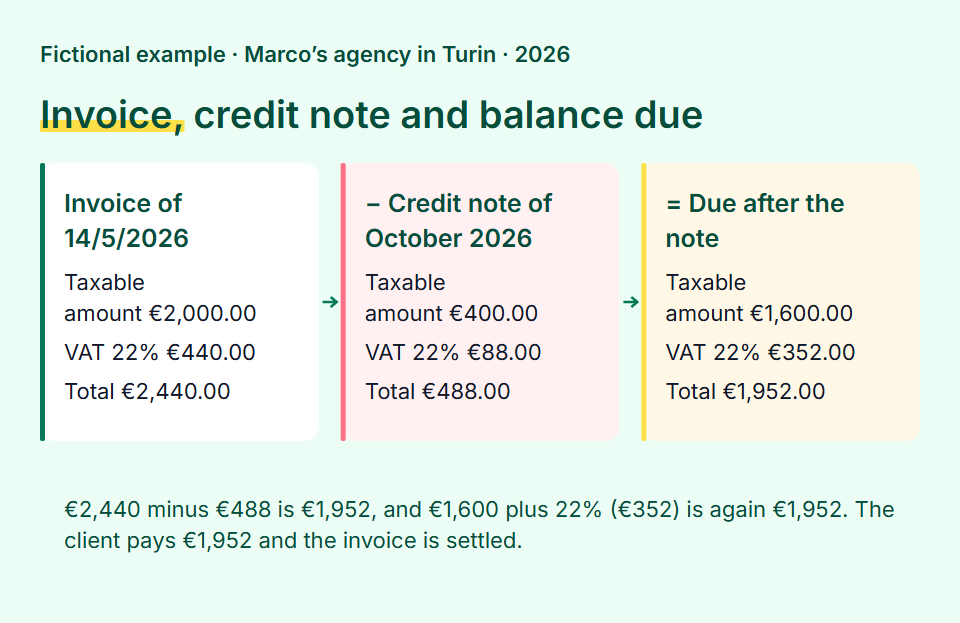
The VAT on the note is 22% of €400, which is €88. The balance works out both ways: €2,440 minus €488 is €1,952, and €1,600 plus 22% (€352) is again €1,952. The client pays €1,952 and the invoice is settled.
The discount comes from an agreement, so the one-year limit applies: with a transaction made in May 2026, the October agreement is comfortably within it.
The three cases in which you can issue one
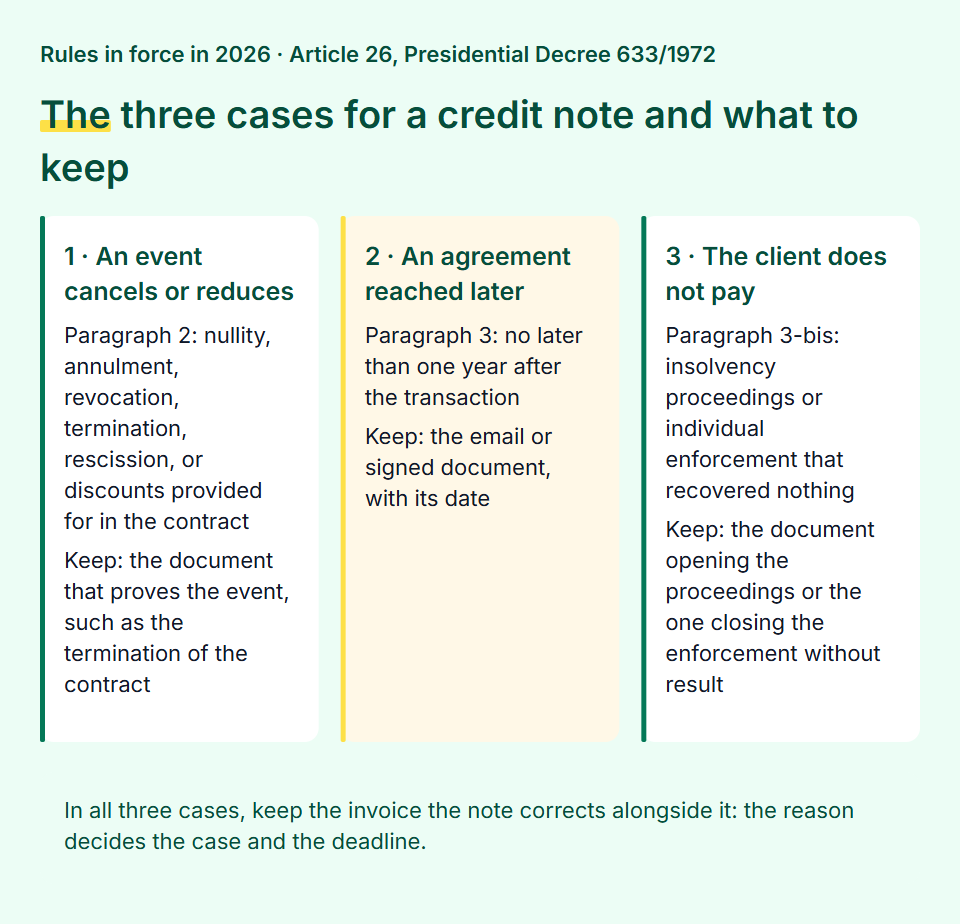
The rule is in Article 26 of Presidential Decree 633/1972, Italy's VAT law, in the text in force until 31/12/2026. It sorts situations by the reason for the reduction, not by the amount.
1. An event cancels or reduces the transaction
Paragraph 2 allows a downward adjustment when the transaction falls away or is reduced as a result of a declaration of nullity, annulment, revocation, termination, rescission and similar events, and for rebates or discounts provided for in the contract. Think of a terminated contract, a job cancelled before it started, or a discount that was already in the terms.
2. An agreement reached later
If the reduction comes from an agreement between the parties made after the invoice, as in Marco's case, paragraph 3 sets a limit: the adjustment cannot be made once one year has passed since the taxable transaction took place. After that year, the note can no longer reduce the VAT.
The difference from the first case lies in the word sopravvenuto, "arising later". A discount written into the contract falls under paragraph 2; a discount decided after delivery falls under paragraph 3. That is why the agreement should be in writing and dated, even if only in an email.
3. The client does not pay
A late-paying client is not enough on its own. Paragraph 3-bis allows a credit note for non-payment in two situations:
- from the date on which the client becomes subject to insolvency proceedings (procedura concorsuale);
- after individual enforcement proceedings that recovered nothing, for example a seizure that produced no money.
For insolvency proceedings, the Italian Revenue Agency's Circular 20/E of 2021 states that you do not need to file a claim in the proceedings to issue the note. Before you get that far, though, there is all the chasing to do: see our article on the overdue invoice.
The deadline: the open question in 2026
The honest answer is that there is no firm deadline today.
The reference practice is Circular 20/E: according to the circular, the note is issued at the latest by the deadline for filing the VAT return for the year in which the triggering event occurs, meaning the event that justifies the reduction. For Marco the triggering event is the October 2026 agreement, so the return is the one for 2026.
Then came Legislative Decree 148/2026. Its Article 12 amended Article 19 of Presidential Decree 633/1972, in force from 12 August 2026: VAT can now be deducted up to the return for the second year after the year in which the right to deduct arose. Before, the limit was the return for the same year. The law does not say whether the new limit also applies to credit notes, or from which invoices it applies, and there is no Revenue Agency guidance on it yet.
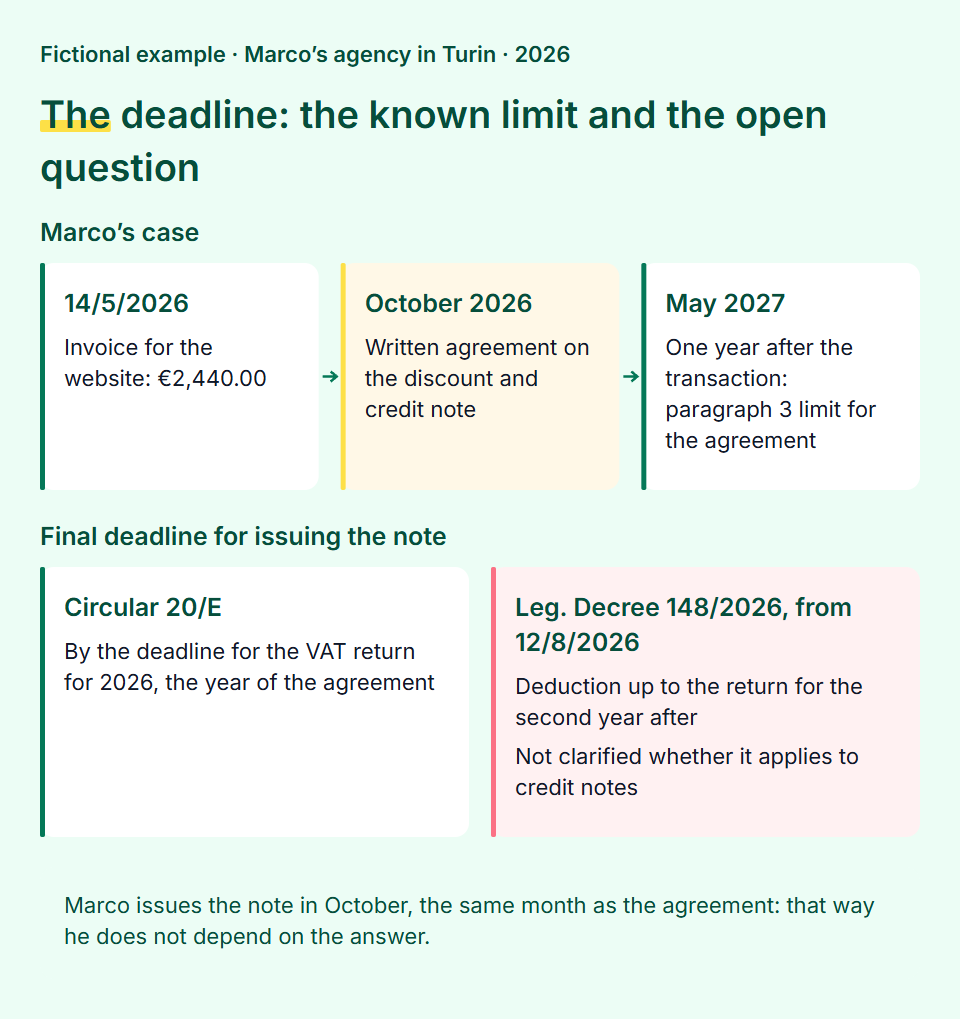
In practice: Circular 20/E describes the old rule, the new law may have extended it, and the Revenue Agency, as far as we know, has not yet clarified it. If your note falls close to a deadline, check the timing with your commercialista (accountant), together with which of the three cases above you are in. The simplest way not to depend on the answer is to issue the note when the event happens: Marco issues his in October, the same month as the agreement.
TD04 and e-invoicing
A credit note between Italian parties is an electronic document like an invoice and goes through the SdI (Sistema di Interscambio, the Revenue Agency's e-invoicing exchange system). In the Revenue Agency's technical specifications its document type is "TD04 Nota di Credito". In the document, refer to the invoice you are correcting and show the amounts being reduced, taxable amount and VAT for each rate.
An invoice that has already been sent cannot be edited or deleted. If the amount was wrong from the start, the route is the same: a credit note on the wrong invoice, then a new document with the right amount.
"Storno", credit notes and cancelled invoices
In everyday Italian, and in many accounting tools, people say the note storna (reverses) the invoice. It is a handy colloquial term: the law does not use it and speaks of adjustments to the taxable amount and the tax. When you read fattura stornata, it means an invoice reduced or cancelled out by a credit note.
Two situations look like credit notes but are not. If the client pays only part of the invoice without any agreement, the rest is still an open debt: our article on partial invoice payments explains how to record it. If the job is split into stages from the start, the answer is to invoice a deposit and balance, not to issue a full invoice and reduce it later.
What to keep
A credit note is kept in the same way as invoices. Alongside the note, keep the documents that explain why you issued it, because the reason decides the case and the deadline:
- the invoice the note corrects;
- for an agreement, the email or signed document, with its date;
- for a paragraph 2 event, the document that proves it, such as the termination of the contract;
- for non-payment, the document opening the insolvency proceedings or the one closing the enforcement without result.
In Marco's case, the invoice of 14 May, the October email with the agreed discount and the note itself are enough.
In Reneva
To correct an invoice issued from Reneva you use Credit note in the More actions menu. The window shows the line items with their amounts: keep the amount to reverse the whole item, lower it for a partial correction, set 0 to leave it out. The note cannot reduce more taxable amount than is left on the invoice, rate by rate, and it keeps the VAT treatment of the original invoice. If the client needs a corrected invoice, issue a new document after the note. The note does not prove that money has been returned: any refund to the client is a separate payment.
From 2027
From 1 January 2027 Article 26 of Presidential Decree 633/1972 is repealed and the rule moves to Article 92 of the Consolidated VAT Act (Testo unico IVA, Legislative Decree 10/2026). In the text published in the Official Gazette, paragraphs 2 and 3, including the one-year limit, stay the same; non-payment under paragraph 3-bis becomes paragraph 4, letters a) and b). The deduction deadline in Article 19 becomes Article 56, paragraph 1, which Legislative Decree 148/2026 extended to two years in the same way. The doubt about credit notes remains there too.


