

A deposit invoice covers part of a service’s price; a balance invoice covers the amount still to be invoiced. Before preparing a balance invoice, check what you have already invoiced: if an invoice for the full amount already exists and the client is paying in instalments, track payments against that document without invoicing the outstanding amount again.
The distinction is this: are you dividing the fee between several invoices, or dividing payment of one full invoice into instalments?
This guide, also as a PDF
Subscribe to the newsletter: once you confirm from the link in the email, the PDF guide opens.
This site is protected by reCAPTCHA and the Google Privacy Policy and Google Terms apply.

The deposit, invoice and payment are different pieces of information
A deposit is part of the agreed price. You can agree an advance payment at the start and the rest later: the percentage and due dates are terms of your agreement. The 30% used in the example below is a teaching assumption, rather than a mandatory share.
Here, “deposit” means an advance part-payment of a service’s price, corresponding to the Italian term acconto. A caparra, a security deposit and withholding tax have different roles and should not be treated as synonyms.
Issuing an invoice does not mean receiving its total. To reconstruct the situation, you need the agreed price, documents already issued and actual payments. An invoiced deposit can still be unpaid; receiving a payment also calls for a check of the invoicing obligations.
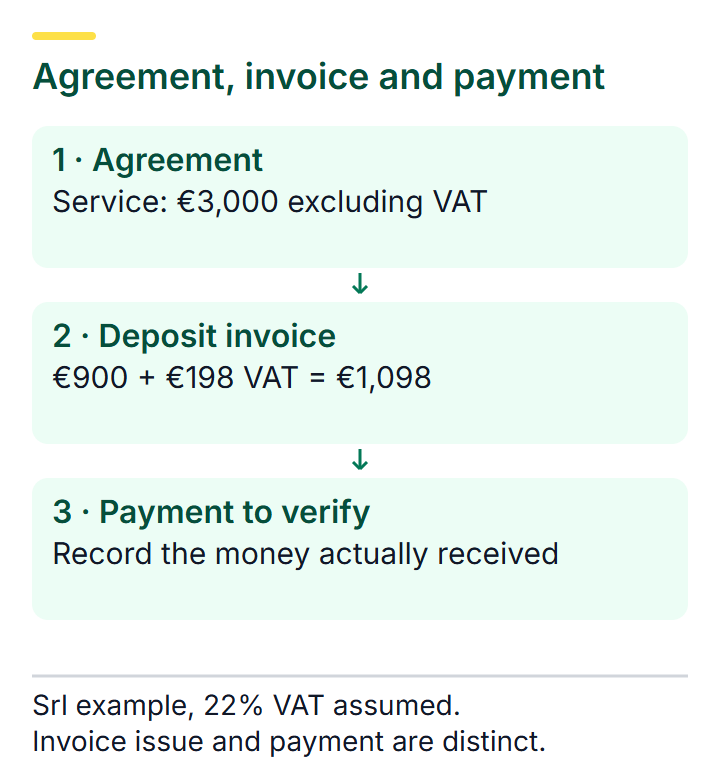
When to invoice an advance payment for a service
For ordinary domestic services in Italy, payment matters when determining when the transaction takes place for VAT purposes. If the client pays part of the price in advance, the transaction is treated as having taken place for that amount. Issuing the tax invoice in advance also matters for the amount invoiced. The reference is Article 6 of Italian Presidential Decree 633/1972.
For an immediate invoice, the general rule is to issue it within twelve days of the transaction taking place. The transaction date and the date you submit the electronic invoice therefore need to be handled correctly: the deadline does not become a new payment date. Exceptions include deferred invoicing for services under the documentation and timing conditions in Article 21(4).
Read the work’s delivery date, agreed payment date and timing for VAT purposes together, without assuming they always coincide. If you receive an advance payment at the start, for example, do not wait until delivery to deal with invoicing that amount.
If you need a summary request before payment, consider a proforma, which remains distinct from the tax invoice.
A €3,000 service with a 30% deposit
Consider a small Italian agency incorporated as an Srl, selling an ordinary domestic service for €3,000 excluding VAT. For this hypothetical case, assume 22% VAT applies, with no withholding, surcharges, pension-fund charges, stamp duty, discounts or other items. The rate and composition do not describe every service or professional.
The agreement calls for a deposit of 30% of the fee and the remaining 70% as the balance. The deposit’s taxable amount is:
€3,000 × 30% = €900, plus €198 VAT. The deposit invoice total is therefore €1,098.
When preparing the invoice for the remaining share, start with the agreed taxable amount and subtract the taxable amount already invoiced:
€3,000 − €900 = €2,100. VAT on that share is €462, giving a balance invoice total of €2,562.
| Document | Taxable amount | VAT at 22% | Total |
|---|---|---|---|
| Deposit invoice | €900 | €198 | €1,098 |
| Balance invoice | €2,100 | €462 | €2,562 |
| Total of both invoices | €3,000 | €660 | €3,660 |
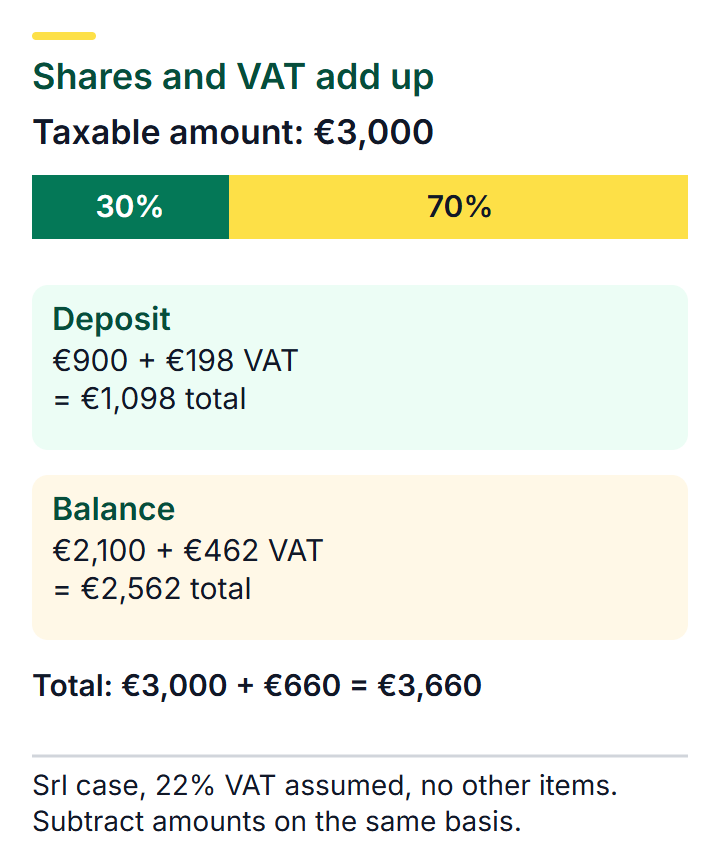
Every column adds up: taxable amounts total €3,000, VAT totals €660 and invoice totals add up to €3,660.
Compare amounts on the same basis. Subtracting the €1,098 deposit invoice total from the €3,000 taxable amount would mix a VAT-inclusive figure with one excluding VAT. For the remaining taxable amount, subtract €900 from €3,000; for the total remaining in this case, subtract €1,098 from €3,660.
What to make clear on the balance invoice
Describe the service, remaining share and connection to the deposit already invoiced, including the previous invoice’s number and date. The reader should be able to reconstruct the full price and see which part you are invoicing now.
In our case, the description could identify the balance for the agreed service, the overall €3,000 fee and the €900 taxable deposit already invoiced, with its document reference. The taxable amount left to invoice is €2,100. If the software displays the service’s total less the deposit, check that the tax result corresponds to the same remaining share.
Before issuing, also check any approved changes to the service. If the final price differs from the original agreement, reconstruct the calculation for that case using the documents already issued.
If everything is already invoiced, follow the unpaid balance
Use the same amounts with a different document sequence. You have already issued one invoice for €3,660, comprising €3,000 taxable amount and €660 VAT. The client pays €1,098 as the first payment.
The amount still to collect is €3,660 − €1,098 = €2,562. This is an outstanding payment on the existing invoice, rather than an amount still to invoice. When the client pays the rest, link it to the same document.
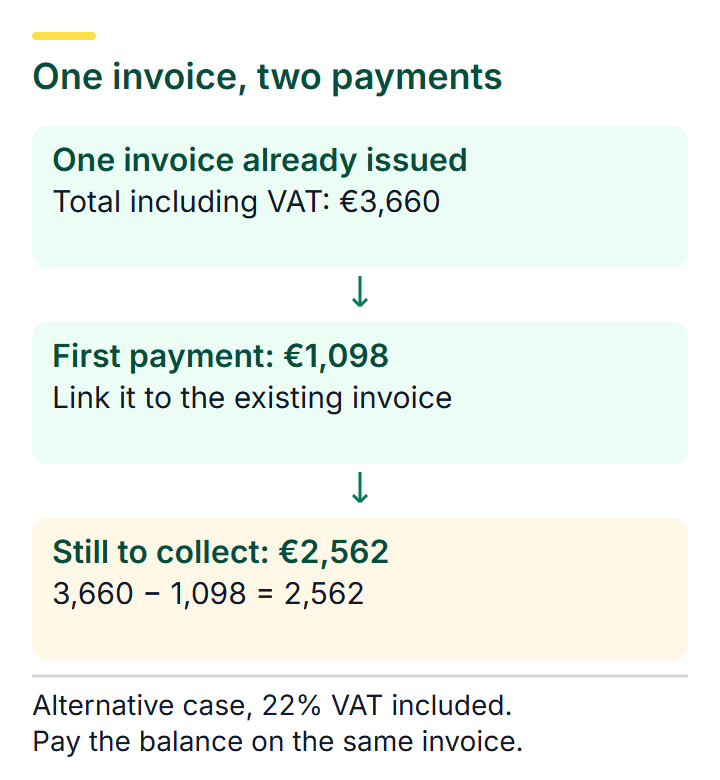
The €2,562 matches the balance invoice total in the earlier example, but the action changes. In the first case, you invoice the remaining part of the service; in the second, you record the remaining payment. Looking only at the final number does not tell you which document to use.
Keep amounts, documents and payments together
Before closing the work, compare the updated agreement with invoices and payments. You need to reconstruct what was agreed, what is already invoiced and what remains to be collected: three separate checks.
If you use Reneva Client projects, you can track instalments with their amount and due date, issue a document from an individual instalment and record payment from the linked document. The Guide to client project instalments and payments explains the steps. Before issuing another share, also compare it with invoices already created outside the project or in another program.
For the balance, start with the documents that exist: the next step may be an invoice for the remaining share, or recording a payment against an amount already invoiced in full.


