

If you are a self-employed professional under the regime ordinario, Italy's standard VAT and income tax regime, and you invoice a company, the client pays you the invoice total minus 20% of your fee, INPS surcharge included. That 20% is the ritenuta d'acconto, a withholding tax: the company keeps it and pays it to the State on your behalf, using an F24 payment form by the 16th of the month after paying you, and in March gives you the Certificazione unica. It is an advance on your own taxes, paid by someone else for you.
On a €1,000 fee with the INPS surcharge and VAT, in 2026 the invoice is worth €1,268.80 and €1,060.80 reaches your account.
This guide, also as a PDF
Subscribe to the newsletter: once you confirm from the link in the email, the PDF guide opens.
This site is protected by reCAPTCHA and the Google Privacy Policy and Google Terms apply.

The example: an invoice from November 2026
This example is made up. Sara is a communications consultant under the standard regime, registered with the INPS Gestione separata (the pension fund for freelancers without a professional fund), so she may charge her client the 4% INPS surcharge (rivalsa). On 10 November 2026 she invoices a Milan company €1,000 in fees, and the company pays on 30 November.
Here is the breakdown, with the figures checked twice:
| Item | Amount |
|---|---|
| Fee | €1,000.00 |
| INPS surcharge 4% of €1,000 | €40.00 |
| Taxable amount for VAT | €1,040.00 |
| VAT (IVA) 22% of €1,040 | €228.80 |
| Invoice total | €1,268.80 |
| Withholding 20% of €1,040 | −€208.00 |
| Net payable | €1,060.80 |
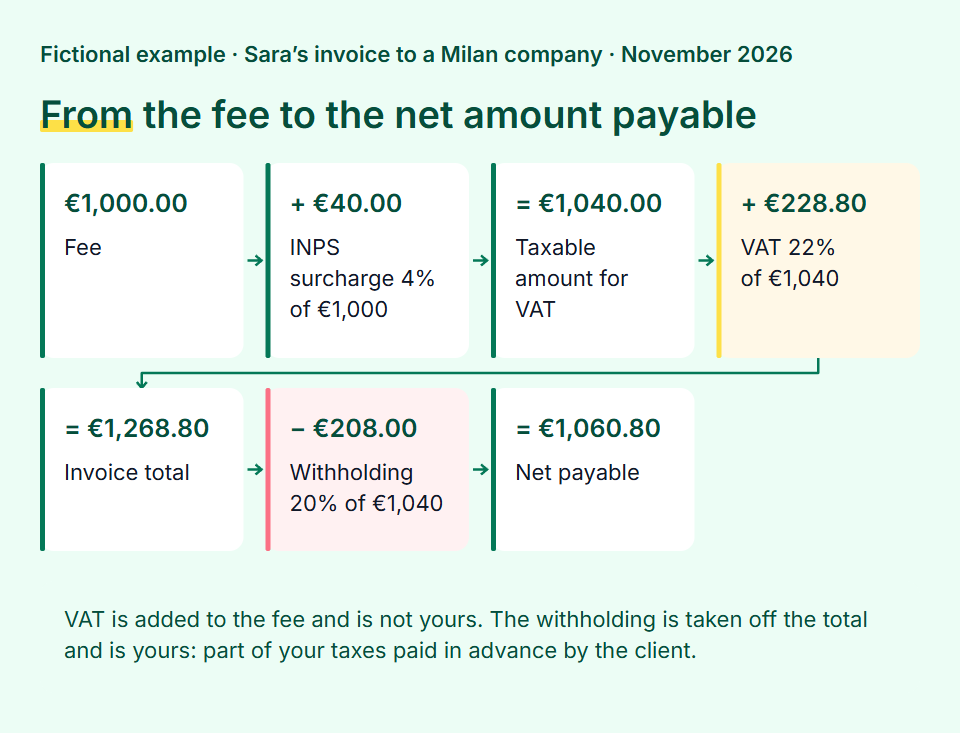
First check, line by line: €1,040 × 0.22 is €228.80; €1,040 plus €228.80 is €1,268.80; 20% of €1,040 is €208; €1,268.80 minus €208 is €1,060.80. Second check, in one go: the net amount is 102% of the taxable amount (plus 22% VAT, minus 20% withholding), and €1,040 × 1.02 is again €1,060.80.
On 30 November the company transfers €1,060.80 to Sara. By 16 December 2026 it pays the €208 using the F24 form. By 16 March 2027, under the rules as read in November 2026, it gives her the Certificazione unica, showing those €208 as paid on her behalf.
Without the surcharge, which is optional (for example if Sara chose not to charge it), the figures are simpler: €1,000 plus €220 VAT makes €1,220, the withholding is €200 and the net amount €1,020.
Two figures in the breakdown move in opposite directions, and they are easy to mix up. VAT is added to the fee and is not yours: you collect it on behalf of the State. The withholding is taken off the total and is yours, because it is part of your taxes paid in advance by the client. The total tells you what the document is worth; the net amount payable tells you what reaches your account. When a client who withholds tax transfers €1,060.80 against a €1,268.80 invoice, the invoice is paid in full.
Who acts as withholding agent
The client who keeps the withholding is called the sostituto d'imposta, the withholding agent, because they pay part of your taxes in your place. Not everyone is one. Article 23 of Presidential Decree 600/1973 lists them: companies and bodies, businesses, individuals practising arts and professions, and also blocks of flats acting through their condominio (owners' association).
A private individual who hires you for personal work is not on the list. In that case there is no withholding and the client pays you the total.
The withholding in this article applies to self-employment income: Article 25 refers to fees, however described, for self-employed services. If you are unsure whether your work falls under it, for example because you trade as a sole business or a company, that is the point to check with your commercialista (accountant) before invoicing.
What the 20% is calculated on
The rate comes from the Italian Revenue Agency's page on rates: for self-employment income paid to residents, the withholding, made as an advance payment, is 20%.
A detail worth knowing if you look it up: the text of Article 25 on Normattiva, Italy's official legislation database, still says 15%. The rate was raised by later laws, which the text mentions in its notes. For the figure to use on your invoice, the Revenue Agency's 20% is the one that counts.
The base is your fee. According to the Revenue Agency's page on the taxable amounts, it also includes the 4% INPS contribution charged to the client. A professional pension fund contribution charged to the client stays out. The Agency's list includes the fee and the 4% surcharge; VAT is not on it. That is why in Sara's case the base is €1,040.
How the 4% works, and what it is not, is covered in our article on the INPS 4% surcharge.
Who pays and when
The client pays, not you. The Revenue Agency's page on payment gives the F24 form with tax code 1040, due by the 16th of the month after the one in which the client paid you.
The month that counts is the month of payment, not the month of the invoice. If the Milan company had paid Sara on 4 January 2027, the withholding would have been made in January and paid by 16 February 2027.
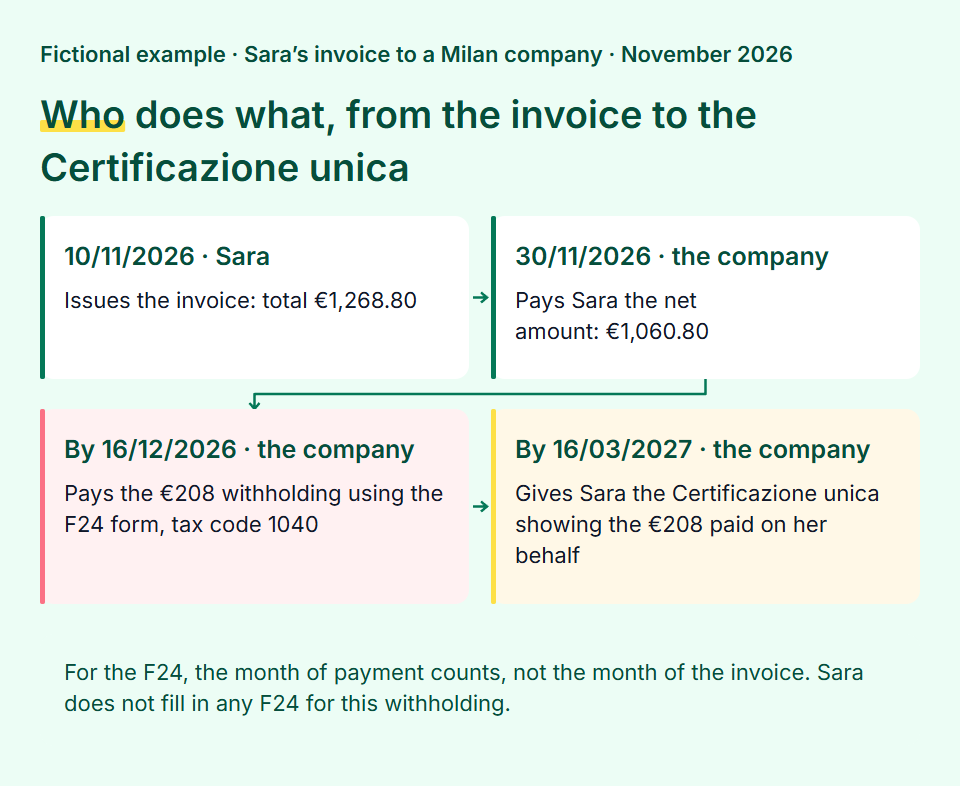
You do not fill in any F24 for this withholding. Your job is to check, at the end of the year, that the client has certified it.
The Certificazione unica
The Certificazione unica (CU) is the statement in which the client tells you how much they paid you and how much tax they withheld and paid for you. The rules are in Article 4 of Presidential Decree 322/1998, which changed them in 2025 and 2026: below are the ones in the text read in November 2026.
- You must receive the CU by 16 March of the following year: for fees paid in 2026, by 16 March 2027.
- The client sends it to the Revenue Agency by 16 March, or by 30 April if the CU contains only regular self-employment income.
For CUs delivered in 2027, check the updated text of Article 4.
When you receive it, compare fees and withholdings with your invoices for the year. If a client has forgotten it or shows different figures, it is worth asking straight away, before your accountant asks you. What to prepare for them is in our article on documents for your accountant.
Withholding and pricing
The 20% is not a discount for the client and you do not lose it. It does reach you later, as taxes already paid. If you set your prices based on what lands in your account that month, work from the net amount payable, not the invoice total: it is one of the calculations in our article on the freelance hourly rate.
If you are under the flat-rate regime
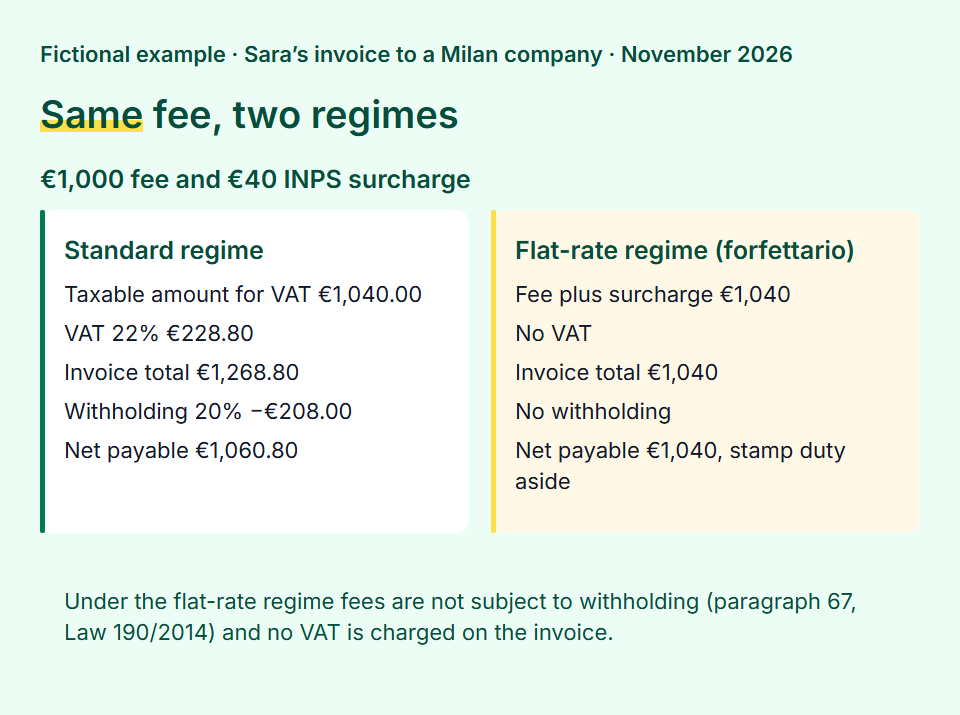
No withholding applies to your fees. Paragraph 67 of Law 190/2014 states that fees of taxpayers under the forfettario, Italy's flat-rate regime, are not subject to withholding by the withholding agent. You do not charge VAT on your invoices either. If you are registered with the Gestione separata and charge the 4% surcharge, combining the surcharge rule with paragraph 67 means that is not withheld either. With Sara's figures: €1,000 plus €40 surcharge makes €1,040, and the client pays you €1,040, stamp duty aside.
In Reneva
On a standard invoice the withholding starts switched off: you turn it on in the individual document, before issuing it, by choosing rate, type and reason code. Reneva does not switch it on by itself based on the client. Below the line items, the summary shows taxable amount, VAT, Total, withholding and Net payable: with €1,000, a 4% surcharge and 22% VAT you get the same €1,268.80 total and €1,060.80 net as in Sara's case.
From 2027
From 1 January 2027 Article 25 of Presidential Decree 600/1973 is repealed and the withholding moves to Article 38, paragraph 1, of the Consolidated Act on payments and collection (Legislative Decree 33/2025), which now states the 20% rate directly. The list of withholding agents becomes Article 33, and payment by the 16th Article 32, paragraph 1, letter a). For flat-rate taxpayers, paragraph 67 moves to Article 235, paragraph 4, of the Consolidated Income Tax Act (Legislative Decree 117/2026), with the same wording.


