

Dealing with stamp duty, or bollo, on an Italian electronic invoice involves three checks: whether it is due, how much the client needs to pay and what tax you need to pay to the authorities. Keep those checks separate. If an invoice has a €100 fee and you bear the €2 stamp duty yourself, the client owes you €100.
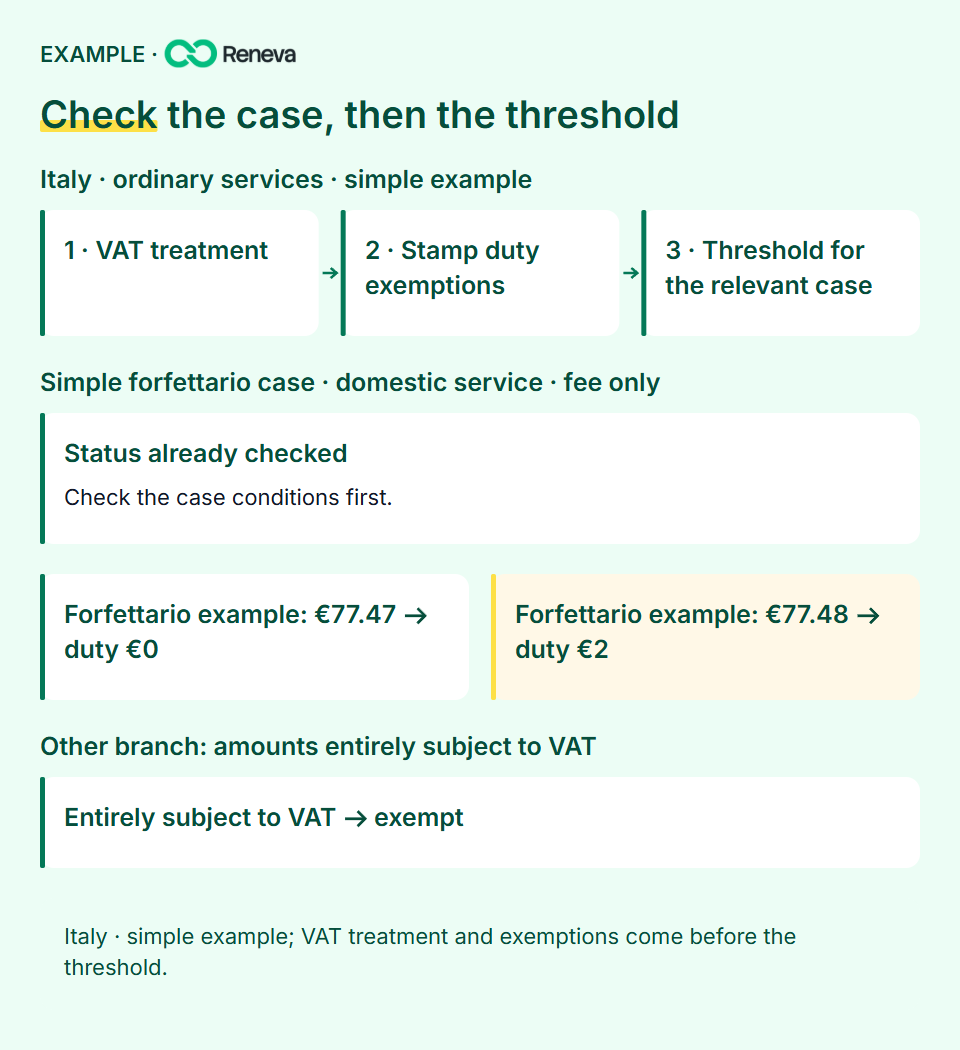
To establish whether stamp duty applies, start with the transaction's VAT treatment and any exemptions. The €77.47 threshold comes after that: the total alone does not decide.
This guide, also as a PDF
Subscribe to the newsletter: once you confirm from the link in the email, the PDF guide opens.
This site is protected by reCAPTCHA and the Google Privacy Policy and Google Terms apply.

When the €2 stamp duty applies
Take an ordinary service supplied in Italy by a professional correctly using the Italian forfettario tax regime. The invoice contains only the fee, with no reimbursements or other special items. In this case, €2 stamp duty is due when the amount exceeds €77.47.
The threshold is strictly “more than”: on this simple invoice, stamp duty is not due at €77.47, but is due at €77.48. The amount and threshold are set out in Article 13 of the Schedule to Italian Presidential Decree 642/1972.
An invoice entirely relating to amounts subject to VAT is exempt from stamp duty, as provided by Article 6 of the exemption table attached to the same decree, even if its total exceeds €77.47.
That is why it helps to work in this order:
- Identify the service's VAT treatment.
- Check whether the transaction qualifies for a stamp duty exemption.
- If the invoice falls within the scope of stamp duty, check whether the threshold is exceeded.
The absence of VAT is not enough to classify every invoice: specific exemptions exist. If one document contains items with different tax treatments, or the transaction has special features, have that case checked before applying this approach.
A €100 invoice: how much does the client need to pay?
Imagine issuing an invoice in November 2026 for a service supplied to an Italian business. You correctly apply the forfettario regime, have agreed a €100 fee and bear the stamp duty yourself. There are no reimbursements, surcharges or additional contributions in this example.
You do not charge VAT on the domestic service. The fee is not subject to withholding tax, and the required declaration is present. These are the conditions of the example under paragraph 58 and paragraph 67 of Article 1 of Italian Law 190/2014.
The invoice breaks down as follows:
| Item in the hypothetical example | Amount |
|---|---|
| Agreed fee | €100.00 |
| VAT charged | €0.00 |
| Withholding tax | €0.00 |
| Stamp duty due, borne by you | €2.00 |
| Stamp duty charged to the client | €0.00 |
| Amount payable by the client | €100.00 |
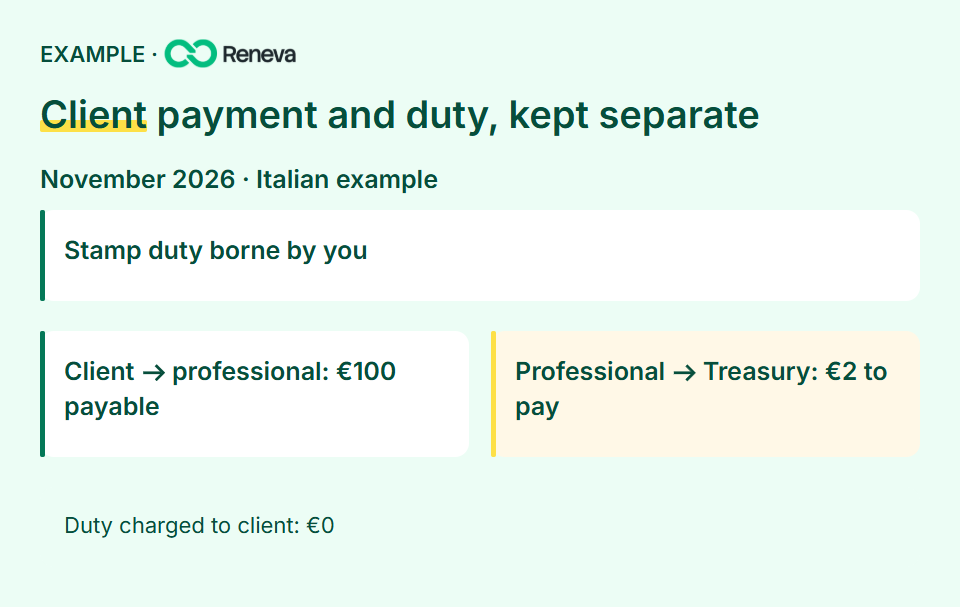
The client therefore owes €100. When you receive it, the payment received is €100: the €2 stamp duty must not be deducted from the client's bank transfer. The tax still needs to be paid separately. This breakdown does not calculate your taxable income or profit.
If you choose to pass the stamp duty on to the client, the amount you ask them to pay changes too. Check the choice and the total before issuing the document; have the tax implications of recharging it checked for your circumstances.
Compare an invoice entirely subject to VAT
Now consider a separate ordinary service entirely subject to VAT, with no special items. Assume a €100 fee and an applicable VAT rate of 22%:
| Item in the hypothetical comparison | Amount |
|---|---|
| Fee | €100.00 |
| VAT, assumed at 22% | €22.00 |
| Document total | €122.00 |
| Stamp duty due | €0.00 |
The total exceeds the threshold, but stamp duty is not due because the amounts are entirely subject to VAT. The 22% rate is an assumption for this comparison, not the rate for every service. We are not calculating any withholding tax here: €122 is the document total, not a forecast of what will reach your bank account.
What to check before issuing the invoice
Before confirming, compare the tax choices with the resulting document:
- the regime applied and type of transaction;
- the VAT treatment of the items;
- the amount to compare with the threshold, where relevant;
- stamp duty due and the choice to bear it or charge it to the client;
- the total you are asking the client to pay.
For the €100 example above, with stamp duty borne by you, the amount requested remains €100.
If you use Reneva, the Taxes on a document guide explains how to compare Stamp duty, under Tax choices, with Total. Duty borne by you remains declared without increasing the total; duty charged to the client appears as a line item and increases it. The choice on the document represents the case you have checked. Paying the tax is a separate step.
Declaring stamp duty and paying it are separate steps
An electronic invoice subject to stamp duty must carry the required annotation. Payment to the tax authorities then requires a separate action: selecting stamp duty in your software does not pay it.
The Italian Revenue Agency's deadline calendar for the first quarter of 2026 describes two payment methods: a debit from an account held in the taxpayer's name, using its IBAN in “Fatture e corrispettivi”, or an F24 form prepared by the Agency and submitted electronically. For your payment, check the official instructions for the relevant period and agree with your accountant who will carry it out.
A separate example: the first two quarters of 2026
Suppose stamp duty has already been determined at €120 for the first quarter of 2026 and €80 for the second:
| Period in the example | Stamp duty payable |
|---|---|
| First quarter of 2026 | €120.00 |
| Second quarter of 2026 | €80.00 |
| Total for the two quarters | €200.00 |
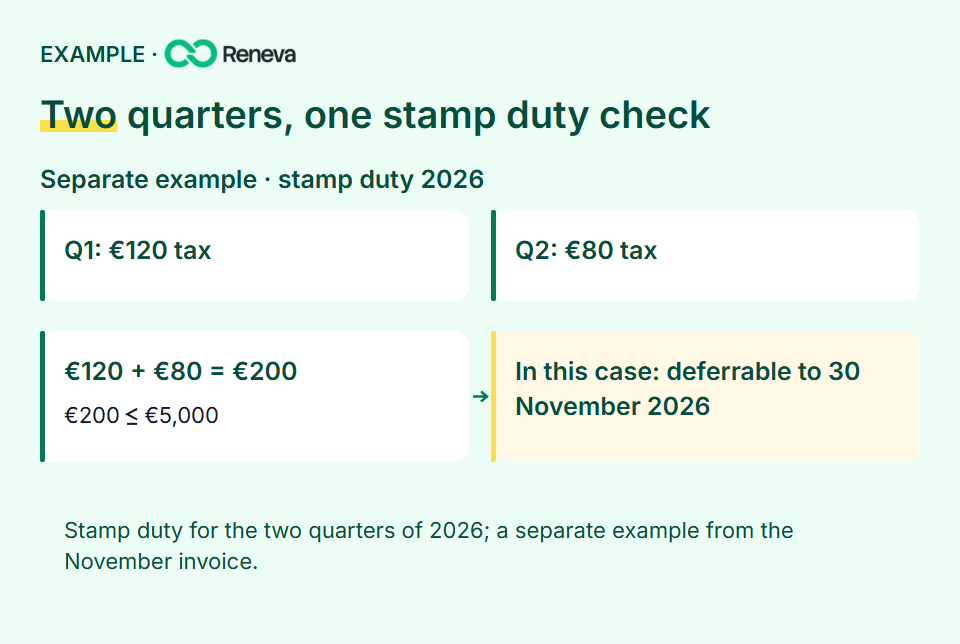
These are amounts of tax, not fees or payments received from clients. Their sum does not exceed €5,000. For this case, the Agency's 2026 deadline calendar allows payment to be deferred until 30 November 2026. The threshold concerns the aggregate stamp duty for the two quarters.
This example is separate from the €100 invoice issued in November and does not set the deadline for paying stamp duty on that invoice. Consult the relevant deadline calendar for other periods.
When preparing an invoice, keep two practical checks alongside it: the amount you are asking the client to pay and the stamp duty you need to pay to the authorities. This keeps the client's total clear and gives the tax payment its own step to complete.


