

To deal with an overdue invoice that still has an unpaid balance, check how much is missing, when payment was due and which payments you have already received. Then gather the records of the work and any responses from the client. These help you decide what to do next, from clearing up an administrative issue to asking a professional to assess the case.
A delay alone does not explain why payment is missing. Before asking for the full invoice amount again, work out the balance as at the date of your check.
This guide, also as a PDF
Subscribe to the newsletter: once you confirm from the link in the email, the PDF guide opens.
This site is protected by reCAPTCHA and the Google Privacy Policy and Google Terms apply.

Is the invoice overdue, outstanding or already paid?
An invoice can have an outstanding balance before its due date. It can also have been paid late: at the time of your check, that payment may have cleared the original amount owed, even though it arrived after the deadline.
To tell these situations apart, you need the date of your check, the payment due date and verified payments received. Issuing or sending an invoice tells you about the document; it does not prove that the money has arrived.
Find the basis for the due date too: an agreement, a contract or another relevant source. If the date is uncertain, clarify it before treating every outstanding amount as overdue. The article on invoice payment terms explains the difference between a due date and the basis for setting it.
Three invoices checked on 10 November
Consider a hypothetical example as at 10 November 2026, with three invoices to business clients. All amounts are final sums payable, including VAT where applicable. The table covers the original invoice amounts only, with no withholding tax, fees, credit notes, interest or other charges.
| Invoice | Invoice total | Agreed due date | Verified payments received | Outstanding on 10 November | Status of the remaining amount |
|---|---|---|---|---|---|
| A | €1,200 | 31 October 2026 | €300 on 25 October | €900 | Overdue |
| B | €600 | 30 November 2026 | None | €600 | Not yet due |
| C | €800 | 31 October 2026 | €800 on 3 November | €0 | Original amount paid in full, after the due date |
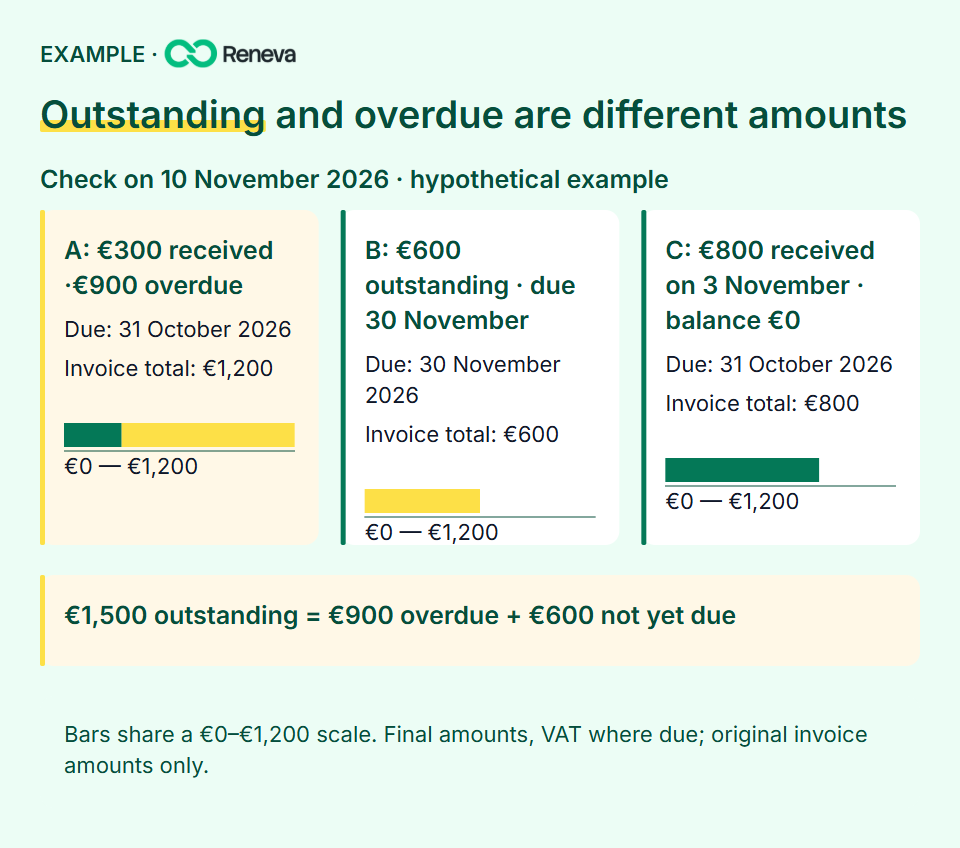
The invoices total €2,600, and verified payments received total €1,100. That leaves €1,500 outstanding, but only €900 is overdue at the date of the check: the balance on A. The €600 on B is not yet due, and C has no original invoice amount left unpaid.
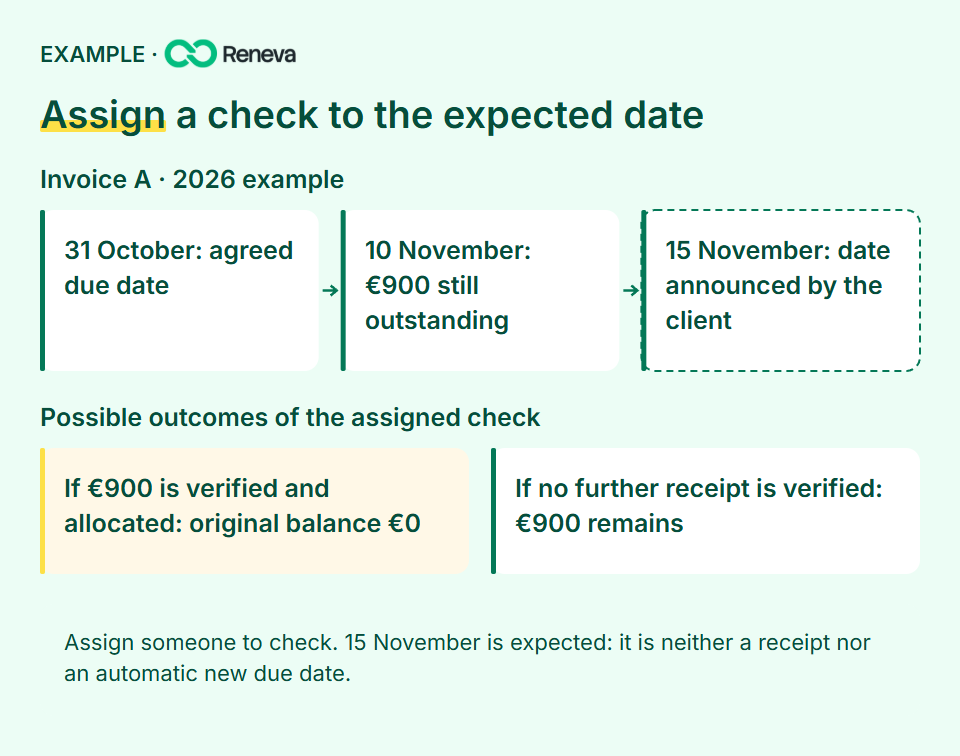
Asking for €1,200 again on A would overlook the €300 already received. If the client has said they will pay the rest on 15 November, keep that message as something to follow up. It is not a payment received, and we do not automatically treat it as a change to the agreed due date.
Any entitlement to interest or other additional amounts needs a separate assessment. The table neither calculates those amounts nor concludes that no such entitlement exists.
Gather the records for each overdue balance
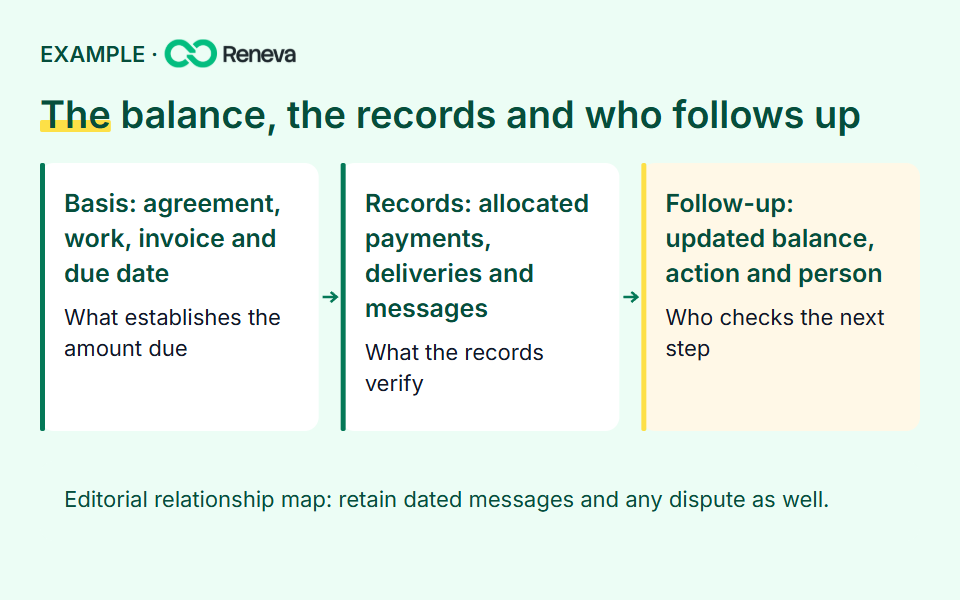
For each overdue balance, collect what someone needs to understand the work and the agreement, beyond the invoice itself. Whoever follows it up should be able to find:
- the agreement and scope of the work, including agreed changes;
- the invoice, its references and the amount actually payable by the client;
- the payment due date and the document or agreement it comes from;
- payments received, the amounts allocated and the updated balance;
- deliveries, approvals or other records of the work carried out;
- disputes and messages from the client, with their dates;
- the next action and the person responsible for it.
Keep documented facts separate from assumptions. “The client says they have initiated payment” and “we have verified receipt of the payment” are different pieces of information. Likewise, keep a record of what a dispute says without assuming that it proves bad faith or that the complaint is justified.
If records of the work or an updated agreement are missing, make that gap clear. The file also helps a professional assess the case later. A list of unpaid amounts alone leaves out part of the story.
Choose the next step based on what you find
If the client says they have paid, check the reference, date, amount and transaction before repeating your request. There may be money that has not yet been allocated to the right document. If payments have been split, track the remaining balance after a partial invoice payment without counting the same money twice.
If the problem is an administrative detail, check it against the available documents and clarify what is needed to resolve it. If it concerns the service, collect the complaint and compare it with the agreement, delivery records and correspondence. Non-payment alone does not tell you which document or amount, if any, should change.
If you are simply waiting for a response, you can use a payment reminder based on the updated balance. The preparation here is about getting the facts of the case clear, so the message starts from what you have checked.
If the issue remains unresolved, the client disputes what is owed or you are considering formal action, take the records to a suitably qualified professional to assess the case. Agreements, documents, amounts and responses allow the next step to be considered on its own facts, rather than applying the same sequence of messages and actions to every unpaid invoice.
Assign a next action and keep the facts up to date
For A, you can note who will check for the expected payment on 15 November and when they will review the case. If the €900 arrives, update the balance. If it does not, the next check starts from the same unpaid amount and any new correspondence.
If you use Reneva, Documents lets you find invoices and references using search and filters, then open the document you need to check. The Document list and statuses guide distinguishes information about the document from its due date and payment. Update the record on the basis of a verified payment; sending the invoice alone does not prove that it has been paid.
After each contact, keep the outcome, date and next step. A useful check lets the person responsible answer three questions precisely: how much is still unpaid, which due date has passed and what needs to happen next?


