

A partial payment covers only part of an invoice. To work out what is left, start from the amount payable by the client on that document, allocate the payments received and update the balance. Keep money received separate from agreed instalments and dates that are only expected.
The calculation is straightforward when the trail is clear: one invoice, its payments and the amount remaining. First, check that the same payment has not been entered twice and that a promise has not been recorded as money received.
This guide, also as a PDF
Subscribe to the newsletter: once you confirm from the link in the email, the PDF guide opens.
This site is protected by reCAPTCHA and the Google Privacy Policy and Google Terms apply.

Are you splitting the payment or the invoicing?
Here we start with an invoice already issued for the whole service, with partial payments agreed between the client and the agency. Receiving a second payment does not mean invoicing that part of the same document again: it needs to be tracked against the existing amount owed.
That is different from a situation where you still need to issue documents for separate parts of the fee. The article on deposit and balance invoices covers that process.
The payment agreement and the record of payments received are separate. Knowing that the client intends to pay an amount does not mean you have received it. A smaller payment alone does not establish a discount or a new due date.
Allocate the payment to the right document
Check the client, invoice reference, amount payable, and the date and amount of the payment received. Your starting point is what the client owes under the document, rather than automatically using just the taxable amount.
If a bank transfer covers several documents, establish which amounts it relates to before updating their balances. Our example keeps this simple: there is one invoice, and all the payments shown relate to it, with no other amounts to allocate.
The method, also described in Stripe's Italian-language guide to partial payments, keeps the invoice total, amount paid and remaining balance identifiable. Applying it starts with your documents and the agreement with your client.
One €1,220 invoice, two payments already received
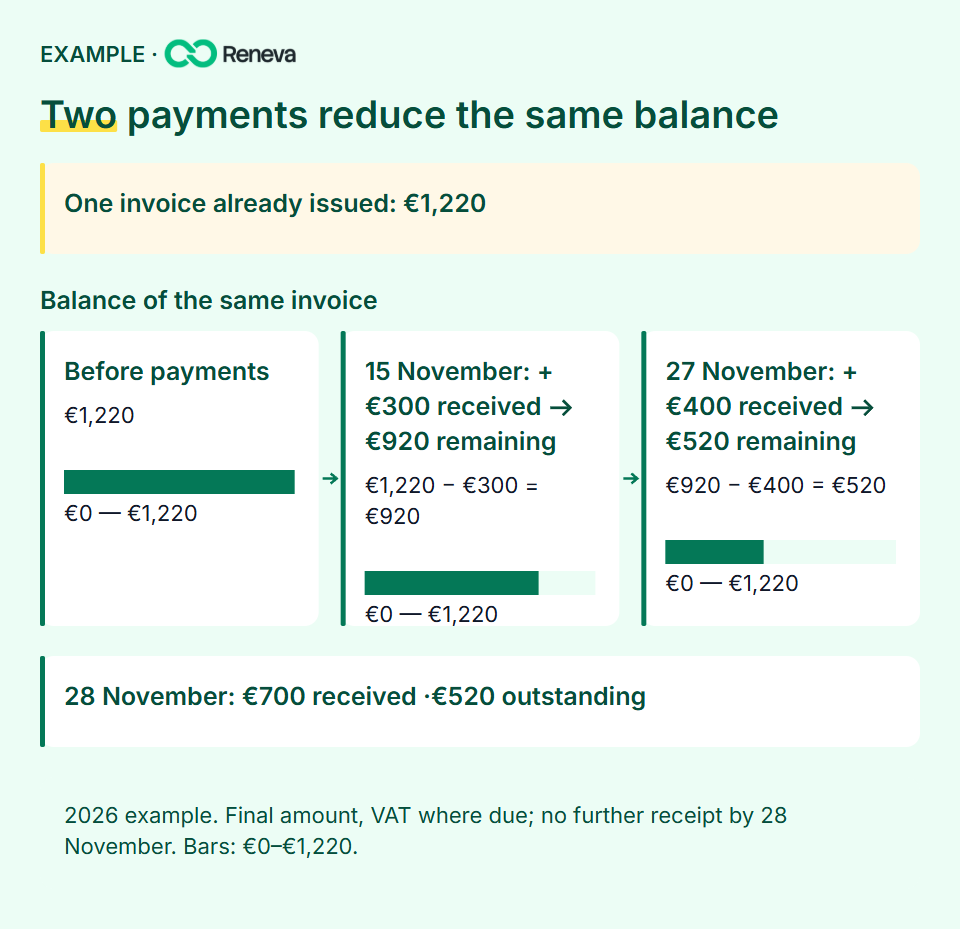
Consider a hypothetical timeline in November and December 2026. An invoice has already been issued for €1,220 payable by the client. That is the final monetary amount in this example, including VAT where applicable. There is no withholding tax, fee, interest, credit note or dispute to account for in the calculation.
The first payment of €300 arrives on 15 November. Receipt of the second, €400, is verified on 27 November.
| Point in the example | New verified payment received | Total received against the invoice | Remaining balance |
|---|---|---|---|
| Before any payments | €0 | €0 | €1,220 |
| 15 November 2026 | €300 | €300 | €920 |
| 27 November 2026 | €400 | €700 | €520 |
| Check on 28 November 2026 | No further payment | €700 | €520 |
After the first payment: €1,220 − €300 = €920. After the second: €920 − €400 = €520. Checking the total gives the same result: €1,220 − €700 = €520.
As at 28 November, you can therefore say that you have received €700 and are still waiting for €520. The invoice total remains €1,220. What changes is the split between the amount received and the remaining balance.
An expected final payment is not a third payment received
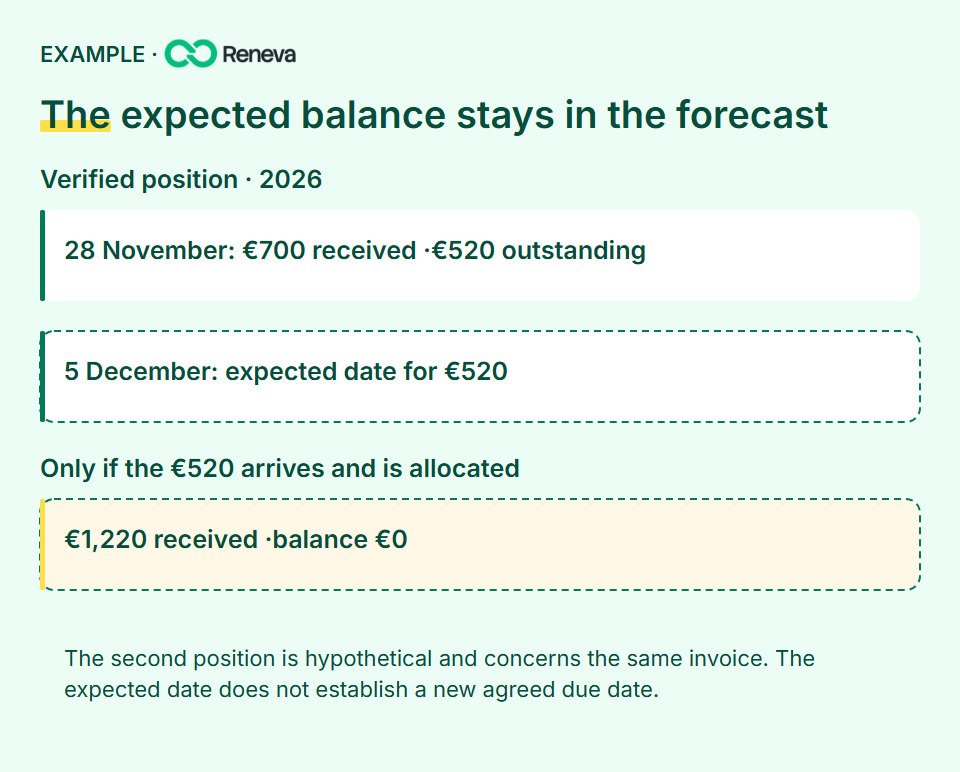
Suppose the remaining €520 is expected on 5 December. At the check on 28 November, that is still an expected date. You do not add the €520 to payments received or reduce the balance to zero.
Now consider a further hypothetical event: on 5 December, the €520 actually arrives and is allocated to the same invoice. Only then does the calculation become €520 − €520 = €0. Total payments received are €300 + €400 + €520 = €1,220, and the amount has been paid in full.
Keep and follow up a date communicated by the client, but do not treat it as automatically replacing the agreed payment deadline. To establish whether any amount is also overdue, compare the remaining balance with the relevant due dates, rather than only with the expected date of the last payment.
If part is missing, check why
A smaller payment may be an agreed instalment, or it may come with a request for a change or a complaint. Clarify the situation before treating the difference as a discount, a waiver of the balance or an extension of the payment deadline.
In our example, the partial payments are agreed. The calculation does not give the client a unilateral right to reduce what they owe. If the fee changes or a dispute arises, keep the records and check separately how to deal with the amount owed and the documents.
If you need an update, use a payment reminder that states what has already arrived and only the amount still outstanding. At the check on 28 November, asking for the full invoice total again would ignore the €700 already received.
Check that €400 does not become €800 in your records
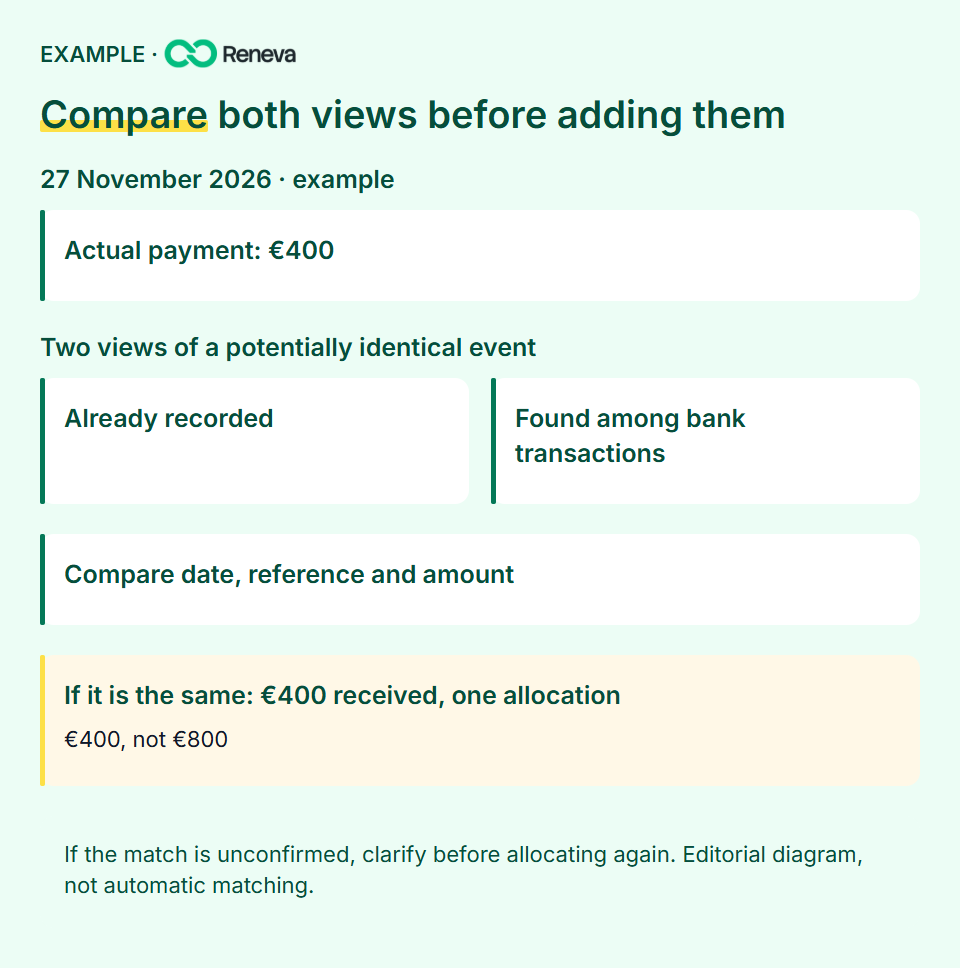
Suppose you have entered the €400 payment in your records and later find it among bank transactions waiting to be allocated. Before entering it again, compare the date, reference and amount: you may be looking at the same money.
Entering one €400 payment twice does not mean you have received €800. The records need to reflect a single allocation of the actual payment. If you find a duplicate, reconstruct what was entered and use the appropriate correction process, keeping the real payment identifiable.
If you use Reneva, the Partial payments and the remaining balance guide distinguishes two actions: Record the payment on a row settles that due-date row in full, while a bank match for less than the amount due can leave it open with a remaining balance. In Payments, you can see what has arrived and what is still to come, separately from the invoice total.
After each update, check that the invoice, allocated payments and remaining balance agree. At the date of your check, you should be able to state how much has actually arrived and how much is still only expected.


