

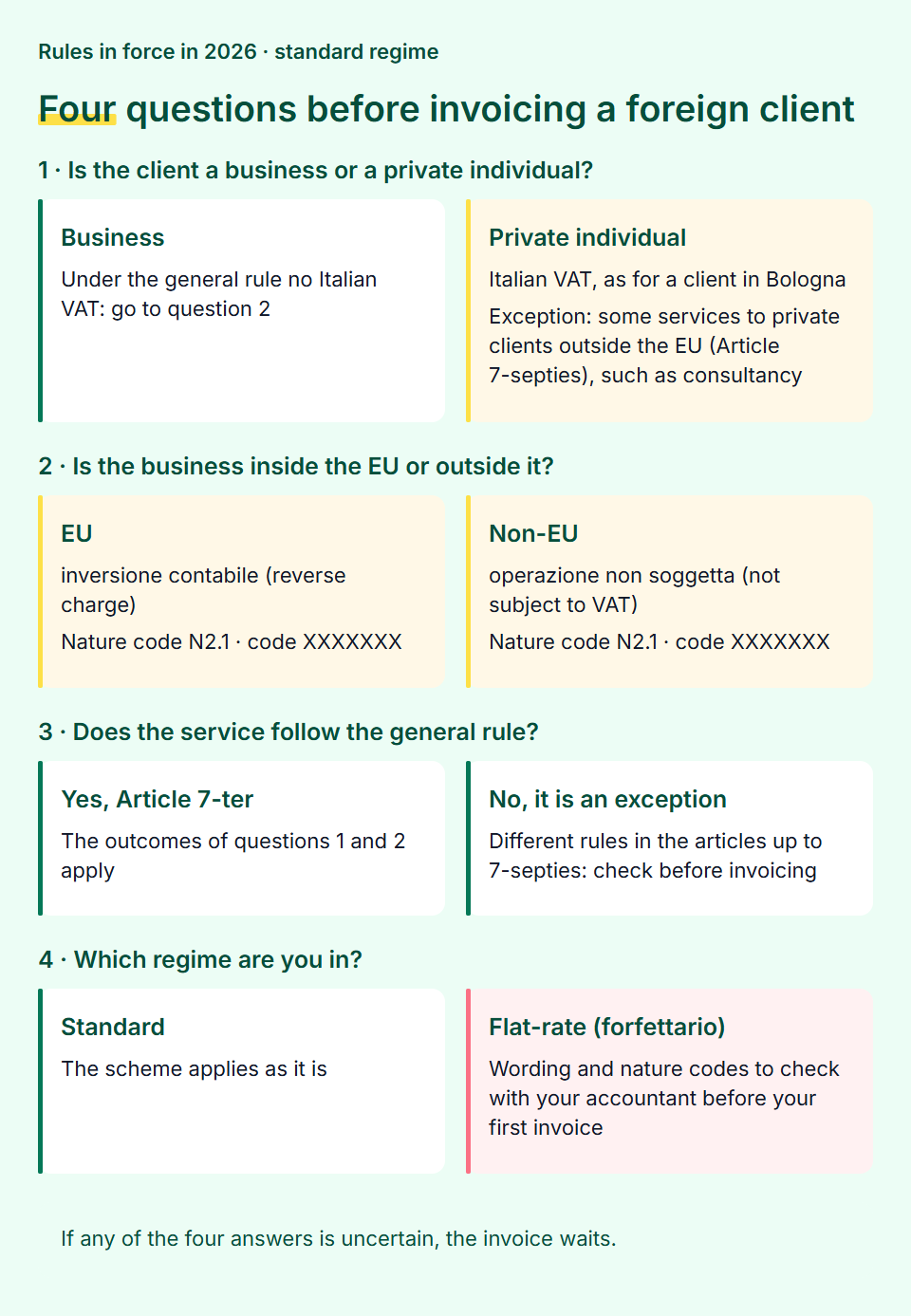
Before you issue an invoice for a service sold abroad, you need four answers: is the client a business or a private individual, are they inside the European Union or outside it, what service are you selling, and which tax regime are you in. If the client is a foreign business and the service follows the general rule, Italian VAT (IVA) does not apply: you write inversione contabile (reverse charge) for an EU business and operazione non soggetta (transaction not subject to VAT) for a non-EU one, with nature code N2.1 and recipient code XXXXXXX in both cases. For an EU business, the invoice must be issued by the 15th of the following month.
The rules below are those in force in 2026 and apply to the regime ordinario, Italy's standard VAT and income tax regime.
This guide, also as a PDF
Subscribe to the newsletter: once you confirm from the link in the email, the PDF guide opens.
This site is protected by reCAPTCHA and the Google Privacy Policy and Google Terms apply.

The example: two invoices from November 2026
This example is made up. Giulia runs a small web development studio in Bologna under the standard regime. In November 2026 she completes two identical jobs: a website for a company in Munich and one for a company in Lugano. Same service, same price, €3,000 each.
The two invoices look alike, but they are not the same.
| German business (EU) | Swiss business (non-EU) | |
|---|---|---|
| Taxable amount | €3,000.00 | €3,000.00 |
| Italian VAT | €0.00 | €0.00 |
| Total | €3,000.00 | €3,000.00 |
| Wording on the invoice | inversione contabile | operazione non soggetta |
| Nature code | N2.1 | N2.1 |
| Recipient code | XXXXXXX | XXXXXXX |
| Deadline to issue | by 15 December 2026 | ordinary deadlines |
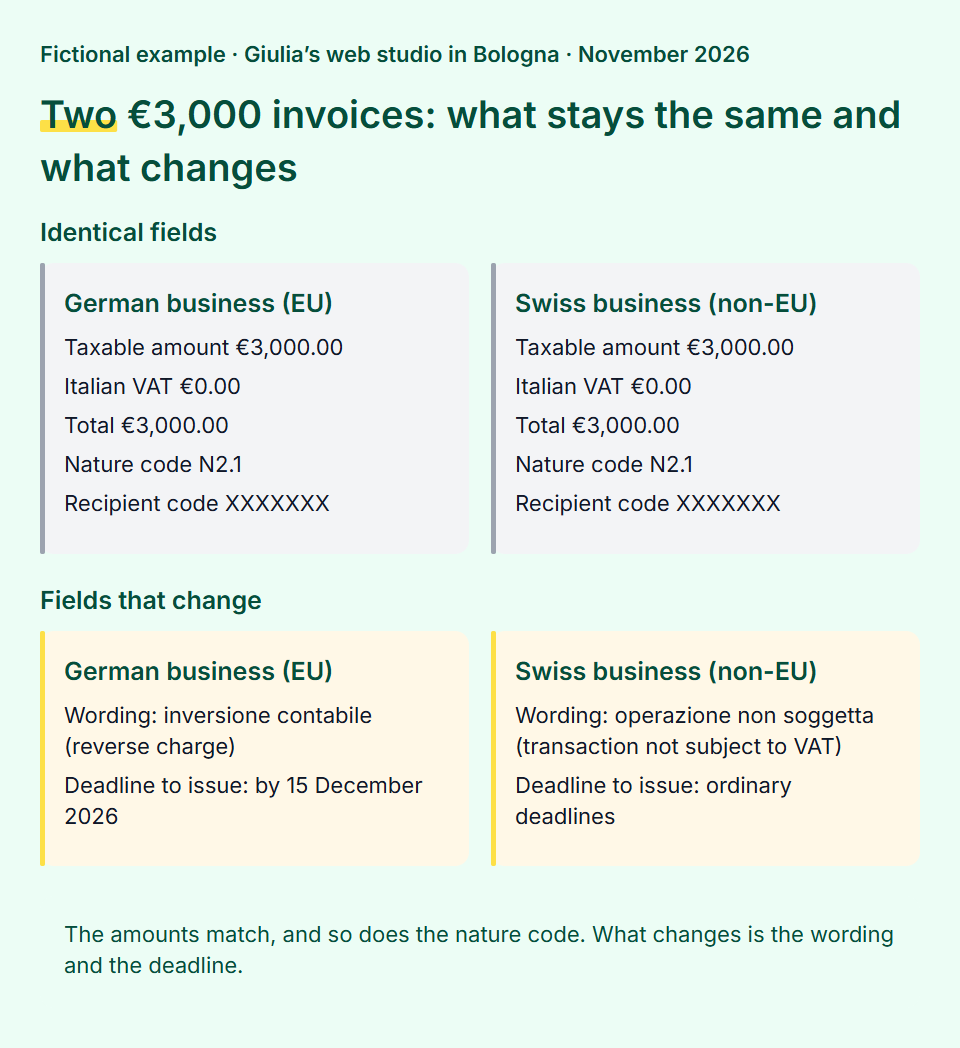
The amounts match, and so does the nature code. What changes is the wording and the deadline. To get to this table Giulia asked herself four questions, always in the same order.
1. Is the client a business or a private individual?
This question decides almost everything. For services that follow the general rule, Article 7-ter of Presidential Decree 633/1972, Italy's VAT law, looks first at who is buying.
If the client is a taxable person, meaning a business or professional buying for their own activity, the service is taxable in Italy only when it is supplied to taxable persons established in Italy. A company in Munich or Lugano is not established in Italy. So no Italian VAT.
With a private individual the rule flips. The service is taxable in Italy when the supplier is established in Italy: if Giulia built the same website for a private person in Munich, she would charge Italian VAT just as she would for a client in Bologna.
2. Inside the EU or outside it?
For a business, the country does not change the outcome: there is still no Italian VAT. It does change what you write. Article 21, paragraph 6-bis requires two different annotations, which go on the invoice in Italian:
- for a business in another EU country, inversione contabile: the client accounts for VAT in their own country, under their own rules;
- for a business outside the EU, operazione non soggetta.
For a private individual, the country matters because of an exception. Article 7-septies lists services that, when supplied to private individuals outside the EU, are not treated as supplied in Italy: among them consultancy, advertising, and data processing and supply. Consultancy for a private client in New York, for example, falls outside Italian VAT even though the client has no business.
3. What service are you selling?
Article 7-ter is the general rule. Other articles of the same decree, up to 7-septies, set different rules for specific services, and nature code N2.1 refers to all of them together. Before invoicing, check that your service is not one of the exceptions. With a business client the general rule is the usual case; with a private client outside the EU, the difference between a website and a consultancy can move the VAT from due to not due.
In the example, Giulia checked that building the two websites follows the general rule. That is why both invoices start from the same basis.
4. Which regime are you in?
Everything above refers to the standard regime. Under the forfettario, Italy's flat-rate regime for sole traders and freelancers, this scheme is not enough: the wording and nature codes on an invoice to a foreign client are the point to check with your commercialista (accountant) before your first invoice, together with the classification of your service if you are unsure about step 3.
If you are the one buying services from a foreign supplier, that is a different topic, covered in our article on reverse charge for flat-rate taxpayers.
What goes into the electronic invoice
Invoices to foreign clients also go through the SdI (Sistema di Interscambio), the Revenue Agency's e-invoicing exchange system. Article 1, paragraph 3-bis, of Legislative Decree 127/2015 requires data on transactions with foreign parties to be sent through the SdI within the deadline for issuing the invoice. For a service invoiced in XML, you do this by issuing the invoice itself. The paragraph was amended on 12 August 2026: if you look it up, read the version in force on the date of your invoice.
The file needs three things an Italian invoice usually does not have:
- recipient code XXXXXXX, which the Revenue Agency's technical specifications (version 1.9.1 of 31 March 2026) require for invoices issued to parties not established in Italy;
- nature code N2.1 on the zero-VAT line, described as transactions not subject to VAT under Articles 7 to 7-septies of Presidential Decree 633/1972;
- the wording from step 2, inversione contabile or operazione non soggetta.
With code XXXXXXX the client has no Italian channel to receive the file: you send them a copy yourself, in the format you have agreed. If e-invoicing is still new to you, start with how it works for freelancers.
Deadlines: the 15th only applies to the EU
For services supplied under the general rule to a business in another EU country, Article 21, paragraph 4, letter c) says the invoice is issued by the 15th of the month after the month in which the transaction takes place. For Giulia, with a transaction in November 2026, the German invoice must be issued by 15 December 2026.
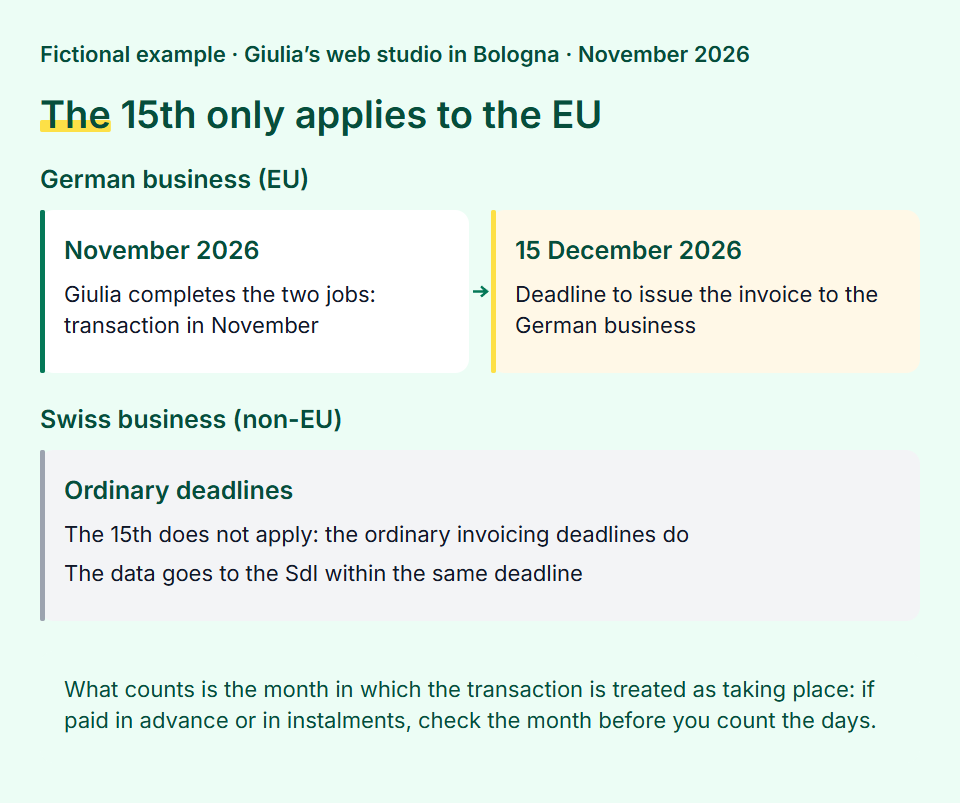
The month that counts is the one in which the transaction is treated as taking place, and for services that moment has its own rules, not covered here. If the job was paid in advance or split into instalments, check the month before you count the days.
For the Swiss invoice the 15th does not apply: the ordinary invoicing deadlines do (they depend on when the transaction takes place and are not covered here), and the data goes to the SdI within the same deadline.
Intrastat returns, stamp duty and VIES checks are not covered here. For stamp duty on invoices without VAT, see our article on stamp duty on electronic invoices.
The checklist before you issue
Before you hit "send" on an invoice to a foreign client, go back over four lines:
- business or private individual;
- EU or non-EU;
- general rule or exception for that service;
- standard or flat-rate regime.
The answers lead to the wording, the nature code, the recipient code and the deadline. If any of the four is uncertain, the invoice waits. Once it has been sent it can no longer be edited: a mistake is corrected with a credit note and a new document.
In Reneva
The VAT menu on each line item is the same for Italian and foreign clients: for a line without VAT you choose the nature code, and N2.1 is available for foreign companies and for private clients outside the EU. Until every line with an amount has its VAT treatment, the invoice cannot be issued, and a rate and nature code that do not match stop it too. The choice of treatment stays with you: Reneva does not decide the tax case on its own.
From 2027
From 1 January 2027 the rules quoted here move to the new Consolidated VAT Act (Testo unico IVA, Legislative Decree 10/2026). The general rule becomes Article 17, the Article 7-septies exceptions become Article 22, the invoice wording Article 72, paragraph 7, the 15th-of-the-month deadline Article 72, paragraph 4, letter c), and transmission through the SdI Article 77, paragraph 4. In the text published in the Official Gazette, the content of these provisions stays the same; only the numbers change. The description of nature code N2.1 in the technical specifications still refers to Presidential Decree 633/1972: check the version of the specifications in force when you invoice.


