

If in 2026 you collect more than €85,000 in fees but stay within €100,000, you remain in the forfettario (Italy's flat-rate tax regime for sole traders and freelancers) until 31 December 2026 and move to the standard regime from 1 January 2027. If you go above €100,000 you leave straight away, in the same year, and VAT applies from the transaction that takes you over the threshold. Both figures stay the same in the new consolidated code that applies from 2027.
Below you will find the two rules with their sources, a case with a graphic designer's month-by-month receipts in 2026, and the employment income condition, where the 2027 figure is still unclear.
This guide, also as a PDF
Subscribe to the newsletter: once you confirm from the link in the email, the PDF guide opens.
This site is protected by reCAPTCHA and the Google Privacy Policy and Google Terms apply.

The two thresholds in 2026
The forfettario regime has two fee limits, and they do different jobs.
€85,000: decides the following year. Law 190/2014, art. 1 paragraph 54 letter a) admits to the regime those who in the previous year received fees, scaled to a full year, not exceeding €85,000. It is a condition both for joining and for staying. What you collect in 2026, then, decides whether you can still use the forfettario regime in 2027.
€100,000: decides the current year. Paragraph 71 of the same law ends the regime in the very year in which revenue or fees received exceed €100,000.
In between lies the band that raises most questions. The Italian Revenue Agency (Agenzia delle Entrate), in Circular 32/E of 5 December 2023 (paragraphs 2.1 and 4.1), explains that an amount above the €85,000 limit but below the €100,000 limit does not affect staying in the forfettario regime for that year: you stay until 31 December and leave from the following year. Above €100,000, on the other hand, VAT applies from the transaction that takes you over the threshold.
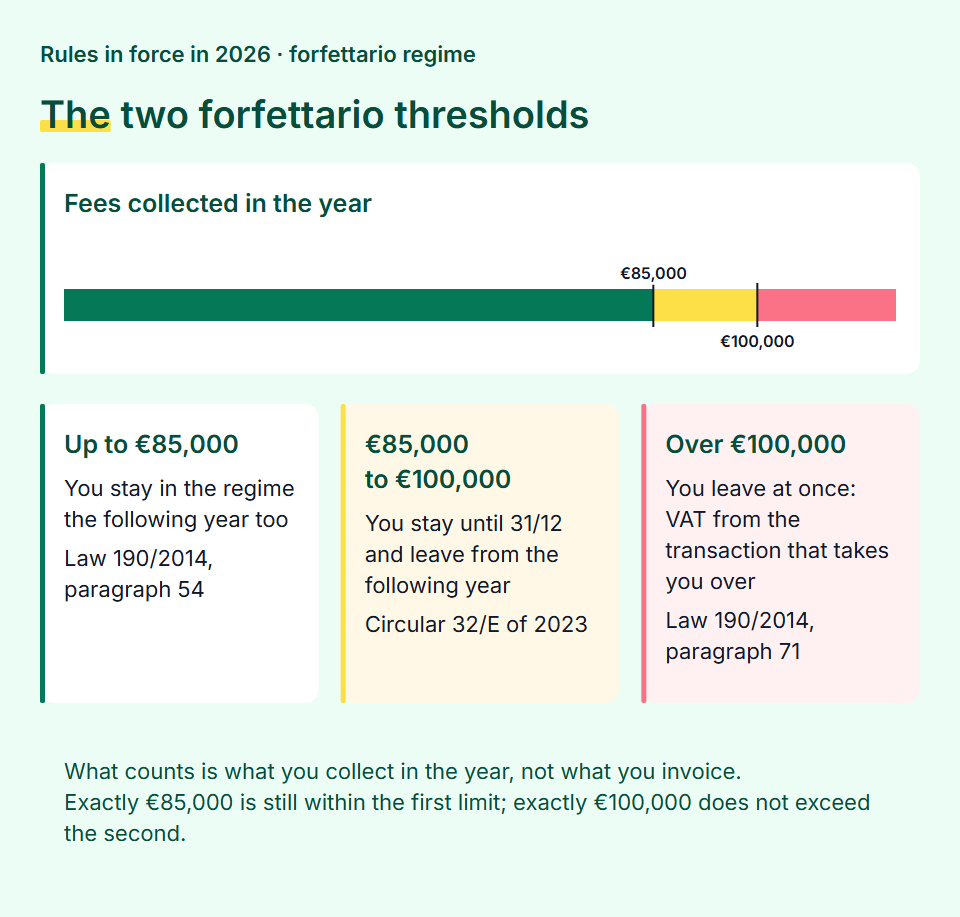
Two points on the wording. The law says "not exceeding" and "exceeding": exactly €85,000 is still within the first limit, and exactly €100,000 does not exceed the second. And for those paid in fees, such as professionals, the word is "received": what counts is what you collect in the year, not what you invoice. The difference between the two, which matters a lot here, is explained in the article on invoiced versus collected.
The case: a graphic designer's receipts in 2026
The case is invented. Elena is a graphic designer on the forfettario regime. These are the fees she collected month by month in 2026, with the running total.
| Month 2026 | Collected in the month | Running total |
|---|---|---|
| January | €6,000 | €6,000 |
| February | €7,500 | €13,500 |
| March | €8,000 | €21,500 |
| April | €6,500 | €28,000 |
| May | €9,000 | €37,000 |
| June | €7,000 | €44,000 |
| July | €8,500 | €52,500 |
| August | €3,000 | €55,500 |
| September | €9,500 | €65,000 |
| October | €10,000 | €75,000 |
| November | €12,000 | €87,000 |
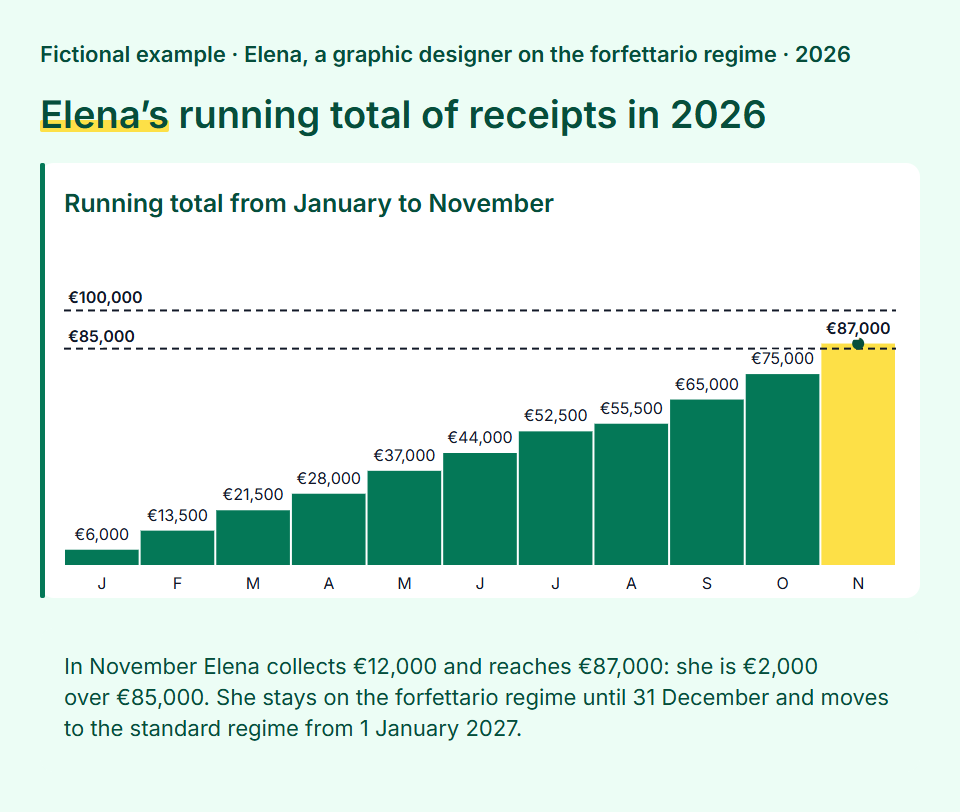
Where she passes €85,000. At the end of October Elena is at €75,000, €10,000 below the first threshold. In November she collects €12,000 and reaches €87,000: she is €2,000 over €85,000. For 2026 nothing changes: she stays on the forfettario regime until 31 December. From 1 January 2027 she moves to the standard regime.
How much room she has below €100,000. After November the margin is €13,000 (100,000 − 87,000). In December Elena is expecting two payments: first the balance for a brand identity project worth €9,000, then, towards the end of the month, a packaging project worth €6,000.
| December scenario | 2026 total | Outcome |
|---|---|---|
| Collects only the €9,000 balance | €96,000 | Stays on forfettario until 31/12/2026, leaves from 2027 |
| Collects the balance and the €6,000 project | €102,000 | €2,000 over €100,000: leaves in 2026 |
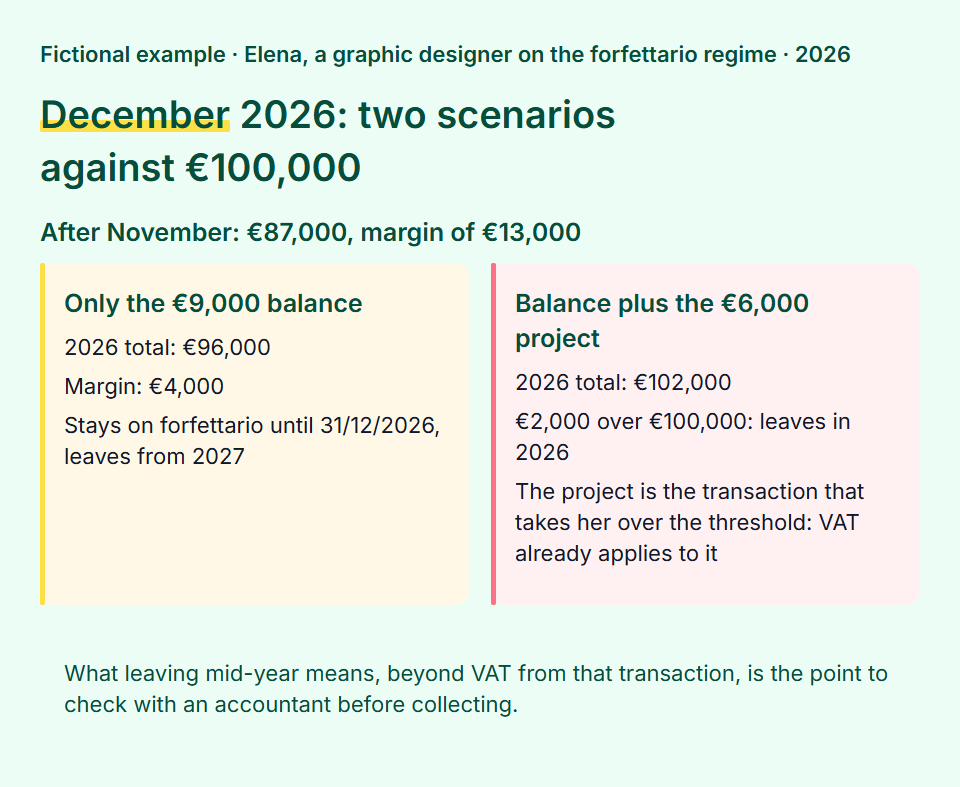
With the balance alone Elena reaches €96,000 and has €4,000 of margin left. The €6,000 project exceeds that margin by €2,000: it is the transaction that takes her over the threshold, and VAT already applies to it.
The case also shows why it pays to look at expected receipts, not only those already in. At the end of October €75,000 looked far from both thresholds; with the payments expected in November and December Elena was already at €102,000. A receipts forecast, like the one described in the article on the cash flow forecast, shows the problem a month or two ahead.
What leaving mid-year means for Elena, beyond VAT from that transaction, is the point to check with her accountant (commercialista) before collecting: it depends on her situation, and the sources used here do not describe it.
The monthly check
To avoid discovering the threshold in December, three figures updated at the end of each month are enough.
- Collected since the start of the year. Only fees that have reached your account, with the date of receipt. Invoices issued and not yet paid do not count here yet.
- Receipts expected by 31 December. Balances, instalments and deposits the client has already agreed, each with the month it should arrive.
- Margin below €100,000. It is 100,000 minus the sum of the first two figures. If it comes out negative, one of the expected receipts will take you over the threshold, and by putting them in date order you already know which.
In Elena's case, at the end of October the three figures were €75,000, €27,000 (12,000 + 9,000 + 6,000) and minus €2,000: the signal was there two months early.
Employment income: the other threshold to check
Alongside the fee limits there is an exclusion linked to employment income. Paragraph 57 letter d-ter) of Law 190/2014 excludes from the regime those with employment income exceeding €30,000, and specifies that the check is irrelevant if the employment has ended. For 2025 and 2026 that limit is higher: Law 207/2024, paragraph 12, as amended by Law 199/2025, says that for 2025 and 2026 the limit is raised to €35,000.
From 2027 the rule moves to art. 233 paragraph 1 letter f) of the consolidated income tax code (Legislative Decree 117/2026), which again states €30,000 and keeps the rule that the check does not count if the employment has ended. We have found no rule extending the €35,000 figure to 2027. The sources we read do not say which limit applies to those joining or staying in the regime in 2027 on the basis of 2026 income, and we do not infer it: the 2027 budget law should be checked again in December.
There is also a second, related exclusion: working mainly for your current employer or a recent one (paragraph 57 letter d-bis). From 2027 it moves to art. 233 paragraph 1 letter e) of the consolidated code, whose paragraph 2 adds an exception: if it concerns you, check its text. If you have an employment relationship in progress or recently ended and your main client is your employer, check this one too.
What changes from 2027
For the two fee thresholds, nothing in the figures. From 1 January 2027 the forfettario rules move to the consolidated income tax code, Legislative Decree 117/2026. The €85,000 is in art. 232 paragraph 1 letter a), with the same "not exceeding €85,000" wording. The €100,000 is in art. 238 paragraph 1, which says that above €100,000 VAT is due. The text we read is the one published in the Official Journal (Gazzetta Ufficiale); the updated versions following the 2026 amendments should be checked again in January.
For Elena, then, the consequence of her €87,000 in November 2026 already reads under the new text: from 2027 she needs the condition in art. 232, and she does not meet it.
If you charge the INPS 4% surcharge and want to see how a forfettario invoice is put together, the full calculation is in the article on the INPS 4% surcharge.
Thresholds in Reneva
In Reneva threshold alerts arrive in the bell and by email, with no option to turn on, when actual receipts in the current year exceed €80,000, €85,000 or €100,000, including receipts outside Reneva confirmed in the annual data. Forecasts never trigger them: only money that has arrived counts. Reneva does not change the regime by itself: the alert flags the threshold, and the choices remain yours.


