

Cash flow measures money actually coming in and going out during a period. To understand it, gather the transactions that happened and check where the money came from and what it paid for. A client payment and a loan both increase available money, but they tell different stories.
A balance is the money held at a particular date, such as the beginning or end of January. The month's cash flow explains how that balance changed, provided you include all the transactions and the same accounts.
This guide, also as a PDF
Subscribe to the newsletter: once you confirm from the link in the email, the PDF guide opens.
This site is protected by reCAPTCHA and the Google Privacy Policy and Google Terms apply.

Choose the period and which accounts to include
Before calculating, choose the month or date range and the money you are tracking: one account, all business accounts, or accounts and cash on hand together. Use the same scope for the opening balance, transactions and closing balance.
For each transaction, record the actual date, amount received or paid, and reason. An unpaid invoice is not an inflow that has already happened; an expected payment belongs in a forecast. To separate client documents from payments first, see the difference between invoiced sales and money received.
Gather other inflows and all outflows too: suppliers, other expenses, taxes paid, equipment purchases and financing transactions. To reconstruct the money, use the final amounts actually transferred, including VAT where due.
A month with client payments, outflows and a loan
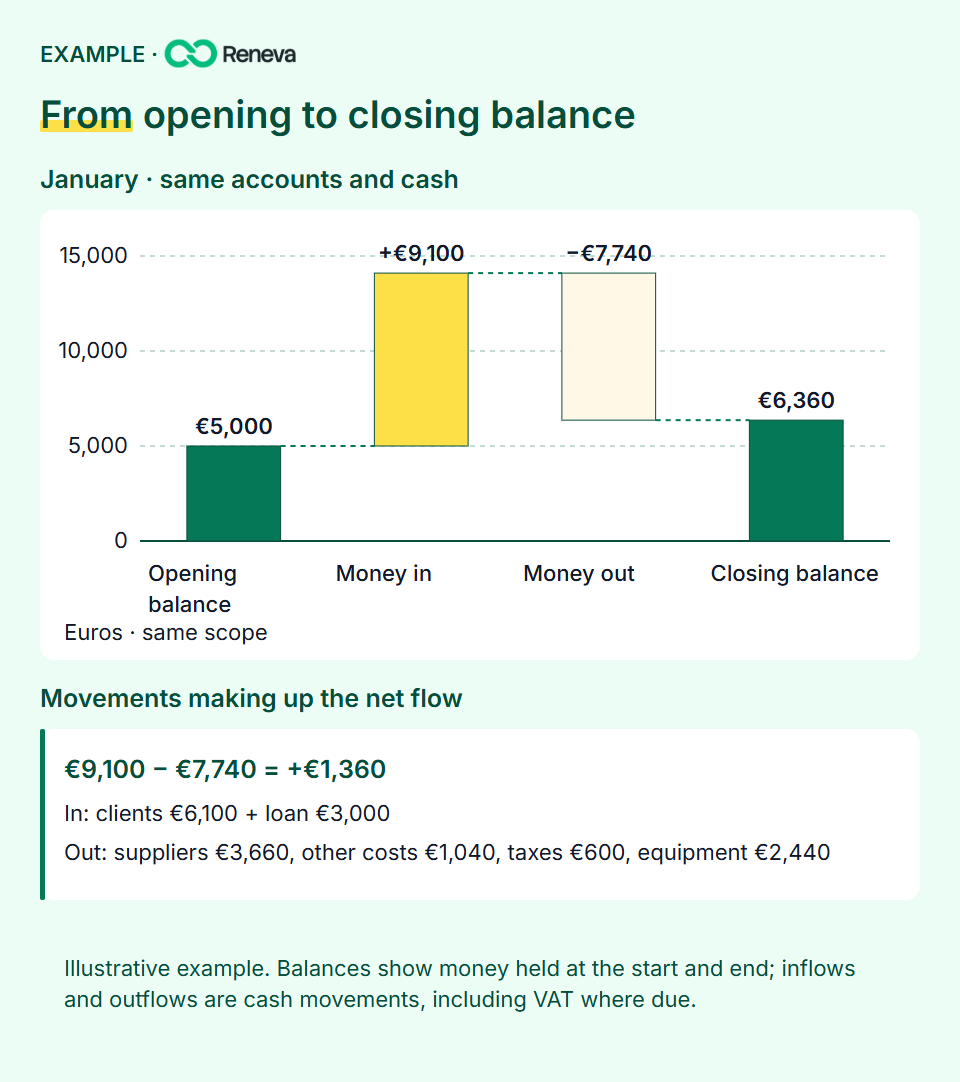
For this separate hypothetical example, take an agency in January, using euros. We include all its accounts and cash on hand. Its combined opening balance is €5,000.
The following transactions took place during the month:
| Actual January transaction | Money in | Money out |
|---|---|---|
| Payments received from clients | €6,100 | — |
| New loan received | €3,000 | — |
| Payments to suppliers | — | €3,660 |
| Other costs paid | — | €1,040 |
| Taxes paid | — | €600 |
| Equipment purchase paid for | — | €2,440 |
| Transaction totals | €9,100 | €7,740 |
These are final cash amounts, including VAT where due. The €600 in taxes is a hypothetical payment whose amount has already been determined. We are not calculating it from invoice VAT, and we count it only once. There are no other transactions or exchange-rate changes in the example.
Now calculate the net flow:
Money in − money out = €9,100 − €7,740 = €1,360.
The money within our chosen scope increased by €1,360. Check the closing balance:
Opening balance + net flow = €5,000 + €1,360 = €6,360.
Compare that €6,360 with the actual combined balances at the end of January, covering the same accounts and cash on hand. If they differ, look for a missing or duplicated transaction, a transaction assigned to another date or an incomplete opening balance.
Look at where the increase came from
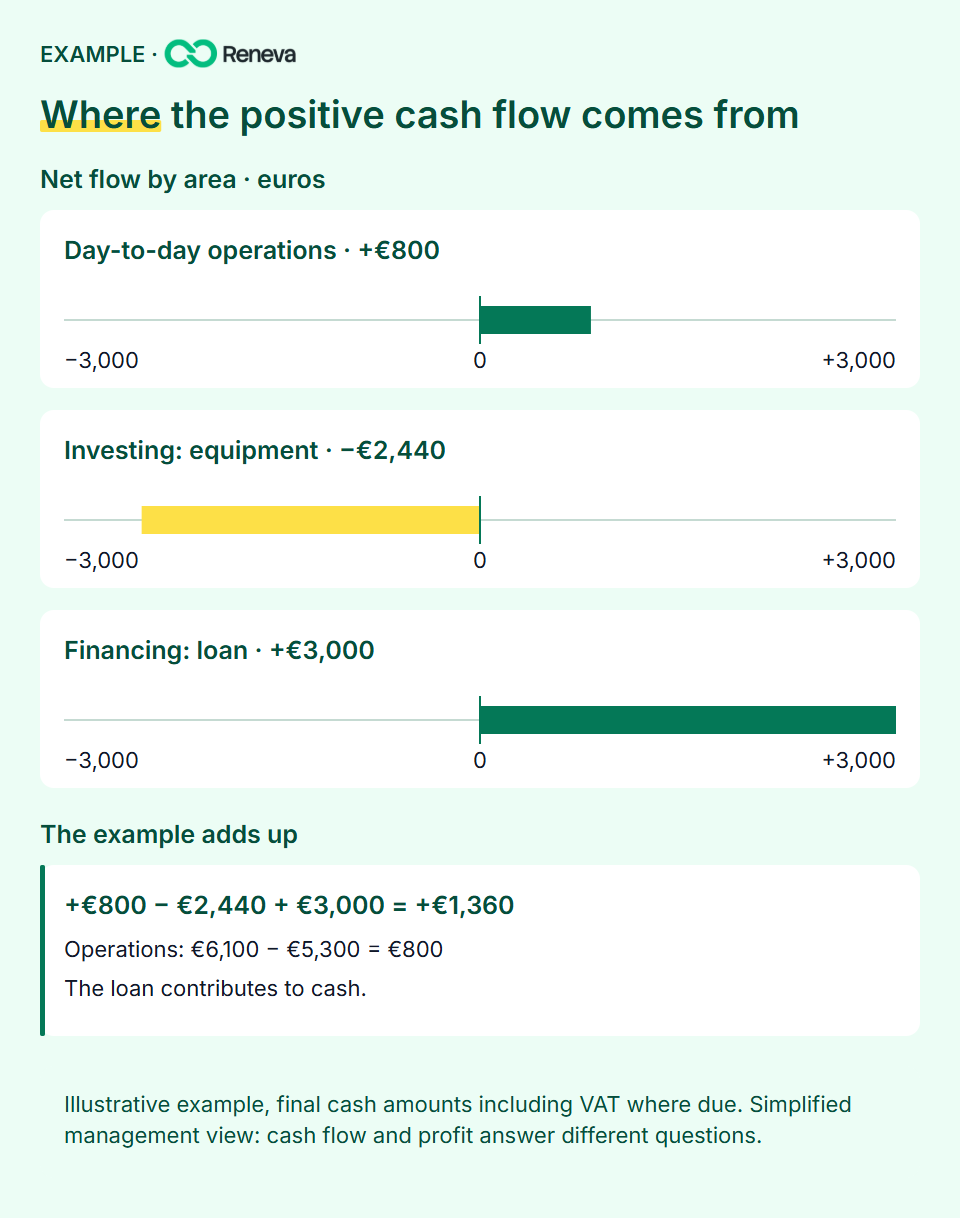
The overall result is positive in this example. To interpret it, separate the cash connected with day-to-day operations, investing and financing. These are the three areas also identified in OIC 10, the Italian accounting standard on cash flow statements. Here we use them in a simplified management table, not to prepare a complete statutory cash flow statement.
| Area in this example | Transactions included | Net cash flow |
|---|---|---|
| Day-to-day operations, also called operating activities | €6,100 from clients less €3,660 to suppliers, €1,040 in other costs and €600 in taxes | +€800 |
| Investing | Equipment purchase | −€2,440 |
| Financing | Loan received | +€3,000 |
| Total | €800 − €2,440 + €3,000 | +€1,360 |
Cash flow from day-to-day operations is €6,100 − €5,300 = €800, because suppliers, other costs and taxes paid total €5,300. The equipment purchase uses €2,440; the loan brings in €3,000.
The loan increases cash, but it is not revenue. A positive total therefore does not mean the agency earned €1,360 from the month's services. To understand profit, you need revenue, costs and the rules for recognising them. To understand cash, you need to reconstruct receipts and payments.
A negative cash flow also needs its causes examined. An equipment purchase can use money without proving poor management on its own. The sign of the total does not replace looking at the transactions.
A transfer between your accounts creates no additional money overall
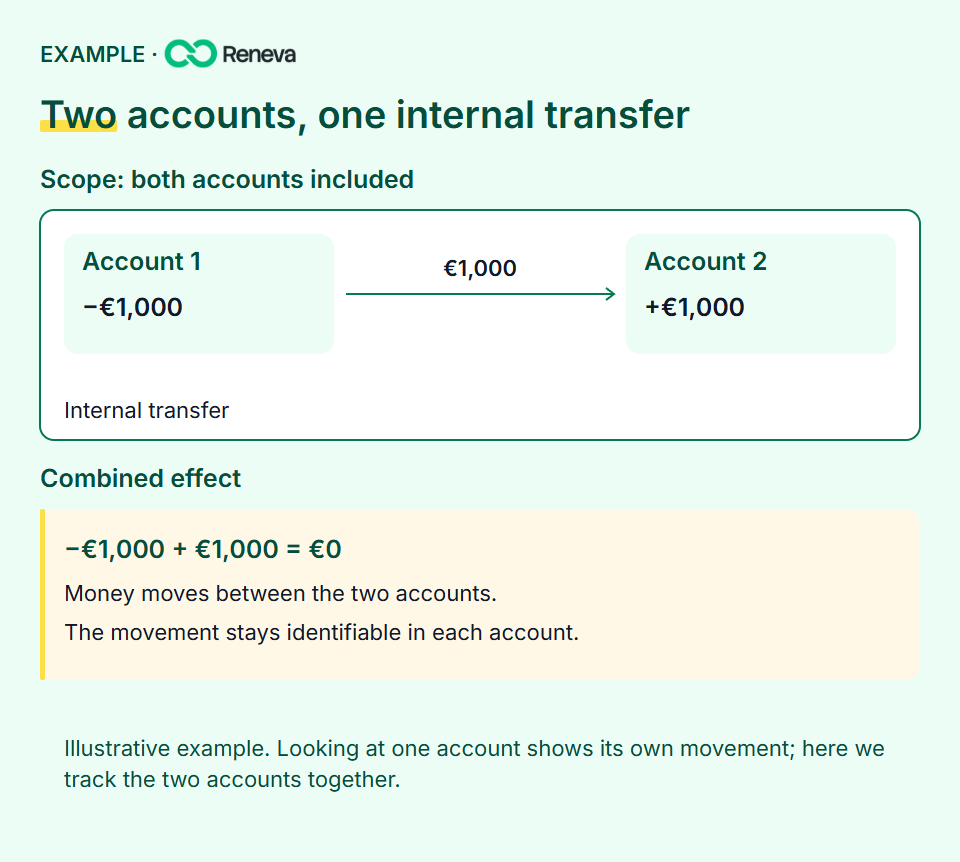
Suppose you transfer €1,000 from one agency account to another, with both accounts already included in the scope. One account shows money out and the other shows money in. The combined amount available stays the same.
Keep the internal transfer recognisable in the combined calculation. Do not present it as a new client receipt or a new business expense. Its effect on the overall net flow is zero. If you examine only one account, you will see the movement on that account. That is why you need to define which accounts you are including first.
Check the balance before looking ahead
Once you have compared balances and transactions, use the completed month to understand what used cash and which inflows contributed to the result. In Reneva's Analysis page, choose the tab and period to read Cash from the data recorded. The Analysis page guide explains the available views. Check which transactions you have recorded before comparing them with your accounts.
For upcoming due dates, keep a forecast separate from amounts that have already moved. A cash flow forecast uses expected dates and amounts. Do not add them to actual transactions as if the money had already come in or gone out. That guide also has a free weekly Excel template to download.
The example's €6,360 closing balance does not tell you how much you can spend without considering future commitments. A monthly result can also hide days with less money available. Before deciding to make a payment, check when it must go out and how much money you expect to have then, keeping forecasts and actual results distinct.


