

To set the price of a recurring service, define the work included each month, estimate all the hours it takes and add the costs the service uses. Then compare your proposed price with the value for the client and test the calculation with a heavier workload.
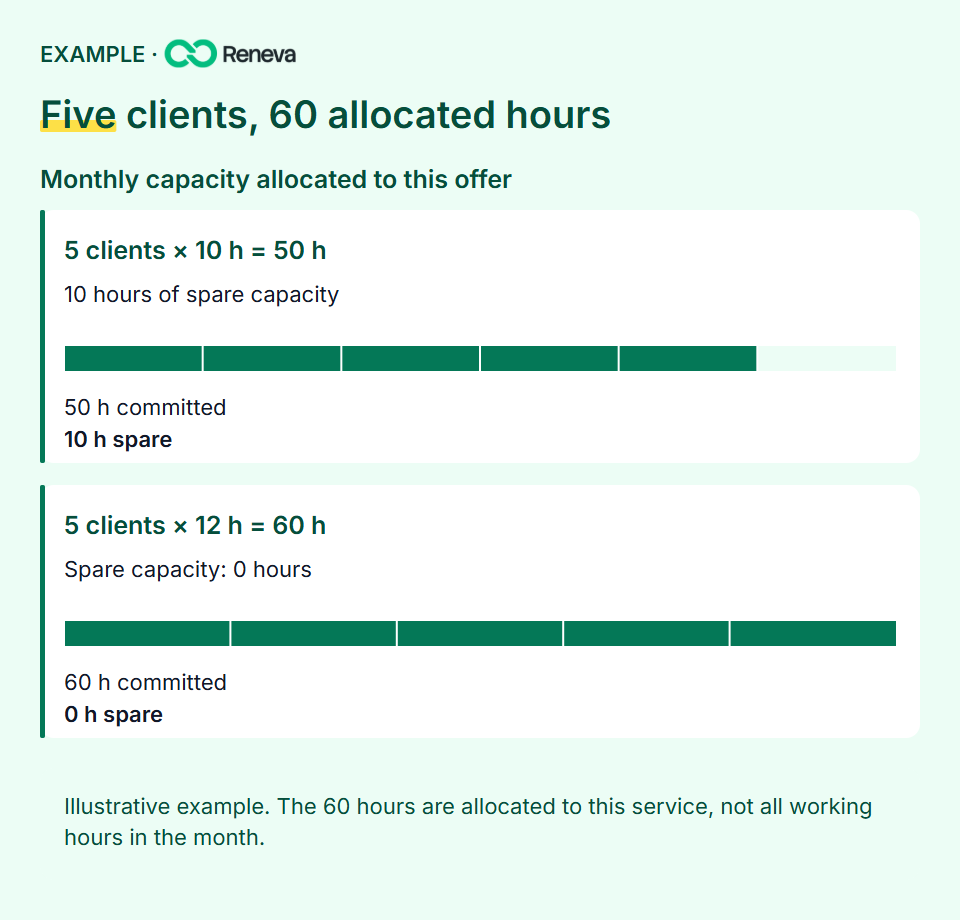
Check the calendar too. Five clients who each need ten hours take up fifty hours; at twelve hours each, they need sixty. The price on the quote can stay the same while your available time runs out.
This guide, also as a PDF
Subscribe to the newsletter: once you confirm from the link in the email, the PDF guide opens.
This site is protected by reCAPTCHA and the Google Privacy Policy and Google Terms apply.

Define what repeats before setting the price
The client needs to know what they receive each period. “Monthly reporting and support” is a starting point. To price it, specify what goes into the report, the analysis, the discussion with the client and the support included.
Define what can change the workload: how many meetings you include, which revisions are covered and how you handle new requests. If you sell reserved availability, explain when you reserve it and for which tasks. A monthly fee does not give you unlimited time to spend on the client.
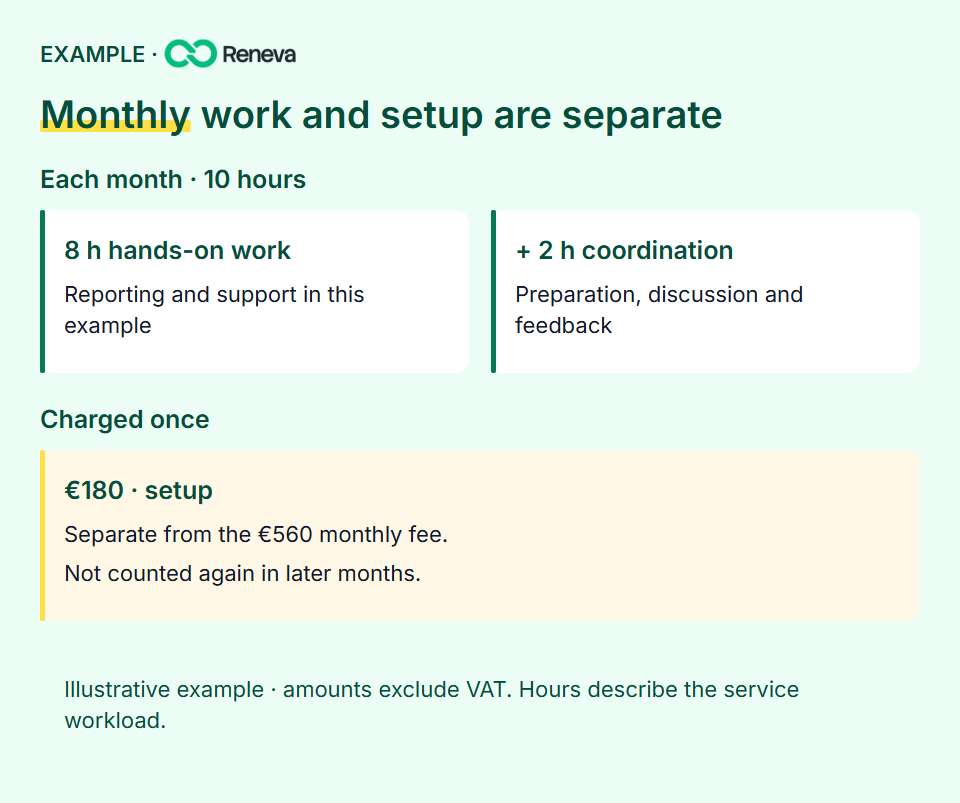
Separate the initial work from a normal month. Collecting access details, setting up the first report or reconstructing the initial data may take work that does not repeat every month. You can quote for it separately or include it in the monthly price using an explicit method. Avoid charging for it separately and counting it again in the monthly fees.
If you still need to define the working arrangement, start with how to structure a service retainer. Here, the service is already described: the task is to check its numbers.
Count coordination and shared costs too
Include both the hands-on work and the time needed to make it useful: preparing the discussion, collecting feedback, answering requests within scope and coordinating the people involved. Your own time has a cost in the internal calculation even when you are not paying an outside contractor.
The internal cost of an hour helps you assess the resources used. It is different from the hourly rate you quote to a client. The freelance hourly rate calculation starts with the revenue you need and the hours you can sell over a year. The monthly calculation for one recurring service has a different purpose.
Check which expenses your hourly cost already includes. Adding the same overheads again would overstate the service's cost. If you allocate a share of common costs to each client, use a method you can explain and revise. Not every expense can be assigned precisely to one job.
A monthly example with ten hours
Take a hypothetical reporting and support service. We estimate eight hours of hands-on work and two hours of coordination, making ten hours a month.
The internal cost chosen for this example is €35 an hour. It excludes the other two amounts we will add: €40 a month in direct costs and €30 in allocated shared costs. All amounts in the comparison exclude VAT.
| Monthly item for one client | Calculation | Cost included |
|---|---|---|
| Hands-on work and coordination | 10 hours × €35 | €350 |
| Direct costs | Monthly assumption | €40 |
| Share of common costs | Monthly assumption, not already included in the €35 hourly cost | €30 |
| Total | €350 + €40 + €30 | €420 |
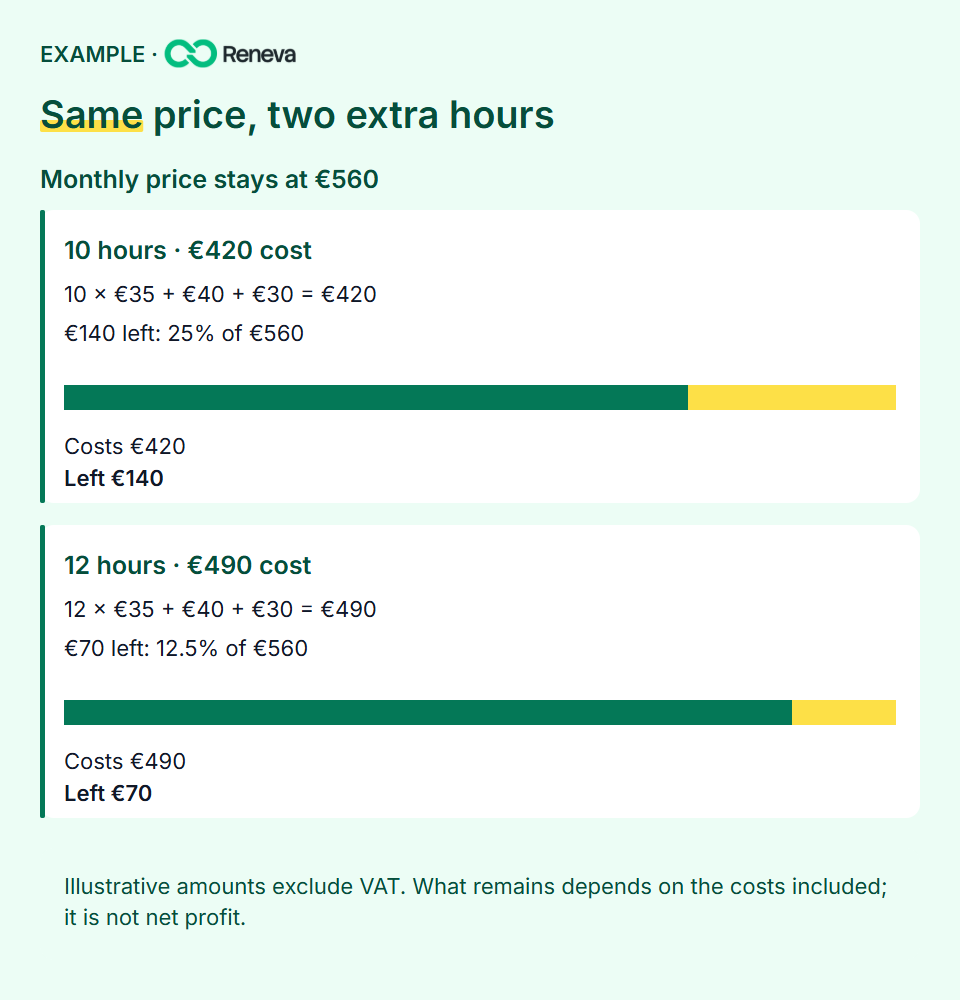
Suppose the price is €560 a month. After the €420 of costs included in this calculation, €140 remains, or 25% of the price: €140 divided by €560.
That amount is not your personal or business net profit. It depends on which costs the calculation includes and contains no tax calculation. The 25% is also just the result of this example, not a recommended target for every service.
If the client pays a one-off setup fee of €180, keep it separate from the €560 monthly fee in the offer. In this example, we do not spread it across the months or add it again to their costs.
What changes when the work takes twelve hours?
Keep the price and other expenses fixed and increase only the hours actually needed. The monthly cost becomes:
12 × €35 + €40 + €30 = €490.
At a price of €560, €70 remains, or 12.5% of the price. Two extra hours have halved the amount left in this example, from €140 to €70.
| Monthly assumption for one client | Costs included | Price | Amount left after these costs | Share of the price |
|---|---|---|---|---|
| 10 hours | €420 | €560 | €140 | 25% |
| 12 hours | €490 | €560 | €70 | 12.5% |
Before deciding what to change, find out why the extra two hours were needed. A slower start may belong to the initial setup. An extra meeting every month may mean you underestimated coordination. A new task requested by the client needs to be checked against the agreed scope.
The calculation helps you decide whether to change the estimate, the way you do the work, the inclusions or the price of a service still to be agreed. It does not turn every additional hour into an extra charge.
Do five clients fit into the calendar?
Suppose you can allocate sixty hours a month to this service, after allowing time for the other commitments in your business. These are not all your working hours for the month. They are the capacity you have chosen to give this offer.
Five clients at ten hours each use fifty hours, leaving ten available. The same five clients at twelve hours each use sixty hours. You have used all the capacity you planned, before taking on another client or a request beyond the estimate.
If you promise availability at particular times, check when those windows fall. Ten free hours spread across a month do not necessarily give you a full day when a client needs it. Compare the time you reserve with the commitments you have made, as well as the hours actually worked.
Turn the calculation into an offer
Cost tells you what you need to cover. To assess the price, consider what the client receives too: deliverables, expertise, continuity and real alternatives. Before comparing two prices, check whether the offers include the same work and availability.
Make the monthly service, setup and additional work clear in your offer. If you use Reneva, Line items and amounts on a subscription lets you organise descriptions, quantities and prices; the total comes from the line items. The subscription line items guide explains the steps. Keep that commercial breakdown separate from the internal cost calculation you used to decide the price.
After the initial work, compare actual hours and costs with the assumptions for the same period. Before adding the next client, check both questions again: how much remains at the agreed price, and how much monthly capacity is left to deliver the service you promised?


