

MRR, or Monthly Recurring Revenue, puts the value of active recurring services on a comparable monthly basis. For a fixed-price agreement, divide the recurring fee by the number of months it covers, then add the results for the agreements included. One-off work, such as a separate setup service, stays out.
The figure helps you read your ongoing service portfolio at a chosen date. It does not tell you how much you invoiced that month or how much money reached your account.
This guide, also as a PDF
Subscribe to the newsletter: once you confirm from the link in the email, the PDF guide opens.
This site is protected by reCAPTCHA and the Google Privacy Policy and Google Terms apply.

Choose the agreements before doing the calculation
Set an observation date and identify the active agreements you want to include. Check the agreed recurring fee and the period covered for each one. Leave out unconfirmed offers and distinguish ongoing fees from one-off work.
This article uses active fixed-price agreements, with amounts excluding VAT. This management measure does not determine when to recognise revenue in financial statements or how to calculate taxable income.
Putting different periods on the same basis is what makes the comparison useful. A service costing €900 for three months does not contribute as much as one costing €900 a month: the first has a comparable monthly value of €300.
Divide by the months covered and add the results
For one agreement in our example:
Normalised monthly value = recurring fee ÷ months covered.
“Normalised” simply means put on the same monthly basis. The portfolio’s MRR is the sum of those values. ChartMogul’s MRR definition describes this method for subscriptions and excludes one-off charges. To apply it to your services, keep the agreements and your inclusion rules identifiable.
If you have each agreement’s value, adding them lets you check every part of the total. An average per client is usable only if it comes from those same monthly values and the same client base. An average of annual or quarterly fees does not become monthly simply because you multiply it by the number of clients.
Three agreements, €1,100 on a monthly basis
Consider a fictional example with three agreements, all fully active throughout two consecutive months. We observe the portfolio at the start of each month. There are no discounts, partial starts, terminations, unpaid amounts or variable charges in this example.
| Agreement | Recurring fee excluding VAT | Period covered | Calculation | Normalised monthly value |
|---|---|---|---|---|
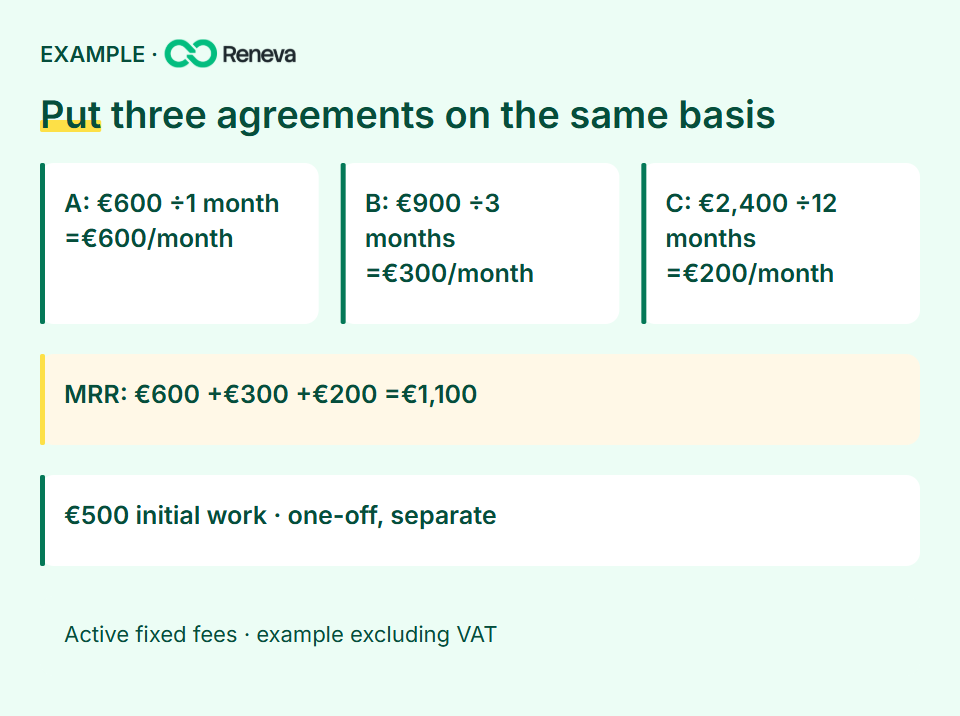
| A | €600 | One month | 600 ÷ 1 | €600 |
| B | €900 | Three months | 900 ÷ 3 | €300 |
| C | €2,400 | Twelve months | 2,400 ÷ 12 | €200 |
| Total MRR | — | Same monthly basis | 600 + 300 + 200 | €1,100 |
There is also one-off initial work costing €500. It is part of the offer’s fees, but it does not recur, so we do not add it to MRR.
C’s €200 monthly contribution does not mean the client receives twelve €200 invoices or pays that amount every month. The division serves the metric; documents and payments follow their own timetable.
The same MRR, different invoiced amounts
Suppose the first month’s invoices cover A’s €600, B’s €900, C’s €2,400 and the €500 initial work. Fees invoiced, excluding VAT, total €4,400.
In the second month, only A is invoiced, for €600. B and C remain active for their respective periods, without a new invoice that month. Their monthly contributions to the metric therefore remain €300 and €200.
| Measure in this example | First month | Second month |
|---|---|---|
| MRR of active agreements | €1,100 | €1,100 |
| Fees invoiced that month, excluding VAT | €4,400 | €600 |
| Payments received | Not provided | Not provided |
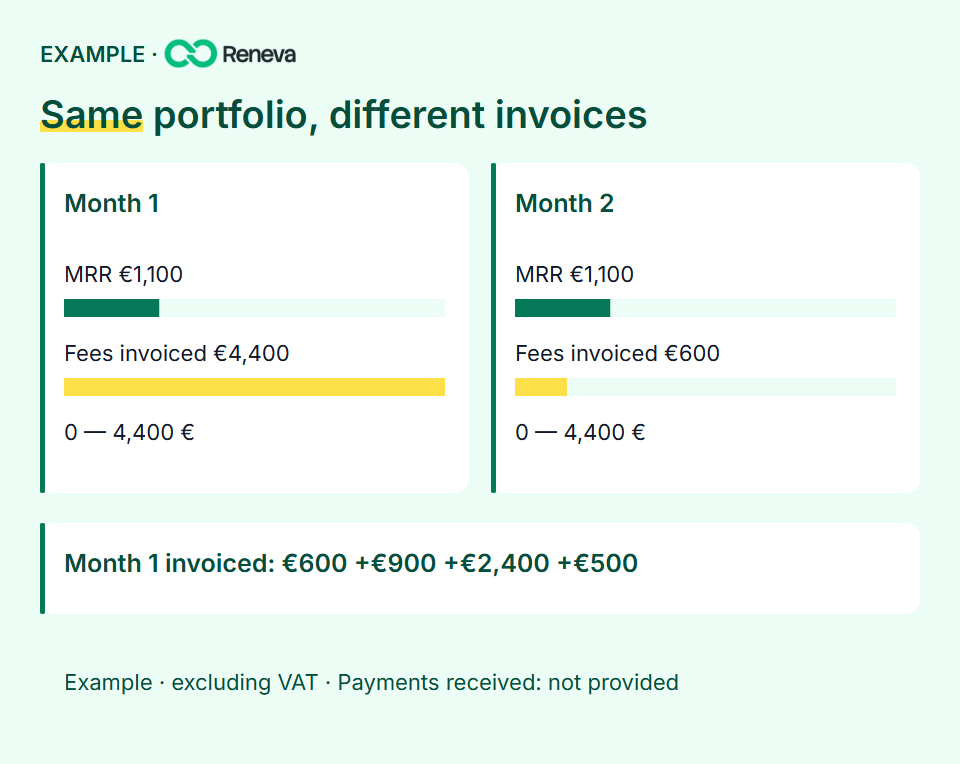
The drop from €4,400 to €600 invoiced does not describe a fall in MRR in this example. What gets invoiced that month changes, while the agreements included stay the same. We do not know the payments received and cannot infer them from either invoiced amounts or MRR.
Tracking documents and due dates calls for managing recurring invoices. Reconstructing actual money movements calls for cash flow.
State how you handle changes
In practice, prices, durations and service statuses can change. Use the recurring fee actually agreed, and make clear from which date you include it in or remove it from the comparison.
Discounts, partial periods, pauses, missed payments and usage-based charges need explicit rules. Our example excluded them to make the calculation clear; it does not assign one rule to all these events or every software product. When comparing two months, keep the rules consistent or state what you changed.
When the total changes, return to the agreements: which one started, which one ended, and which one changed price? The sum is more useful when you can reconstruct the changes behind it.
Use the figure for the question it answers
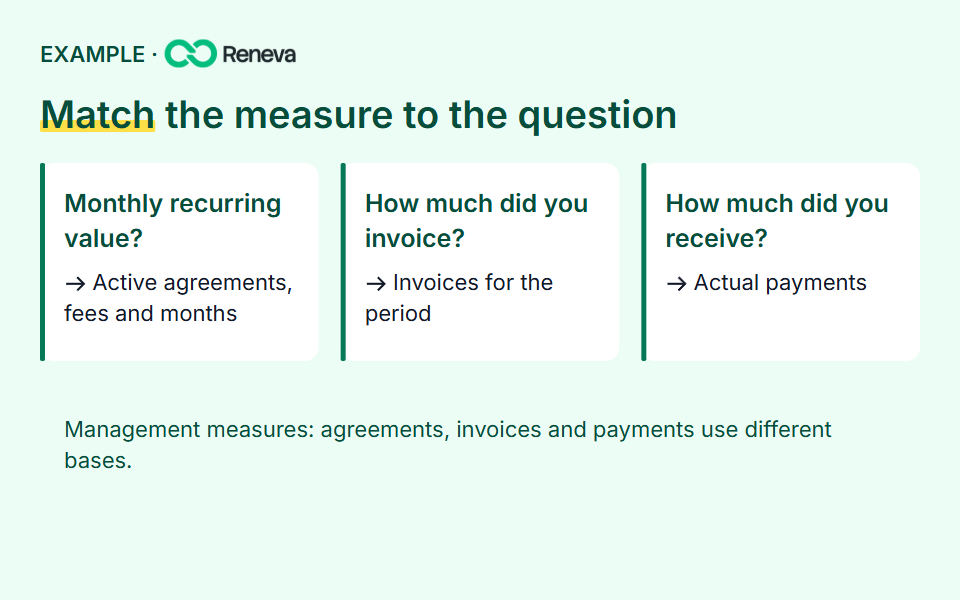
MRR describes the monthly recurring value of the included portfolio at the observation date. It does not subtract costs or determine profit, margin or available cash. Multiplying it by twelve does not guarantee the next twelve months’ invoiced revenue: agreements and terms can change.
If you use Reneva, Analysis places the monthly value of active subscriptions and fixed expenses in the Recurring view; Cash concerns money received and paid during the period. The guide to the Analysis page distinguishes these readings. The MRR calculated here adds only the value of recurring services sold, without adding expenses or combining it with cash movements.
Before your next comparison, keep the observation date, included agreements, fees and months covered. You can then tell whether the total changed because of the actual portfolio or a different calculation rule.


