To organise the automatic renewal of a service you buy for work, start with the deadline by which you can still act under the arrangement's terms. It may come before the end of the service period and the next charge. Gather the instructions, assign who checks and who decides, then keep the record of the action completed.
A reminder is useful when it leaves time to decide and complete the required step. Recording only the payment date may bring the matter to your attention after the decision window has closed.
This guide, also as a PDF
Subscribe to the newsletter: once you confirm from the link in the email, the PDF guide opens.
This site is protected by reCAPTCHA and the Google Privacy Policy and Google Terms apply.

Find the terms before setting a date
For each service, identify the contract holder, supplier and account concerned. Find the accepted terms and the relevant renewal instructions. Your recurring expenses register is a starting point for checking amounts and frequency.
Then find four pieces of information: when the current period ends, when renewal happens, the deadline for communicating your choice and when the charge is expected. These dates may coincide, but do not assume they do. Check how the action must be completed and who is authorised to take it.
If a date or procedure is unclear, ask the supplier before relying on your own interpretation. A general reference to notice should not be turned into a calendar date while ignoring the terms of the actual arrangement.
Work and personal purchases can follow different rules
Article 3 of the Italian Consumer Code defines a consumer as an individual acting for purposes outside their business or professional activity. A freelancer may therefore make both personal and work purchases. Their profession alone is not enough to treat every contract in the same way.
For the business service you are checking, establish the applicable scope and terms. Do not automatically transfer deadlines or procedures read about a personal subscription.
An example: deciding in February for an April renewal
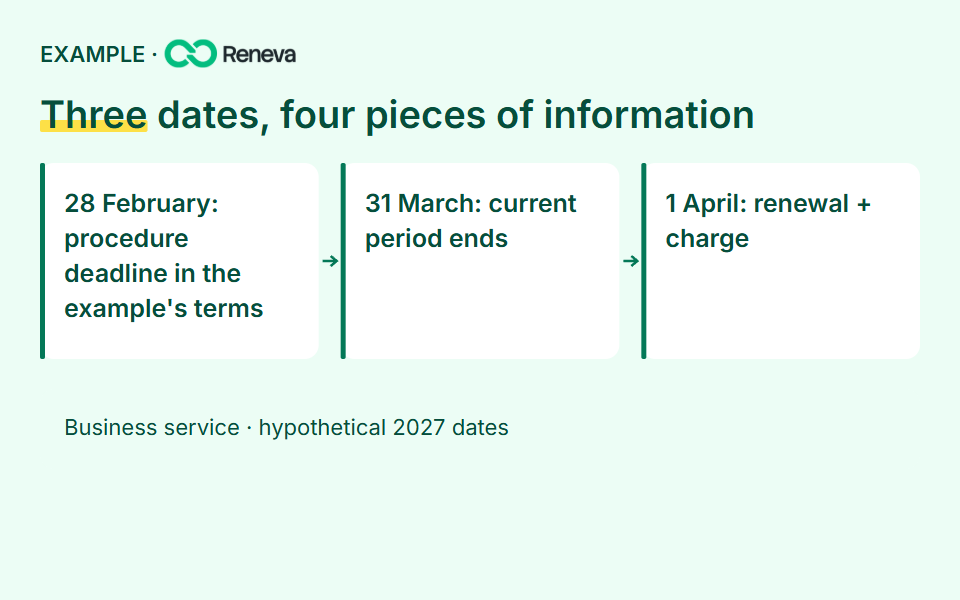
Imagine a service bought by an agency for work, with entirely hypothetical dates in 2027. The terms expressly give 28 February 2027 as the deadline for completing the required procedure, 31 March as the end of the current period and 1 April as the renewal and charge date.
These dates are already stated in the example's terms. We are not deriving them from a number of days that applies to every service.
| Date in this example | What it means | Check or action |
|---|---|---|
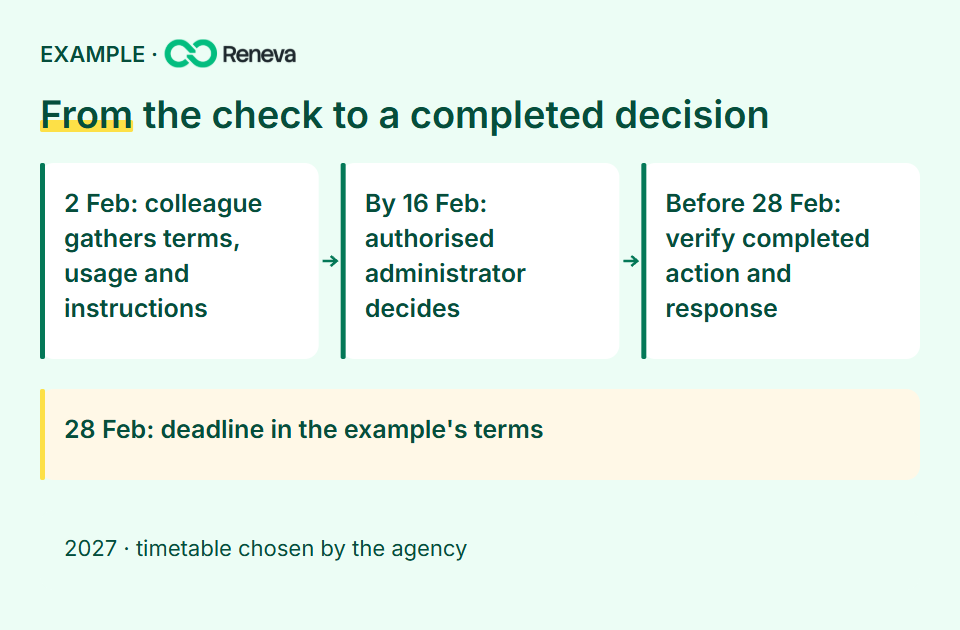
| 2 February 2027 | Internal check chosen by the agency | A colleague gathers the terms, information about service use and instructions |
| By 16 February 2027 | Internal decision date chosen by the agency | The authorised administrator decides how to proceed |
| Before 28 February 2027 | Verification arranged by the agency | Check that the action is complete and the relevant confirmation has been obtained |
| 28 February 2027 | Deadline expressly stated in the example's terms | The required procedure must be completed by this deadline |
| 31 March 2027 | End of the current period | Check the expected continuation or ending of the service under the choice made |
| 1 April 2027 | Expected renewal and charge | Check that the result matches the terms and the action completed |
The colleague prepares the information, but the decision and action belong to the authorised administrator. The first check also helps identify whether other people need to be involved or a move to another service needs planning.
The internal dates of 2 and 16 February are organisational buffers chosen for this example. Adapt them to the actual procedure and time needed, rather than copying them as legal deadlines or a guarantee that every request will arrive in time.
Decide what you want to achieve before acting
Check whether the service is still used, by whom and for which work. If you want to keep it, review the next period's price, inclusions and terms. If you want to change it, consider any data, materials or access to transfer and the work needed to maintain continuity.
Stopping the next renewal and asking to end the current period early are different actions. Identify the one that matches your decision and follow the relevant process, rather than using one procedure for every need.
Hosting and domains need specific attention to account ownership and service continuity. The guide to client hosting and domain renewals adds those checks to the dates.
Keep the action and the response
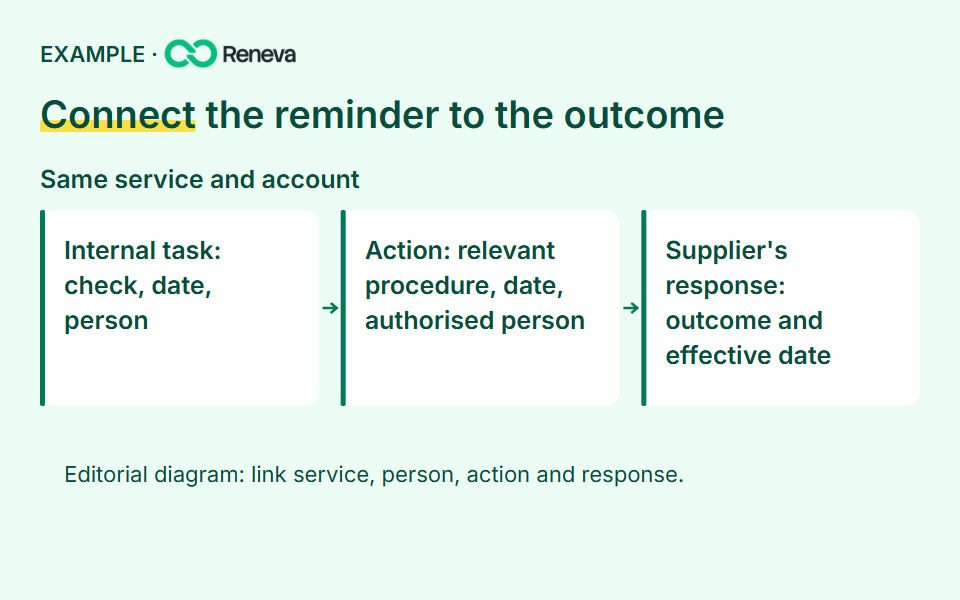
The authorised person completes the action through the appropriate channel and keeps the request or available record, date and supplier's response. Link them to the right service. With several accounts, a result for one does not automatically establish what happened to the others.
Check that the response matches what you wanted and makes the effective date clear. If a step remains incomplete, follow it up before the useful deadline instead of treating the task as finished because you have started the process.
Not using a service or having an expired card does not establish that the arrangement has ended. Blocking a payment is also different from the outcome of the contract. Return to the terms and communication to find out what changed.
Connect the reminder to the decision
Write a task that says what to check, for which service and with whom. For example: “Check the service terms and prepare the renewal decision”, dated for the first review. Keep references to the information needed and the person authorised to act.
If you use Reneva, Calendar lets you create an internal activity dated for the check, with a time if needed. The Calendar guide explains the steps. The activity organises internal work; communication with the supplier and the relevant response remain separate steps.
After the decision, update the dates to follow and keep the outcome. Before closing the check, you should be able to find who decided, which action was completed and what will happen to the service at the next renewal.