

To organise hosting and domain renewals for your clients, create a record for each resource. Note who holds it, who manages it, which provider supplies it, when it expires, and who must authorise and pay for renewal. Check who receives the notices too: receiving an email does not mean someone has done the work.
A domain and hosting may come in one package or have different dates, accounts and payers. Before setting up your checks, identify what needs renewing in the provider’s terms and service dashboard.
This guide, also as a PDF
Subscribe to the newsletter: once you confirm from the link in the email, the PDF guide opens.
This site is protected by reCAPTCHA and the Google Privacy Policy and Google Terms apply.

Hosting and domains: check what the service includes
The domain is the website’s name; hosting is the service that hosts it. Check whether the package includes both and which other services are connected, such as email. One invoice or a shared dashboard does not prove that every resource has the same renewal terms.
For the domain, identify the registrar, the provider that manages its registration, and check who is listed as the registrant, the domain holder. For .it domains, the Registro .it FAQs explain the registrar’s role: it is the point of contact through which the registrant manages operations on the domain.
For hosting, identify the exact service and the account that holds the contract. Check its renewal deadline and the renewal method selected for that service. One provider’s procedure is not a rule for the others.
One record for each client resource
A list of websites alone leaves too many questions open. For each domain or hosting service, record:
- the client, resource name and service purchased;
- the relevant holder, provider and management account;
- the verified expiry date, where it came from and the period covered by renewal;
- the amount and renewal method to check;
- the person responsible, their backup and the person authorised to decide;
- the payer, the address receiving provider notices and the client contact.
Keep a reference to the account and who manages it, without putting login credentials in the register. Beside the expiry date, note where you verified it: the terms, the service dashboard or a relevant provider message.
The holder, the person with access and the payer are different roles. An agency may monitor a client’s domain while the client pays for it directly. Technical access alone does not establish who can decide or who must pay.
One client, two resources and two payers
Consider a fictional example for November and December 2026, involving client Alfa. The hosting provider and domain registrar are fictional. Both renewals are manual, and we assume the dates have already been verified for these two services.
| Responsibility | Alfa’s hosting | Alfa’s .it domain |
|---|---|---|
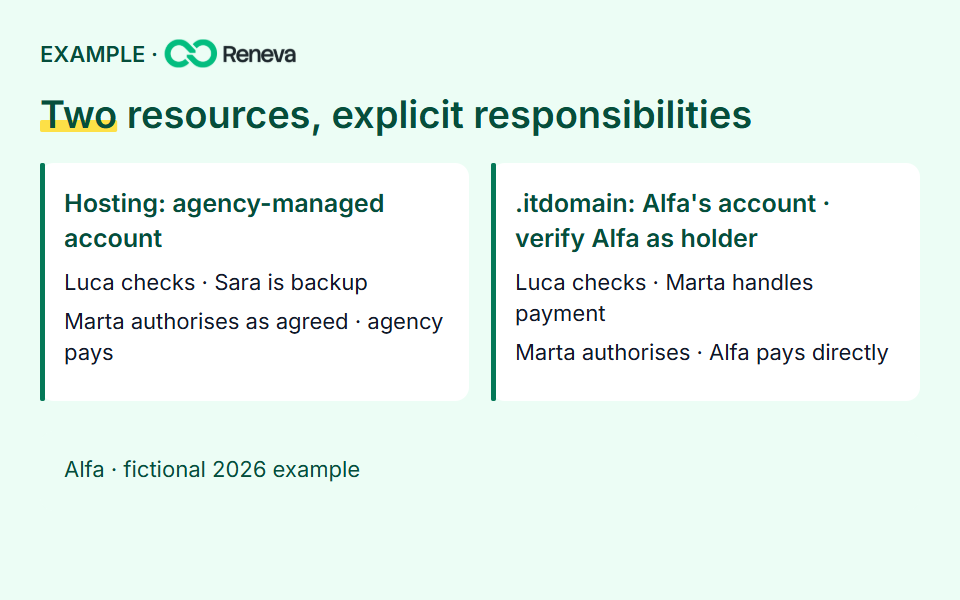
| Service relationship and account | Managed by the agency | Client Alfa’s account; agency appointed to monitor it |
| Domain holder | Not applicable to the hosting resource | Client Alfa, to be checked against the relevant details |
| Operational checks | Luca at the agency, with Sara as backup | Luca checks; Marta handles the client’s payment |
| Authorising the decision | Marta, authorised under the agreement | Marta |
| Payer | Agency | Client Alfa directly |
| Provider notices | Monitored agency administration address | Verified address in the client’s account |
| Agency message to the client | To Marta, separately from provider notices | To Marta, as agreed for these checks |
In our example, the fictional hosting quote is €180 plus €39.60 VAT, totalling €219.60. The domain quote is €24 plus €5.28 VAT, totalling €29.28. The 22% VAT rate is only an arithmetic assumption for these purchases, not a statement about the tax treatment of every service or provider.
| Resource | Amount excluding VAT in this example | Assumed VAT | Total | Who pays |
|---|---|---|---|---|
| Hosting | €180 | €39.60 | €219.60 | Agency |
| .it domain | €24 | €5.28 | €29.28 | Client Alfa |
| Combined resource value | €204 | €44.88 | €248.88 | Split between the two payers |
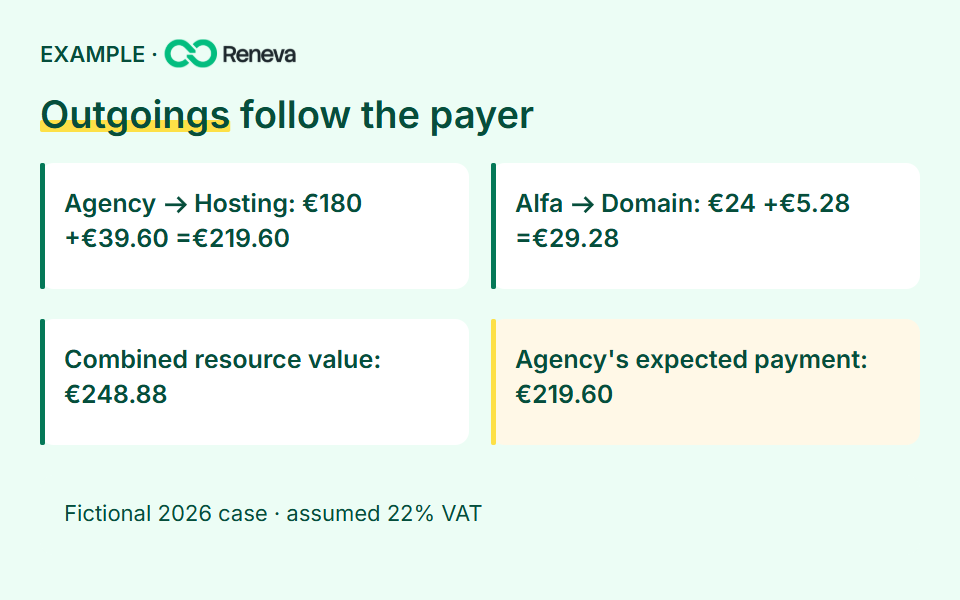
The agency’s expected outgoing payment is €219.60, not €248.88. The client pays the €29.28 domain renewal directly. The resource register must show both renewals; the agency’s outgoings must reflect who pays for each one.
Schedule a check before the provider’s deadline
For this example, we choose the following internal timetable:
| Resource | First internal check | Target for client confirmation | Assumed service expiry |
|---|---|---|---|
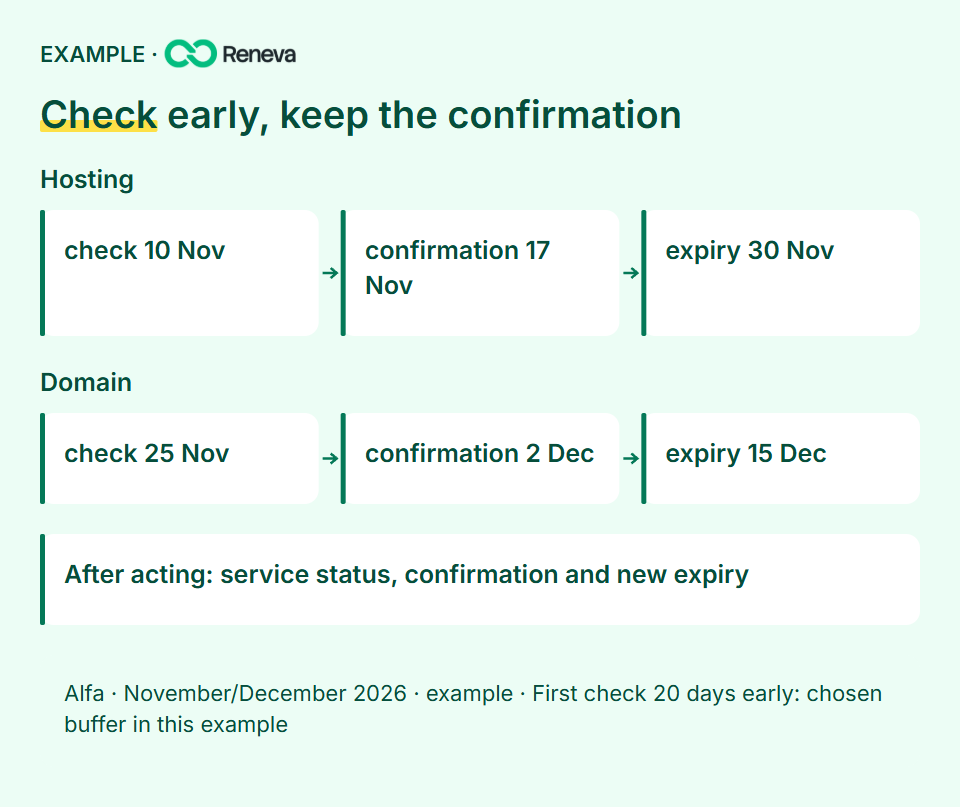
| Hosting | 10 November 2026 | 17 November 2026 | 30 November 2026 |
| .it domain | 25 November 2026 | 2 December 2026 | 15 December 2026 |
The first check is twenty days before each expiry date, an interval chosen for this example. It is not a legal deadline or a lead time that guarantees every renewal. The actual time allowed must account for the terms, procedure and time needed to obtain the decision and complete the relevant payment.
At the first check, Luca verifies the service, price, dates and recipients, then obtains Marta’s confirmation. For hosting, the agency follows the provider’s manual renewal procedure. For the domain, Marta makes the client’s payment and Luca follows up on the outcome within his agreed responsibilities.
If there is no reply, keep the unresolved decision visible and follow the agreed process: silence must not automatically become authorisation. The method for organising a renewal reminder helps separate the internal check from the actual deadline.
Complete the check with the provider
After the action, verify the service status, provider confirmation and new expiry date in the relevant account area. Keep a reference to the confirmation and the date of your check, so the backup can see what was completed and for which resource.
A forecast expense, a prepared payment or a message sent to the client is not renewal confirmation. Even when automatic renewal is enabled, the final check must concern the service and its actual outcome.
If the resource has already expired, check its status and available options with the provider or registrar straight away, for that extension and contract. Do not base recovery on a number of days assumed to apply to every domain or hosting service.
Record the agency’s expense separately
To track the money the agency pays, link the paid renewal to its documents and actual payment. Tracking recurring expenses covers this financial side; verification of the resource stays with the provider.
If you use Reneva, you can set up the example’s hosting as a recurring expense with Recurrence and Start date, check the forecast due date and use Manual payment recording once the payment has been made. The guide to recurring and forecast expenses explains the steps.
Keep the provider’s renewal confirmation alongside it. A complete record should let you find two distinct results: which resource was renewed, and which payment each party made.


