

To compile a prima nota, record transactions in date order and keep the reference that lets you trace each one. In this guide, we follow actual money received and paid, keeping the business bank account separate from cash on hand.
You need each opening balance, the transactions for the period and the documents they relate to. Then check that the balances you reconstruct agree with the bank statement and the cash actually held. We will work through a full week.
This guide, also as a PDF
Subscribe to the newsletter: once you confirm from the link in the email, the PDF guide opens.
This site is protected by reCAPTCHA and the Google Privacy Policy and Google Terms apply.

Record the transaction and its date
If a client pays an invoice dated 2 November on 9 November, record the money coming in on 9 November in this record. The invoice reference also preserves the document date: the two details answer different questions.
An unpaid invoice stays in your document and payment-deadline checks. Issuing it does not turn it into money actually received.
The Italian term “prima nota” can also refer to broader accounting entries. Here, we are building a record of cash and bank transactions to show where money comes from, where it goes and the balance remaining.
Set up the columns and opening balances
For each row, collect:
- Transaction date: when the money came in or went out.
- Account: bank or cash on hand; if you have several accounts, name each one.
- Description: enough detail to recognise the transaction.
- Money in or out: the amount in the corresponding column.
- Reference: an invoice, receipt, bank transaction or other supporting record.
- Account balance: what remains after that row.
If a receipt is missing, flag the document you need to obtain. Do not invent a number to fill the cell.
At the start of the period, enter each account's opening balance. That money was already there: keep it separate from the week's new receipts.
A full week: six rows across two accounts
This is a hypothetical example for 9–13 November 2026. Alfa and Beta are fictional names. The amounts are the full sums received or paid; we do not need to calculate VAT or other tax amounts.
The opening position is:
| Where the money is held | Opening balance |
|---|---|
| Bank account | €1,200.00 |
| Cash on hand | €80.00 |
| Business total | €1,280.00 |
We record these six rows during the week. The balance in the last column always belongs to the account named in that row.
| Date in November 2026 | Account | Transaction | Money in | Money out | Reference | Account balance |
|---|---|---|---|---|---|---|
| 9 | Bank | Payment received from client Alfa | €600.00 | — | Invoice A17 dated 2 November; bank B001 | €1,800.00 |
| 10 | Cash | Stationery paid for | — | €20.00 | Receipt R08 | €60.00 |
| 10 | Bank | Payment to supplier Beta | — | €240.00 | Invoice B09; bank B002 | €1,560.00 |
| 11 | Bank | Withdrawal for the business's cash funds | — | €100.00 | Transfer T01; bank B003 | €1,460.00 |
| 11 | Cash | Money received from the business bank account | €100.00 | — | Transfer T01 | €160.00 |
| 12 | Bank | Bank fee | — | €3.00 | Bank statement, B004 | €1,457.00 |
The first row links a payment received on 9 November to the invoice dated 2 November. You can trace both the payment and the document behind it.
Invoice A18, dated 13 November for €900, has not been paid in this example. It stays out of the money-in column.
An internal transfer needs two linked rows
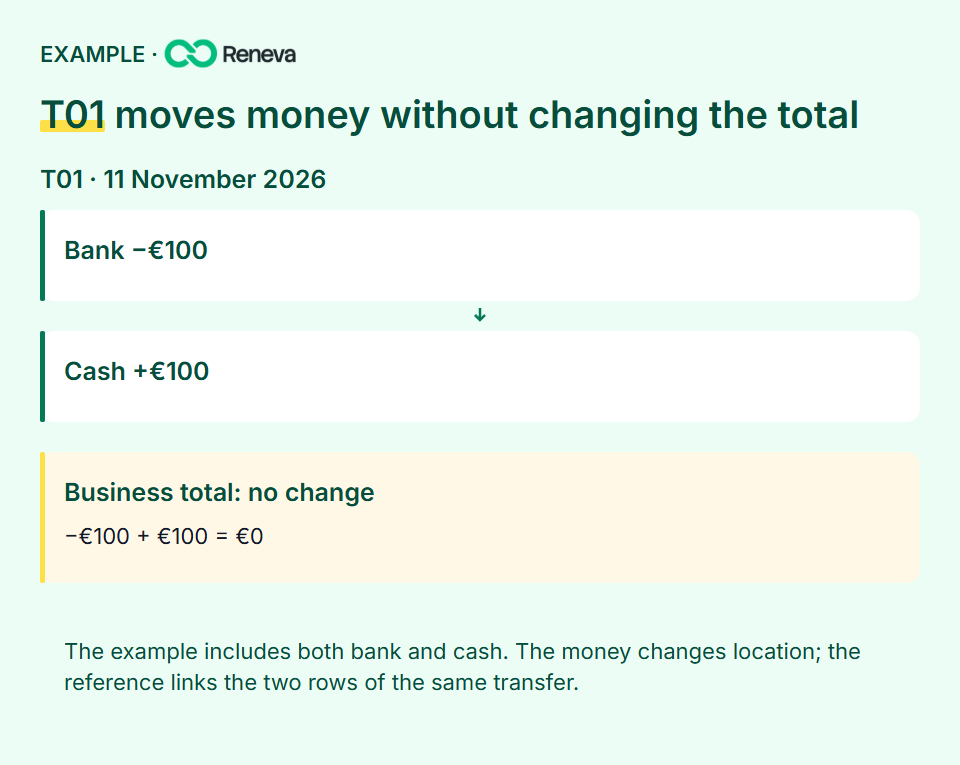
The same €100 leaves the bank and enters the business's cash funds. The reference T01 links the two rows: this is an internal transfer, often called a giroconto in Italian.
The bank balance falls and cash on hand rises. The business's total money does not change: there is no new sale or payment to an outside party.
When reading the period's total receipts, distinguish a client's payment from money moved between your own accounts. In this example, only Alfa's €600 came from outside the business.
Check the closing balances against the bank and cash
At the end of the week, the record should show:
| Where the money is held | Expected closing balance in the example |
|---|---|
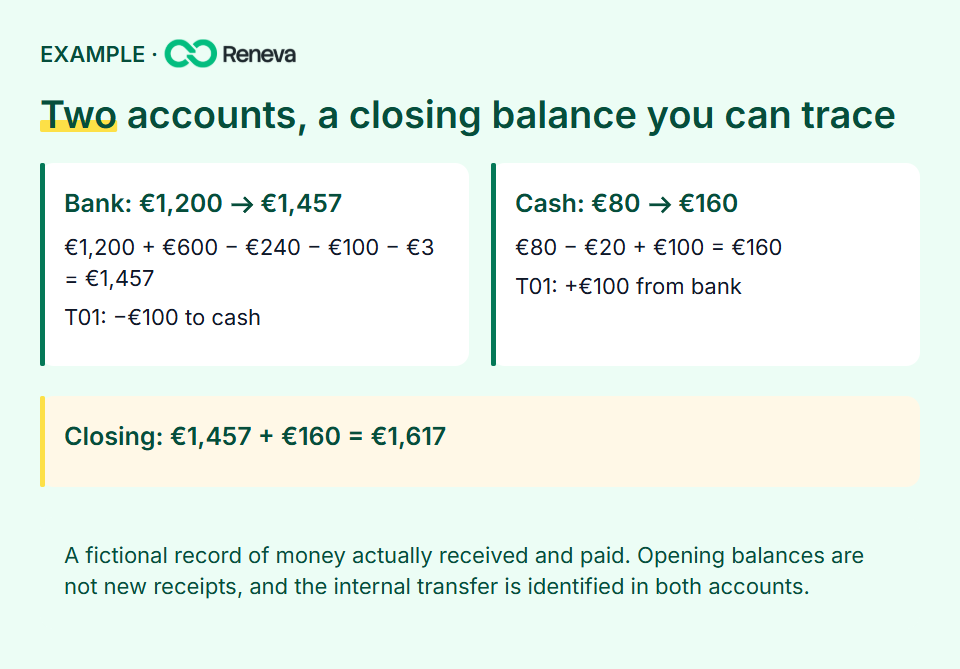
| Bank account | €1,457.00 |
| Cash on hand | €160.00 |
| Business total | €1,617.00 |
The overall check is:
€1,280 opening balance + €600 received − €20 − €240 − €3 = €1,617.
The €100 transfer cancels out between bank and cash. Then compare €1,457 with the bank statement for the period and €160 with the cash actually held. In this example, we assume those checks agree.
If a balance does not agree, find the source of the difference
Before changing an amount, check:
- that the opening balance and period are correct;
- that each transaction is in the right account;
- that money in and out are recorded in the right direction;
- that no transaction is missing or entered twice;
- that the two transfer rows are linked.
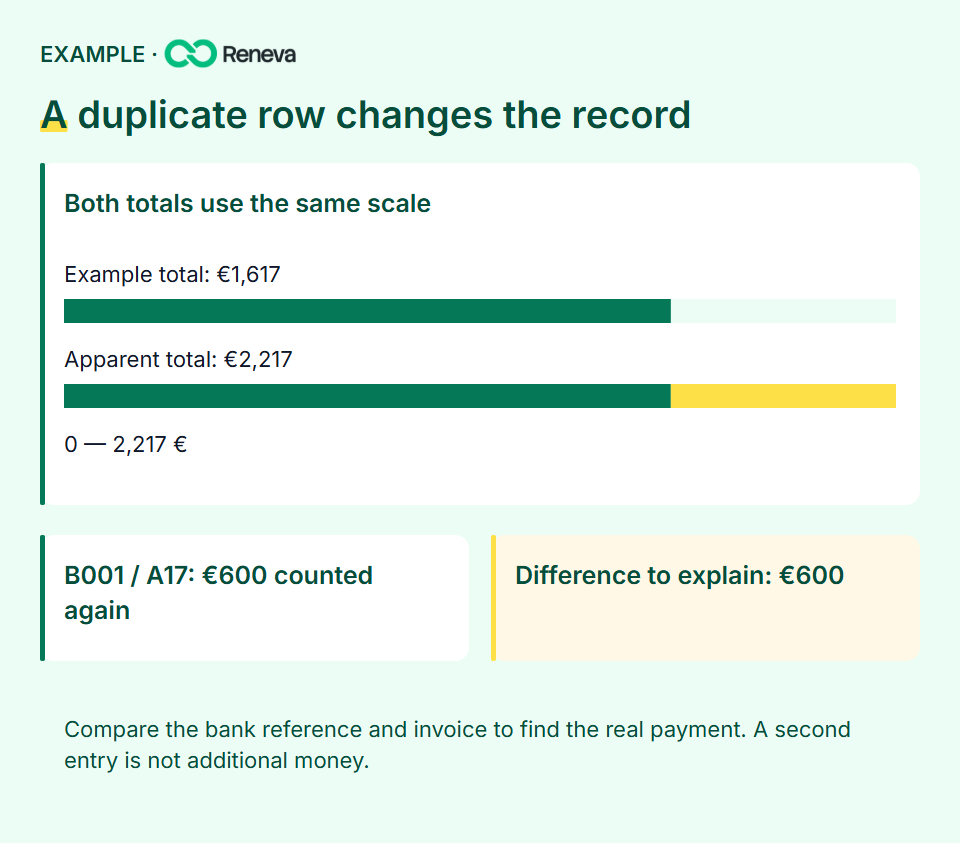
If you entered Alfa's €600 payment a second time, the apparent total would rise to €2,217. That €600 difference would be a recording error, not new money. Compare bank transaction B001 and invoice A17 to identify and correct the duplicate row, keeping the actual payment intact.
If you find a payment without a receipt instead, keep the issue visible and obtain the document. Changing the balance just to make it agree would hide the problem.
Paper, spreadsheet or software: try the same period
Start with a tool that lets you keep these rows up to date and check them. On paper, you need to redo the calculations; in a spreadsheet, you can use balance formulas and keep document references. If several people are involved, agree who records and who checks, to avoid duplicate entries.
In management software, first check which transactions have already been created by payments recorded elsewhere.
If you use Reneva, the Transactions overview guide explains that Record movement is for money received or paid that does not already originate in another section. Look for the payment before adding it manually. The guide to What goes into the Accounting records and the package then distinguishes the chronological Cash journal from Cash, which includes opening and closing balances, and describes the Download choices.
Close the period with unresolved points clearly recorded
Prepare the record with its period, checked balances and document references. Keep a separate list of receipts to obtain and differences still to explain, naming the person responsible.
A money balance alone does not determine income: cash transactions and economic values serve different purposes, as the Turin Chamber of Commerce's teaching material explains. The task completed here is narrower: making each receipt and payment traceable and handing understandable information to whoever looks after the accounts.


