

To collect a clear acceptance of a quote, ask for a response that identifies the offer, version and attachments and confirms the proposed terms. Keep the files you sent together with the reply. If the client changes the price or scope, clarify the new agreement before treating that response as acceptance of the original offer.
The practical task is to keep three things connected: what you proposed, the response you received and the documents it refers to. That is the starting point for beginning a service on the right version.
This guide, also as a PDF
Subscribe to the newsletter: once you confirm from the link in the email, the PDF guide opens.
This site is protected by reCAPTCHA and the Google Privacy Policy and Google Terms apply.

What the client needs to confirm
Before sending the proposal, give it a recognisable reference, date and version. If the detailed work or other terms are in attachments, identify them clearly and send them with the quote.
When the response arrives, check that it refers to those files and does not add different terms. A “looks good” in a conversation containing several offers may need clarification. Refer to the exact document rather than assuming which one was accepted.
For ordinary B2B services in Italy, the general rule in Article 1326 of the Italian Civil Code links conclusion of the contract to the point when the person making the offer learns of the other party's acceptance. The deadline, any required form of acceptance and whether the reply matches the offer also matter. Finding the word “accept” in the message is not enough.
If a reply arrives after the deadline, deal with that explicitly. Under the same general rule, the person who made the offer can treat late acceptance as effective by immediately notifying the other party. Do not let the missed date disappear from the practical handling of the agreement.
A short message to adapt to the offer
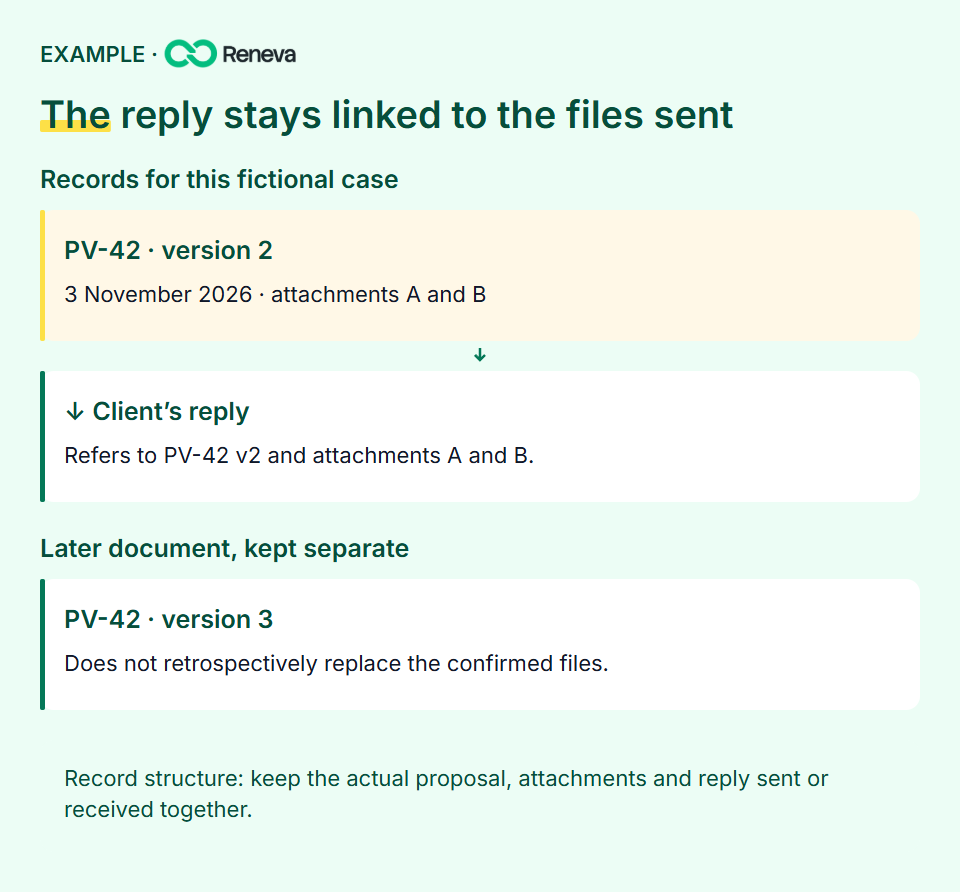
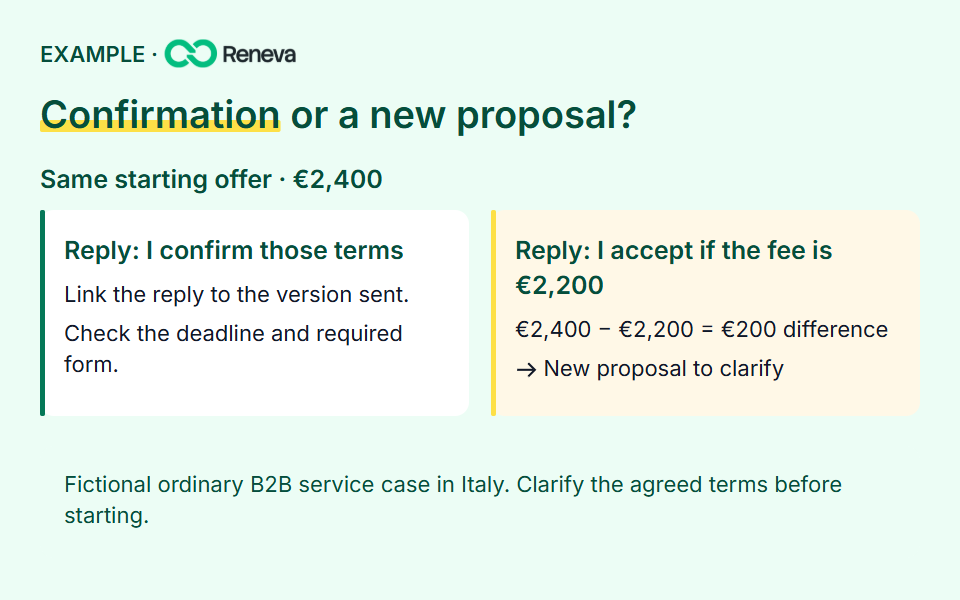
Suppose you sent quote PV-42, version 2 dated 3 November 2026, with attachments A and B. The fee in this invented example is €2,400, with the tax terms already stated in the offer.
A response referring to that proposal could say:
I confirm acceptance of quote PV-42, version 2 dated 3 November 2026, and attachments A and B, on the terms stated.
The wording identifies what is being confirmed. Adapt it to the actual proposal and the required acceptance method. It does not replace any formal requirements applicable to the case.
Keep the message with the quote and attachments actually sent. If you later prepare version 3, keep it separate: it does not retrospectively replace the files the client replied to.
“I accept, but at a different price” changes the proposal
Now consider this response:
I accept if the fee is reduced to €2,200.
Compared with the €2,400 example, the client is asking for a €200 reduction. Under the general rule in Article 1326, an acceptance that differs from the offer is a new proposal. It does not confirm the same price terms.
The scope can change too. “I accept if we add a page” introduces another request. Clarify whether you will agree to it and which terms change. If you update the quote, identify the new version and collect the relevant confirmation, keeping the earlier exchange as well.
Before starting the work, you need to be able to identify the agreed terms without piecing together incompatible parts of different messages.
Email, signed documents and online confirmation: what to keep
Organise the records around the channel actually used. This is a practical way to reconstruct the exchange, not an exhaustive list of evidence for every agreement.
| Channel used | Materials to keep | What to check |
|---|---|---|
| Complete message, quote and attachments sent, reply and later communications | Which version the sender is replying to and whether the terms change | |
| Signed document | The received file in its original form, attachments and accompanying message | What content is signed and which checks the process provides |
| Online confirmation | Document shown, retained copy and event record, with date, time and version if available | What the service records and how it links the event to the proposal |
The electronic channel and the type of signature are different questions
The fact that a signature is electronic, or is not qualified, is not enough to rule out its legal effect or use as evidence. Article 25 of the eIDAS Regulation gives a qualified electronic signature the same legal effect as a handwritten signature. An online confirmation can therefore leave useful evidence without becoming a qualified signature.
Article 20 of Italy's Digital Administration Code distinguishes documents signed or created in ways that meet the legal requirements from other documents. For the latter, a court assesses whether they count as a written record of the agreement and what they show, taking account of security, integrity and protection from changes. Keep the original file and available records, and check which safeguards the service provides. A click, an email address or a one-time code does not, on its own, automatically establish the identity or authority of the person replying for the client, or qualify the signature.
The accepted version and events in Reneva
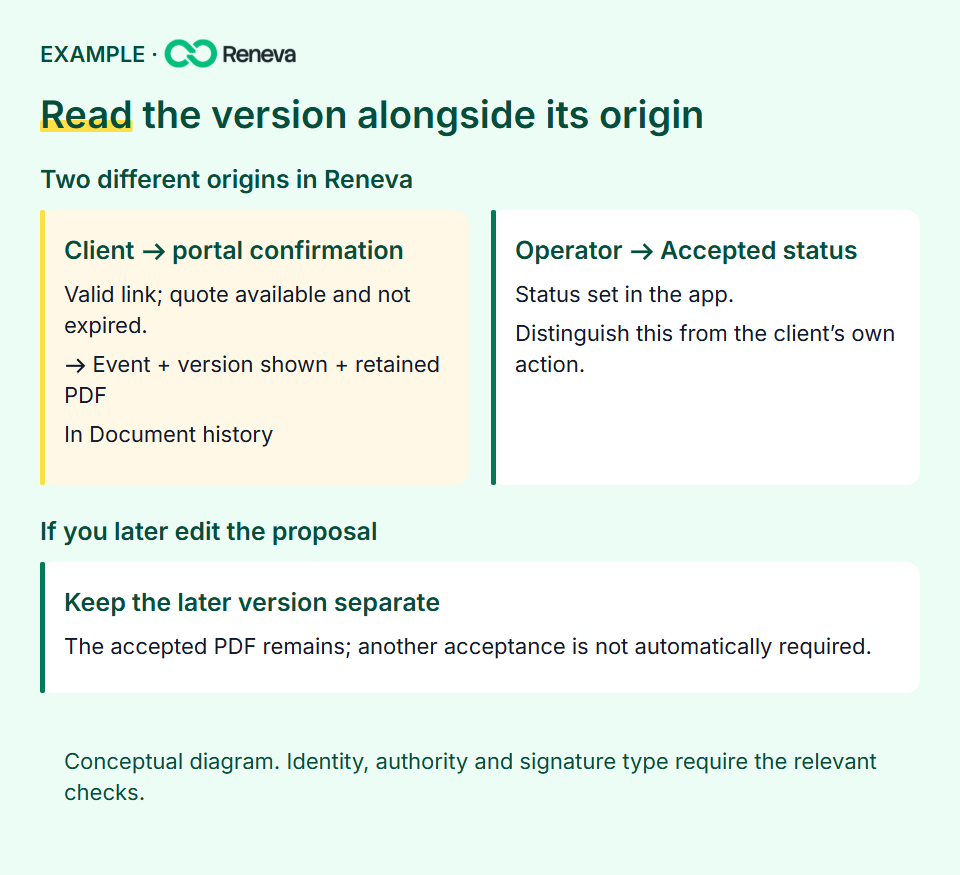
If you use Reneva's client portal, the client can confirm an available, unexpired quote through a valid link. Acceptance through the portal records the version shown and keeps its PDF in Document history.
The Accepted status can also be set in the app. When reconstructing what happened, distinguish a status entered by an operator from the client's own action. The document issuing guide covers the portal and Document history.
If you edit a quote after portal confirmation, the PDF of the accepted version remains. Reneva does not automatically require another acceptance. You therefore need to manage changes to the terms with the client, keeping the earlier offer, new version and reply recognisable.
Clear up ambiguities before starting
Collect the document sent, attachments, complete reply and any later clarifications. Check the version, deadlines, required form and proposed changes. Also check that the person responding has the authority needed to confirm for the client.
If something remains open, ask for confirmation of that point. The records should let you find the terms you are starting work on, rather than just a green status beside the quote.


