

To write a quote for a website, start with what you will deliver: pages, features, content, revisions and final checks. Assign responsibility for materials and approvals, then connect the price and payments to that work. Hosting, the domain, licences and maintenance need clear terms too, even when they sit outside the initial price.
A line saying “complete website” leaves too many decisions open. The client needs to recognise both what they will receive and a request that changes the project.
This guide, also as a PDF
Subscribe to the newsletter: once you confirm from the link in the email, the PDF guide opens.
This site is protected by reCAPTCHA and the Google Privacy Policy and Google Terms apply.

Define the website you are offering
Describe the type of site and its practical purpose. A brochure site that introduces a business and collects enquiries through a form is a different deliverable from an online shop or a portal with a private area.
Name the pages and features included, specifying the language and content management system if one is planned. Page count and layout count are different measures. Five pages might use one design structure for the Home page and another for internal pages. A page needing a different structure can change the design work.
For the contact form, agree the fields, who receives the enquiries and how the form should behave. For a Portfolio section, clarify whether you will upload only the initial projects or provide a dedicated feature for the client to add more. A word in the menu does not yet describe all the work.
Assign content, images, access and approvals
Separate creating content from uploading supplied content. If the client supplies the text and you add it to the site, do not leave writing or substantial editing implicit in the same item.
List the materials needed: text for each page, logo, usable images, contact details and anything required by the agreed features. For each item, say who supplies it, in what format and by which date. If you source images or buy licences, clarify which costs the offer covers and who will hold the accounts.
Identify the client's main contact and the access you need. Arrange hosting access and control of the domain using an agreed secure sharing method. Translations are another deliverable to assign, not an automatic consequence of planning more than one language.
Link the schedule to the conditions for starting
The delivery estimate needs explicit starting conditions: the offer is confirmed, materials are available and the required access is in place. Show the phases and identify where you will need a client decision.
Agree how feedback will be collected and how many rounds are included. A feedback round could be one consolidated response from the main contact, helping avoid conflicting requests from different people. Say which phase it applies to and what can change.
Revising a draft and adding a feature are different requests. If the client adds an unplanned language, page or online booking feature, describe the additional work, fee and effect on the schedule before doing it.
If materials or approvals arrive later than agreed, revise the affected dates with the client. Stating this dependency makes the estimate usable without promising a date regardless of what still needs to arrive.
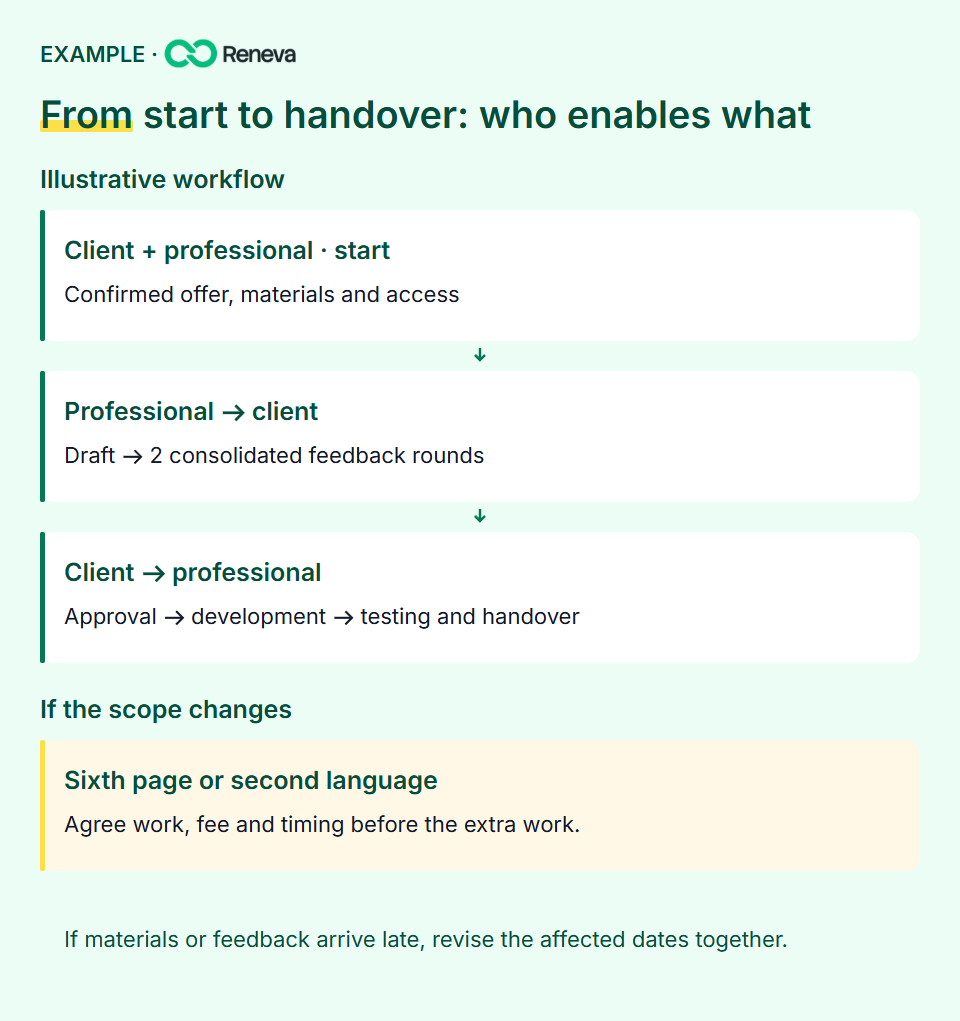
An example offer for five pages
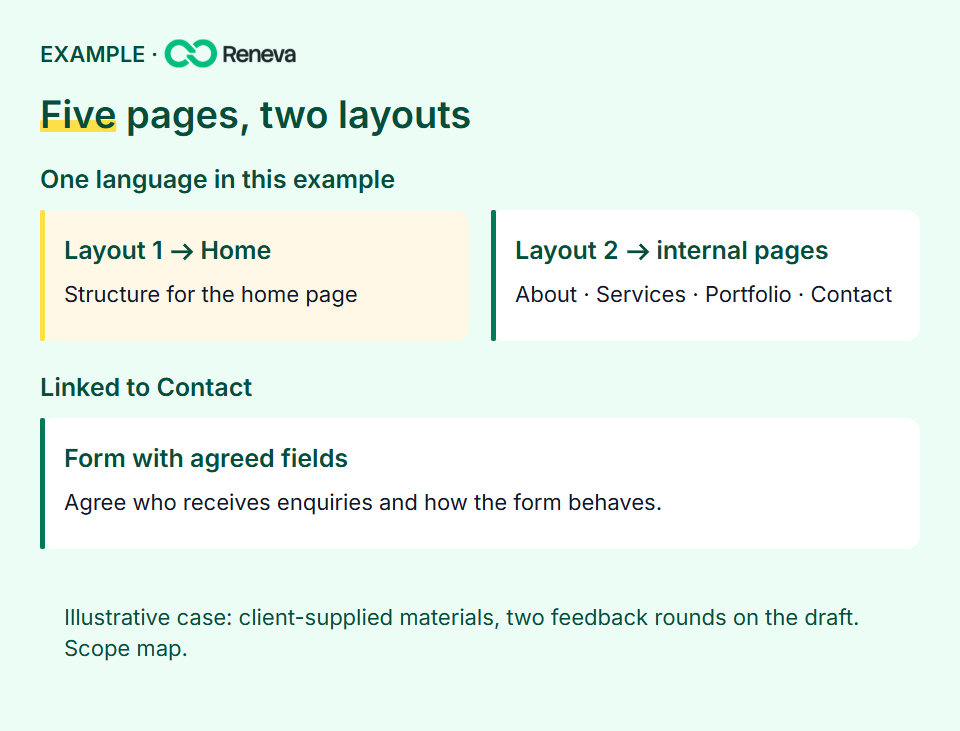
This is a hypothetical example, with illustrative amounts rather than market prices. The brochure site includes Home, About, Services, Portfolio and Contact, in one language. It has two layouts, one for Home and one for internal pages, adapted for desktop and phone, plus a form with agreed fields.
The client supplies text and images for the five pages. Uploading them is included; writing the text and producing photographs are excluded. The design draft includes two rounds of consolidated feedback, followed by a final check against what was approved. A sixth page or second language needs a new quote.
| Phase | Deliverable included in this example | Responsibility and dependency | Fee excluding VAT |
|---|---|---|---|
| Requirements | Approved list of pages, features and materials | The professional prepares the outline; the main client contact confirms the requirements | €300 |
| Design | Two layouts for the agreed structures and two feedback rounds | The professional presents the draft; the main contact collects and sends feedback | €600 |
| Development | Building the five pages and agreed form | The professional works from the approved design | €1,000 |
| Content upload | Adding text and images to the five pages | The client supplies ready-to-use materials in the agreed quantities | €300 |
| Testing and handover | Final checks, access handover and agreed usage instructions | The professional checks the work; the client takes part in the final check and receives the handover | €200 |
| Total | The full scope described | Terms of this example | €2,400 |
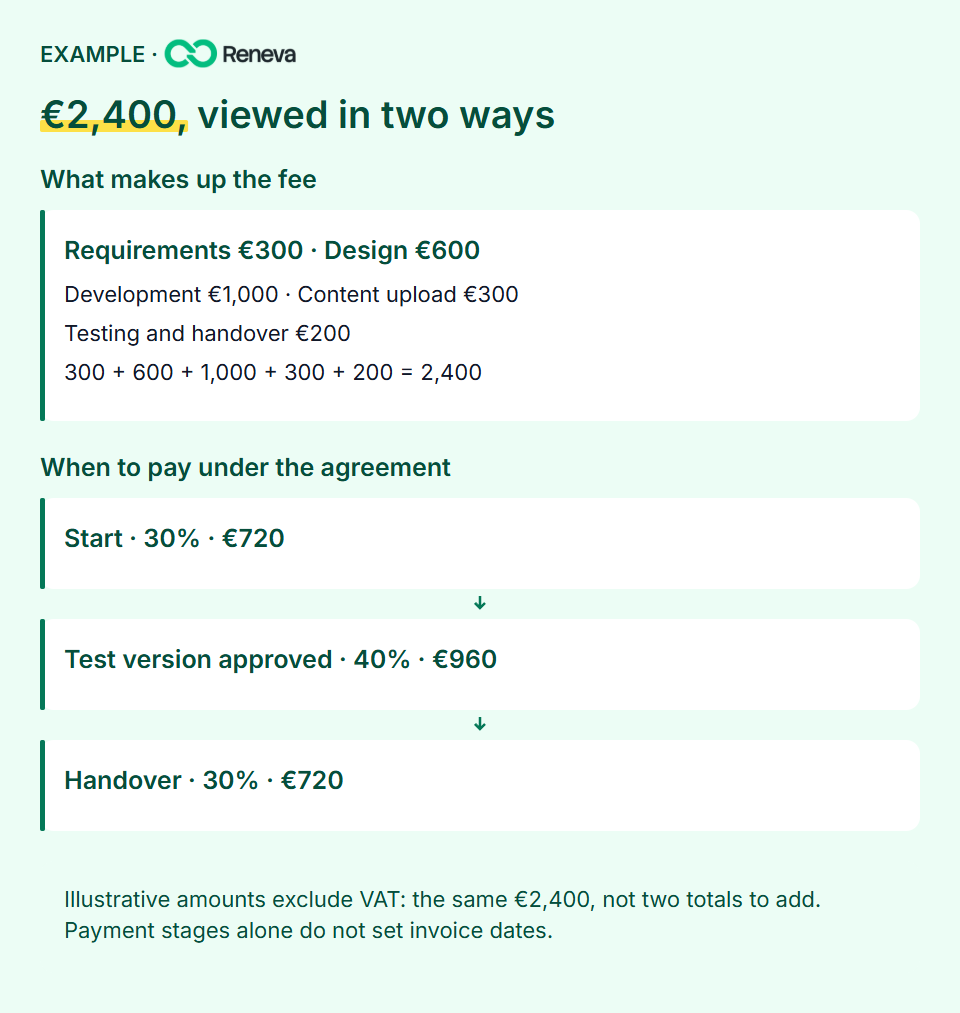
The total adds up: €300 + €600 + €1,000 + €300 + €200 = €2,400. Read the price alongside the inclusions. These figures cannot estimate the price of any other five-page site.
The agreed payment stages
Suppose the commercial agreement sets three payment stages:
| Agreed stage | Share | Fee excluding VAT |
|---|---|---|
| Project start | 30% | €720 |
| Approval of the test version | 40% | €960 |
| Handover | 30% | €720 |
| Total | 100% | €2,400 |
These stages describe when the client pays under the commercial agreement. They do not, by themselves, determine when an invoice must be issued. The amounts are shares of the fee excluding VAT, not the final tax-inclusive amount to pay.
Specify what happens at handover
Agree the final checks, such as opening pages on the planned devices, testing navigation and submitting the form. Define how to collect reports about the approved features and how to handle a new request raised during the final check.
Describe publication online: who does it, which service is used and which confirmations are needed before proceeding. Then say which access and instructions you hand over and whether training is included, with its content and duration to be agreed.
In our example, hosting, the domain, licences and maintenance are separate. For each, define the provider, account holder, amounts and renewals. Handing over the site and doing ongoing work in later months involve different responsibilities, to be set out in the relevant offer.
If the client requests work on legal text, accessibility or SEO, describe the work actually included and who does it. A generic phrase such as “ready-to-use website” does not explain those tasks.
Compare the document with the request before sending it
Return to the initial outline and check that pages, features, materials and approvals match the finished offer. Look for open decisions. If a feature or outside cost is still to be agreed, make it visible before confirmation.
Add the common offer details, including the recipient, date, version, proposed validity period and how to respond. The guide to writing a quote for services covers the general structure and includes a free Excel template.
If you use Reneva, you can enter the work as quote line items with a description, quantity and price. The document issuing guide explains how to fill them in. The line items make the fee understandable when they refer back to the scope you defined. Keep the detailed deliverables, materials and revision terms with them.
Before sending the quote, try a concrete request: “Can we add a sixth page?” If the document makes it clear that this is an addition to assess, and how to agree it, the client has a useful reference for the work ahead.


