

To manage a project in an agency, make four things visible: what you need to deliver, who is responsible for each step, what missing information could block it and which decision is needed when the plan changes.
A date on the calendar becomes credible when people have time for the work and receive what they need. Start with a specific project and check it against the team's other commitments.
This guide, also as a PDF
Subscribe to the newsletter: once you confirm from the link in the email, the PDF guide opens.
This site is protected by reCAPTCHA and the Google Privacy Policy and Google Terms apply.

Define what finished means
Imagine an agency preparing a landing page for client Alfa. This is a hypothetical case in November 2026: preparation on 6 November, with work planned for the week of 9–13 November.
Marta handles design and is the internal project lead; Luca handles development; Sara writes the copy and checks the result. Before starting, the project brief might look like this:
| Point to clarify | The Alfa project brief |
|---|---|
| Deliverable | A responsive landing page, the agreed copy for that page and a checked contact form |
| Outside the agreement | Advertising campaign, translation and additional pages |
| Agency contact | Marta, who collects blockers and decisions and updates the client |
| Client contact | Someone to be confirmed with Alfa by 6 November |
| Target delivery | 13 November, subject to checking the team's availability |
| Conditions for completion | Agreed page and copy, form checks completed, open defects identified and addressed before handover |
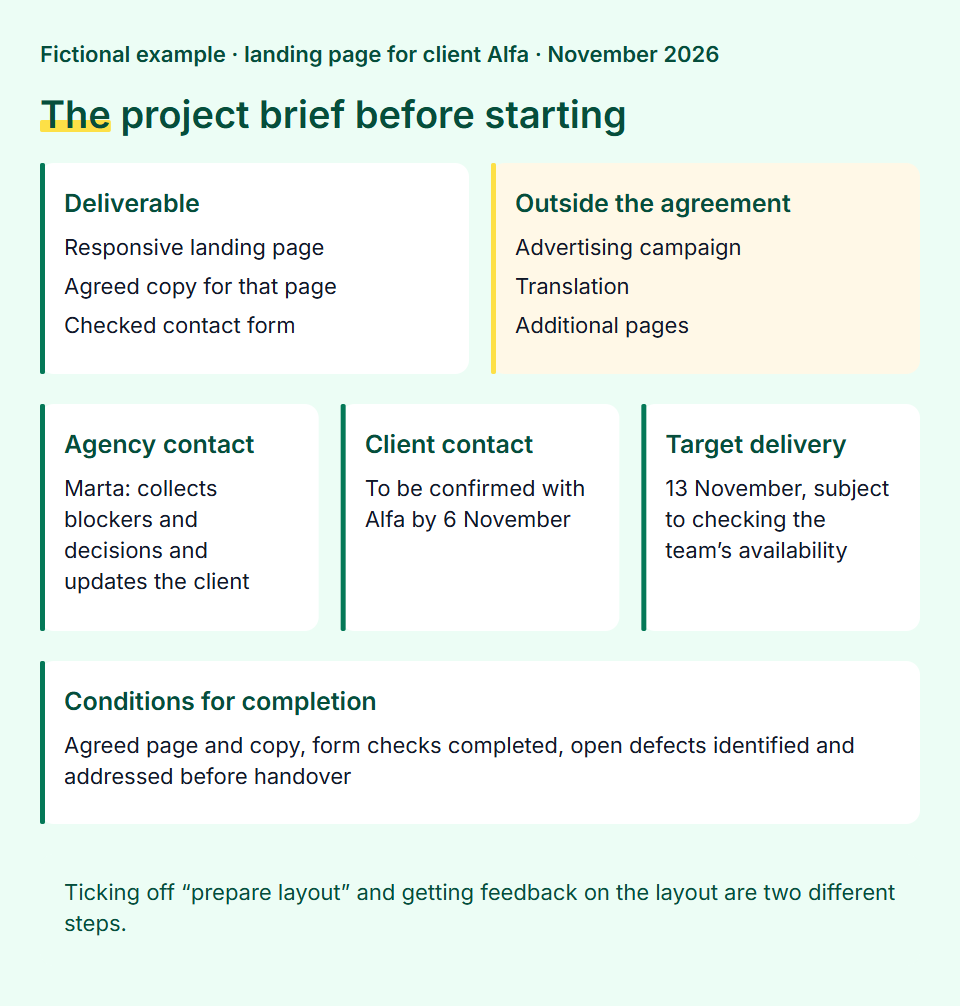
The client contact needs to know what they are being asked to approve. The team needs to know where to keep the response and which version it concerns. Ticking off “prepare the layout” and getting feedback on the layout are different steps.
Put materials and decisions in order
Before filling the calendar, identify what needs to arrive so the next step can be completed. For Alfa, we propose these checkpoints:
| Date in November 2026 | What is needed or should be ready | Who follows it up |
|---|---|---|
| 6 | Initial copy, authorised images and a confirmed client contact | Marta collects inputs from Alfa; Sara checks the material for the copy |
| 10 | Layout agreed on an identified version | Marta follows up the client contact's response |
| 12 | Page and form checks, with a list of defects to address | Luca prepares the developed page; Sara follows up the checks |
| 13 | Planned delivery after the necessary points are closed | Marta checks that the handover to the client is ready |
If the materials due on 6 November are missing, Marta needs to identify what is blocked and ask for a decision. If the layout changes on 10 November, Luca needs to know which version to use to complete development.
These dates describe a plan to assess. Checking the work on 12 November does not, by itself, solve the question of people's availability. Before confirming delivery on 13 November, we also need to check their other projects.
Check each person's hours
We estimate 40 project hours in total for the landing page:
| Part of the work | Estimated hours |
|---|---|
| Copy | 8 |
| Design | 12 |
| Development | 16 |
| Checks | 4 |
| Project total | 40 |
Those 40 hours are shared between people with different skills and commitments. For the week of 9–13 November, assume 32 hours available per person and a choice to reserve 4 hours each for unexpected work. This is an assumption for the example, to adapt to your own work.
| Person | Hours available | Other work | This project | Reserve for unexpected work | Planned total |
|---|---|---|---|---|---|
| Marta | 32 | 16 | 12 | 4 | 32 |
| Luca | 32 | 20 | 16 | 4 | 40 |
| Sara | 32 | 12 | 12 | 4 | 28 |
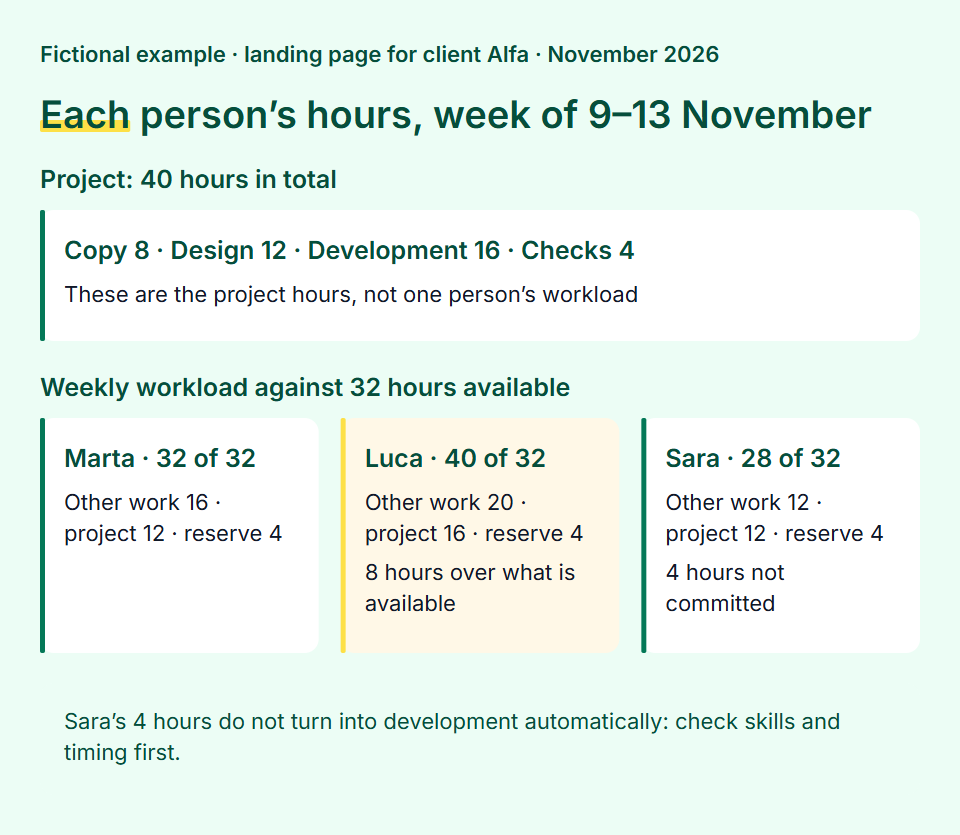
Sara's 12 hours comprise 8 hours of copy and 4 hours of checks. The 40 hours in Luca's row include all his work for the week and the reserve: they are not the hours for this project alone.
Luca is 8 hours over the 32 available under the plan with the chosen reserve. Sara has 4 uncommitted hours, but they cannot automatically become development time. First, check her skills, availability at the right point and which work can be transferred.
Marta's next step is to decide with the team which commitments to move or reorganise, and what to agree with Alfa. While that remains unresolved, the 13 November delivery target needs to be reconsidered.
Hold a project check-in that leads to a decision
During the project, use four questions to update the brief:
- What is the next deliverable, and who is responsible for it?
- What is complete, and where can we see it?
- What is missing or blocking the next step?
- Which decision is needed, from whom and by when?
Update the hours still needed too. A nearly finished task can require more work than the person responsible has time left to complete.
Keep external commitments visible as well. In this example, the chosen external-spending cap is €400 excluding taxes, with €300 excluding taxes already committed. That leaves €100 of headroom under the cap. It is not profit or cash available to spend: we are looking only at planned external spending, without calculating all project costs or money received.
If you use Reneva, the Client projects overview guide describes Activity: you can create an item, add an optional day and mark it with Complete. Use it to keep a step such as “Collect Alfa's copy” visible. Comparing availability and commitments in the table remains an organisational check to make with the team.
The Creating a client project guide also explains that Expected delivery is separate from payment deadlines, managed in documents and instalments. When updating the work, check the payment agreement separately.
Assess an extra request before adding it to the work
Alfa now asks for a second variation of the page. For this example, assume another 6 hours of development for Luca.
Without changing anything else, his weekly plan rises from 40 to 46 hours against 32 available, still including the 4-hour reserve. The excess rises from 8 to 14 hours.
Before adding the variation, Marta brings three options to the discussion:
- Move other work: identify the tasks to postpone and agree the change with the people expecting them.
- Review the date: check a new sequence with the team and propose a compatible delivery date to the client.
- Review the scope: decide what stays in the current delivery and what to treat separately, agreeing the fee too when the work requested changes.
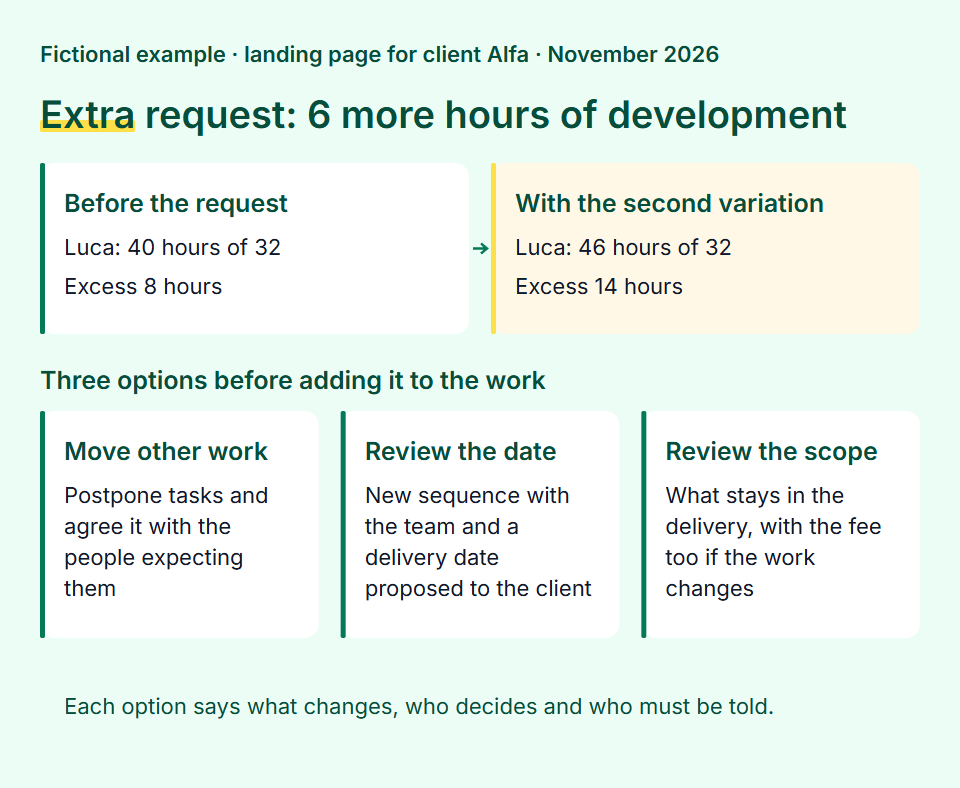
Each option needs to say what changes, who decides and who must be told. A different price does not, by itself, create hours in the week; a new date needs agreement, rather than just a move on the internal calendar.
You can send the client contact a concrete proposal: “The second variation needs another 6 hours of development. Before adding it, we need to decide whether to revise delivery or separate it from the work already planned. We will confirm the plan once we have agreed that step.”
Record the actual decision and update the affected tasks, dates and agreements. The request becomes planned work once you have clarified how it fits into the project.
Hand over the work and improve the next estimate
Before handing over to Alfa, return to the original brief: page, copy, form and open issues. State what you are delivering, what feedback you need and when you expect it. Completing the last task does not replace this step.
Then, with the team, compare the estimates with the work actually done: where did more hours go, which material arrived late and which decision changed the plan? Keep that information with the project. It will be the starting point for estimating and organising the next similar job.


